

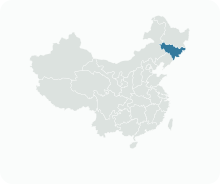
Get to know Yanji
- Administrative area
- County-level city · 县级市
- Part of
- Yanbian Korean Autonomous Prefecture
- Chinese name
- 延吉市
- Local areas
- County-level city guide
Area & population
- Area
- 1,748.30 km²
- Population · 2020 census
- 686,136
- Administrative seat
- Henan Subdistrict
Source: English Wikipedia, as of the dates shown.
In brief: Yanji is the seat of Yanbian Korean Autonomous Prefecture, where river markets, bilingual campus streets, Korean-Chinese food and a southern mountain-and-museum belt show the city at close range.
Yanji works best as a city to experience in layers rather than as one oversized attraction. It is the seat of Yanbian Korean Autonomous Prefecture, a region whose public life is closely connected with Korean Chinese communities, food traditions and the mountains and rivers of eastern Jilin. In the central streets, the useful rhythm is local and practical: a market breakfast, shopping for preserved foods, a walk around Yanbian University, then an evening meal. The city’s bilingual street life, traditional food and night-time public spaces are part of the experience, not just decoration added for visitors.
Three parts of the city
The river-market area is the most direct introduction to everyday Yanji. People’s Daily describes the Oriental Water Market, on the Yanji River, as a large morning market centred on Korean Chinese foods. Stalls sell or prepare items such as rice sausage (米肠), rice cakes (打糕), rice wine, kimchi and pollock, with vendors sometimes making rice cakes in front of customers. Yanji West Market is a different kind of stop: it stands on the western section of Jiefang Road in the busy city centre and combines local foods with regional products, clothing, crafts, vegetables, meat and seafood. Visit the water market for the morning atmosphere; use West Market when you want to browse, eat and buy things to take away.
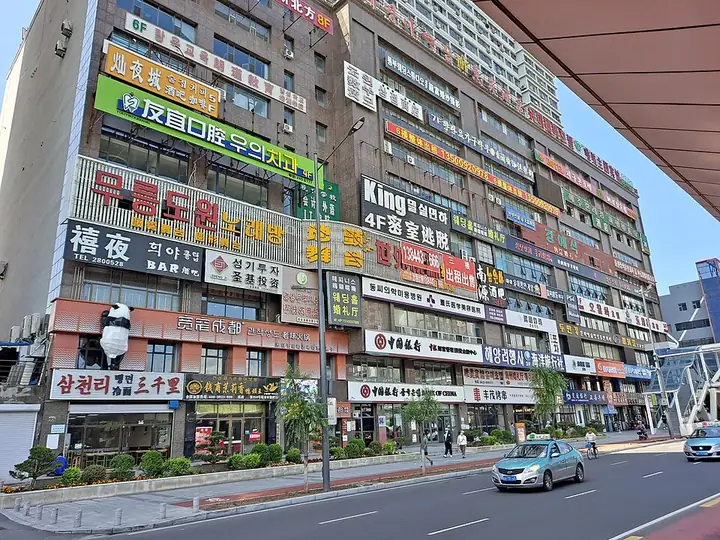
The Yanbian University area shows a more contemporary side of the same city. The city government identifies the “Yanji University viral wall” as the University Town Building 1 at 1188 Gongyuan Road, opposite the main gate of Yanbian University. The lit wall is popular after dark, while the surrounding streets add restaurants, cafés and student-city movement. The Ministry of Culture and Tourism’s report also notes Yanji’s bilingual public life, the wall, the water market and evening food streets. Treat the wall as a short urban stop, not as a substitute for seeing how the surrounding streets work.
South of the centre, the Mao’er Mountain (Dinosaur) Cultural Tourism Area gathers several distinct experiences: Mao’er Mountain National Forest Park, China Korean Folk Custom Park, Yanji Dinosaur Museum and other themed facilities. The Yanbian government describes the area as a 4A-rated attraction combining forest, mountain-and-water scenery, city views, folk culture and leisure. A later city-government description lists the forest park, folk park, dinosaur museum, dinosaur theme park and a hotel as its core resources. These names describe a linked tourism belt, not one single room or entrance. Choose the exact venue you want in Amap or another current map, and confirm its public entrance and return transport before setting out.
A practical way to visit
A simple first day is to begin with one market, spend the middle of the day in the central streets or around Yanbian University, and leave the southern mountain-and-museum belt for a separate outing. That order avoids pretending the whole city is a walkable sightseeing circuit. It also leaves room for the parts of Yanji that do not have a ticket counter: a bilingual bus announcement, a crowded food stall, a café, or a slow walk beside the river.
For food, keep the Chinese names handy rather than relying on an English transliteration. Search for “米肠”, “打糕”, “延边辣白菜” or “明太鱼” on Meituan (美团) or Amap / Gaode Maps (高德地图) to find nearby options. Check the current menu, recent reviews, opening information and that day’s supply before choosing. West Market and the Oriental Water Market are useful places to browse, but neither market listing proves that every stall serves every dish every day, and this guide does not designate a single restaurant as the city’s authentic choice. The market reporting also records rice wine, kimchi, pollock and several kinds of rice-based foods, so the food experience is broader than one signature dish.
Getting there and moving on
By air. The airport operator places Yanji Chaoyangchuan International Airport southwest of Yanji and describes it as about 5 km from the city centre. The airport’s own transport page lists bus routes 44, 28, B45, 48, B29 and 7. The page gives the route numbers but not a complete stop-by-stop timetable, so confirm the direction and current service at the airport before boarding. For a taxi, show the exact Chinese destination name—“延吉市区” plus your accommodation’s Chinese name, or “延吉朝阳川国际机场” for the return—and compare the result with the airport’s current information.
By rail. Use “延吉西站” as the Chinese station name when booking. A provincial transport report places Yanji West Station among the city’s tourism-service points and says that the Yanji Northeast Asia Coach Terminal, Yanji West Station and the airport have had traveller-facing service centres. A later transport announcement lists a Yanji–Changbaishan North Scenic Area intercity route running from Yanji Northeast Asia Coach Terminal via a stop near Yanbian University and Yanji West Station, then onward to Erdaobaihe and the Changbaishan North visitor centre, with the return following the same route when the service operates. Check the current departure page rather than assuming an older seasonal timetable is still running.
For the central markets and university streets, enter the exact Chinese place name in Amap: “东方水上市场”, “延吉西市场”, “延边大学” or “延大网红弹幕墙”. For the southern belt, enter the exact venue—“中国朝鲜族民俗园”, “延吉恐龙博物馆” or “帽儿山国家森林公园”—instead of treating “Mao’er Mountain” as a single verified entrance. The public sources consulted here do not establish one universal entrance, one city-wide shuttle or a fixed return timetable for every venue. Keep the Chinese name of your next stop visible for the driver, and confirm how you will return before entering a mountain or themed attraction.
Yanji is a useful base for exploring Yanbian, but a trip to the city should not be confused with a visit to a separate border destination. Individual museums, parks, markets and seasonal activities have their own operating notices. Check the selected venue’s latest notice for opening, ticketing, reservation and passport-use requirements; a domestic booking or an old travel photograph is not proof that an overseas passport can be used at every gate.
Explore Yanji
Core places to explore, with English and Chinese names.
Places to explore around Yanji
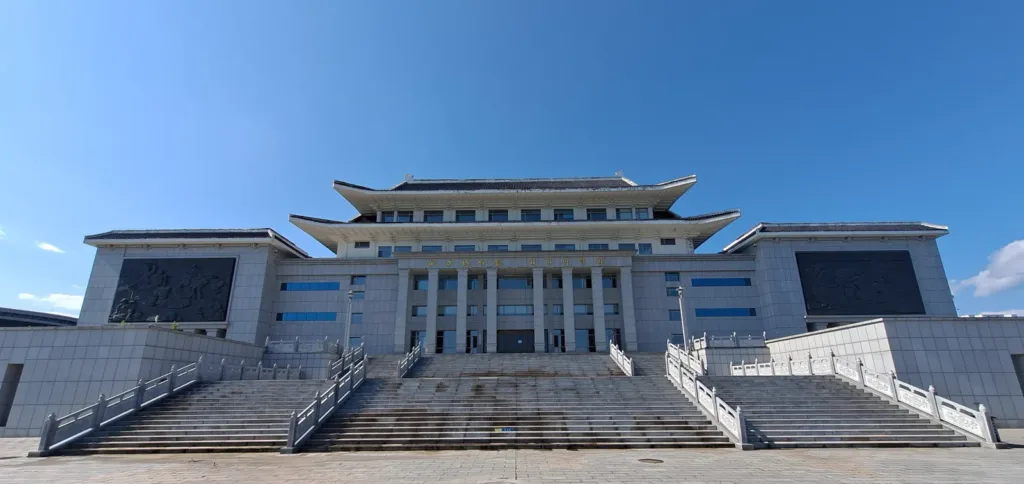 The front elevation of Yanbian Museum in Yanji, seen from the forecourt. Photo: EditQ · CC BY-SA 4.0
Yanbian Museum延边博物馆
Yanbian Museum in Yanji is a free, indoor introduction to the prefecture’s archaeology, shared regional history and Korean Chinese folk culture, now organized around a five-part permanent display renewed in 2024.
Read the place guide →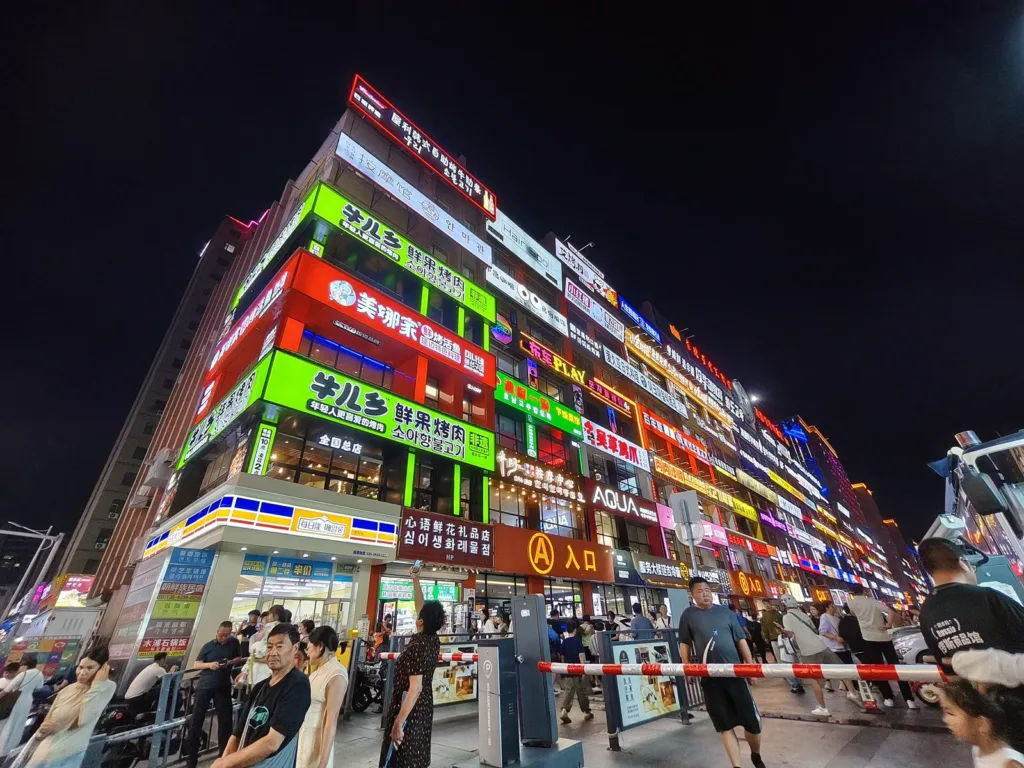 Yanji's bilingual sign wall at night opposite Yanbian University, photographed from the public street. Photo: Liuxingy · CC BY-SA 4.0
Yanji West Market and Yanbian University Area西市场与延边大学周边街区
This two-part Yanji visit pairs the working West Market’s Yanbian food products with the illuminated bilingual sign wall opposite Yanbian University.
Read the place guide →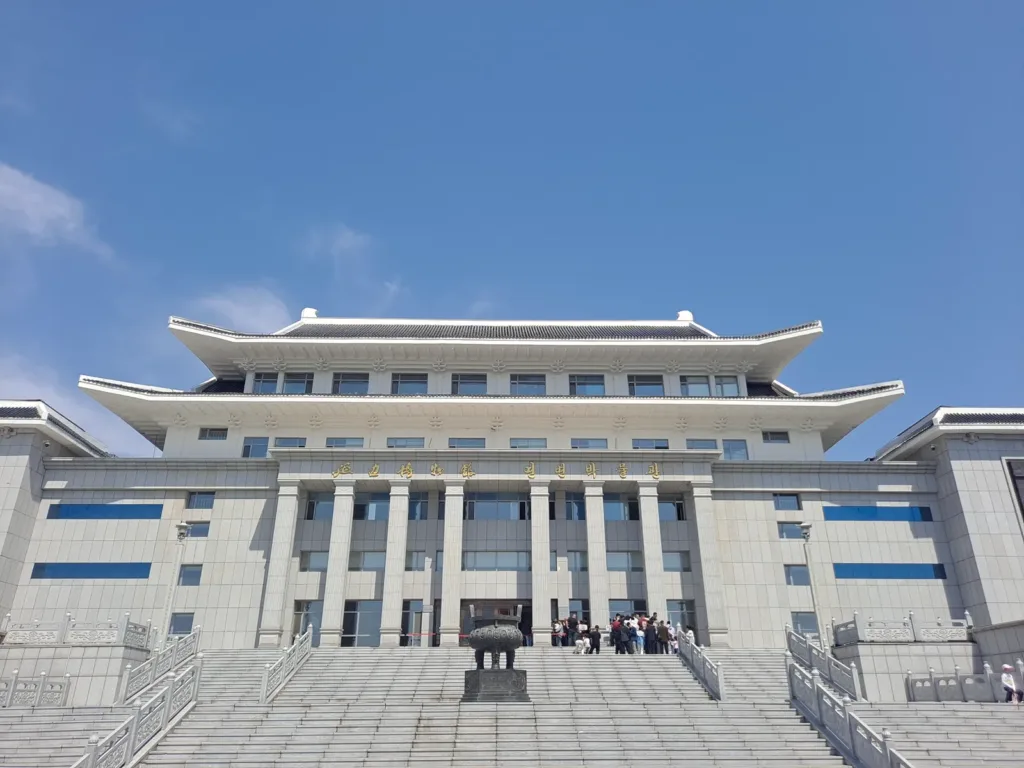 The Yanbian Museum in Yanji, photographed from the front steps. Photo: EditQ · CC BY-SA 4.0
Yanji延吉
Yanji is the capital of Yanbian Korean Autonomous Prefecture in eastern Jilin, a basin city where Korean cultural traditions, regional history and Changbai foothill landscapes meet. A useful first visit compares the Yanbian Museum, the purpose-built Korean Folk Customs Park and the forested Mao’er Mountain viewpoint; they are separate venues, not one shared entrance.
Read the place guide →Local life & food
Yanji local specialties
延吉市特色美食 · 2 specialties to discover
 Yanbian spicy fermented cabbage 延边辣白菜
Yanbian spicy fermented cabbage (延边辣白菜) is a regional fermented napa-cabbage side dish: cabbage is salt-softened, layered with a chilli seasoning paste and fermented, often with garlic, ginger and Yanbian apple-pear, and sometimes seafood seasonings. It is valued for its crisp, sour-sweet-spicy taste and is served with everyday rice, soups and richer dishes across the prefecture.
Source ↗Read the dish guide → Yanbian seasoned pollock strips 延边明太鱼丝
Yanbian seasoned pollock strips are a Korean-Chinese Yanbian food made from dried pollock torn into strands, eaten dry or dressed with chili-based seasoning; the texture and recipe vary, so search by the Chinese name and check the day's supply.
Source ↗Read the dish guide →All dish names · 全部菜名 (2)
More dishes from across Jilin are in the Jilin food guide.
Plan your visit
Getting there
Yanji is about 35 km (straight-line distance) from central Yanbian Korean Autonomous Prefecture. Search for 延吉市 in a map app to find stations and your accommodation.
Where to stay →Build your route
Yanbian Museum and Yanji West Market and Yanbian University Area are about 7 km apart (straight-line distance). The linked place guides have entrance and visit details.
Continue with Yanbian Korean Autonomous Prefecture →More in Yanbian Korean Autonomous Prefecture
Sources & geographic information
Administrative names and parent areas: Official geographic directory (dmfw.mca.gov.cn) · Reference date 2026-09-06.
Background text adapted from Yanji — Wikipedia contributors, under CC BY-SA 4.0. Text has been shortened and reorganized; source revision 1337438251.
Map data © OpenStreetMap contributors. Pins mark approximate centres, not entrances or boundaries.
Image credits & notes (1)
- Commercial streetfront buildings beside the Gongyuan Bridge BRT stop in Yanji. Photo: 2023-06-23.Photo: EditQ · CC BY-SA 4.0Resized for the web; the photo itself has not been edited. Thumbnails may show a cropped view.
