

Lost Passport in China: Police, Embassy and Flight Changes
A lost passport in China means handling two jobs: replacing the travel document through an embassy or consulate, and sorting out the Chinese paperwork needed to stay and leave legally. Start with the police and the local Public Security Exit-Entry Administration, contact the embassy immediately, and tell the airline before the flight becomes a no-show.
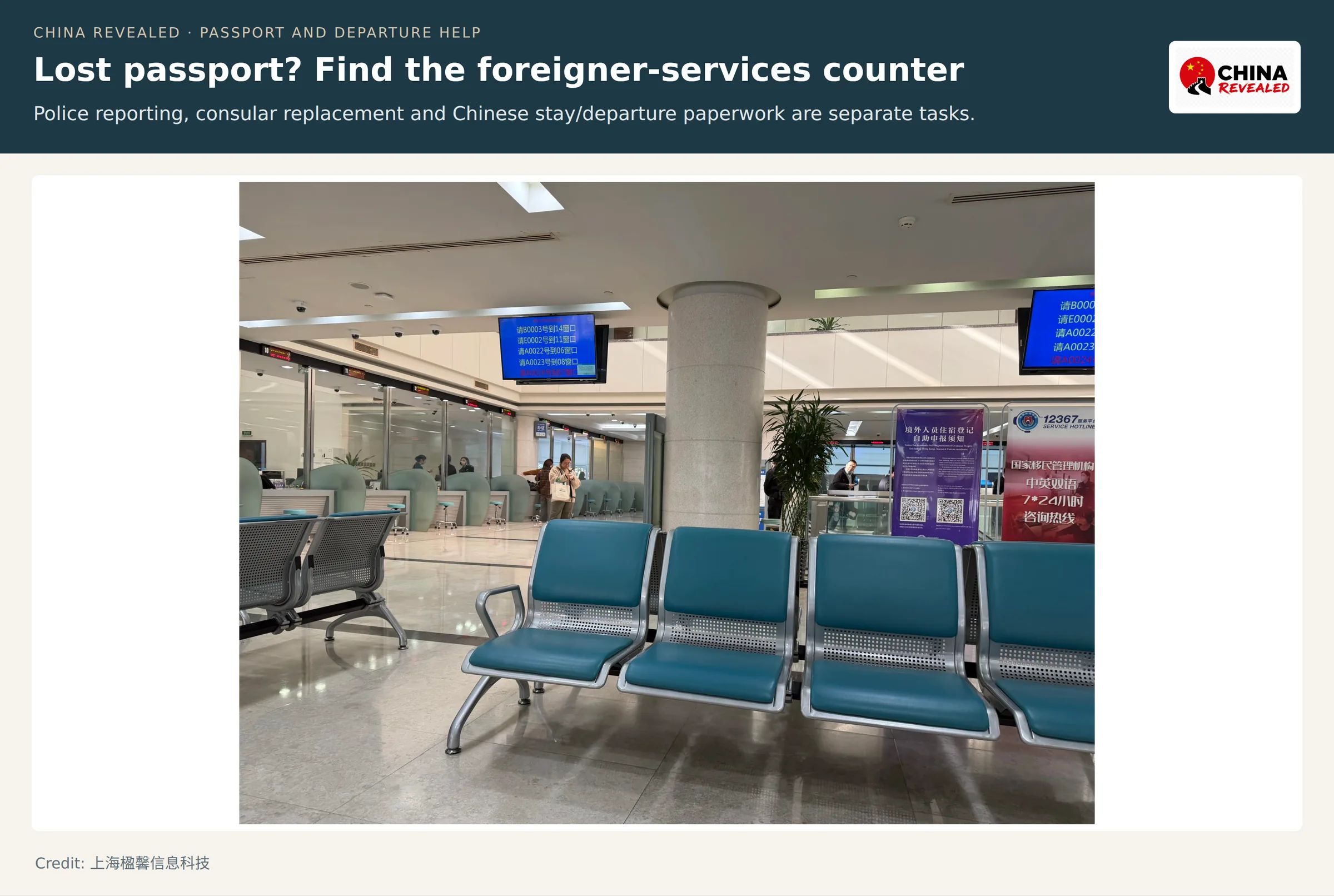
The most expensive mistake is treating these as one appointment. A police receipt, a passport-loss certificate, a new passport and permission to leave China do different jobs. Getting the right documents in the right order avoids another trip across the city—and a missed departure.
Quick takeaways
- Report the loss promptly. For theft or an immediate safety problem, call 110; for immigration procedure questions, call 12367.
- Ask the local Exit-Entry Administration for the Certificate of Loss of Passport for Foreigners. An ordinary police report is a different document.
- Contact the embassy or consulate the same day. Ask whether a full replacement passport or an emergency travel document suits the actual route.
- Keep the current Chinese stay deadline in view. Waiting for an embassy does not automatically extend it.
- Update accommodation and transport records after receiving a new document. Contact both the ticket seller and the operating airline before changing the flight.
In this guide
- The first hour: search, report and stop unnecessary travel
- Step 1: report the loss and obtain the correct certificate
- Step 2: contact the embassy and choose the replacement
- Step 3: deal with the Chinese visa or stay documents
- Processing time and the stay deadline
- Hotels, friends’ homes and accommodation registration
- Can a train or domestic flight still be used?
- Change the international flight without losing the remaining booking
- Keep the receipts and contact the insurer
- Chinese phrases to show at the counter
- Before going to the airport
The first hour: search, report and stop unnecessary travel
If the passport is simply missing, check the hotel safe, the reception desk, the last bag used and any place that handled the document. Contact the taxi or ride-hailing platform, railway station or attraction lost-property desk where relevant. Have someone help retrace the route while the police and consular calls are being made. If it was stolen, report the theft promptly rather than spending the afternoon looking for it.
Tell the current hotel or host what happened. Ask for the accommodation-registration record and the full address in Chinese, including the building and room number. These are useful at the police and immigration counters. Staying put in the current city is usually more efficient than trying to continue a multi-city itinerary without a valid passport.
Make one folder on the phone and one paper file. Collect the old passport number and information-page copy, visa or entry-permission copy, entry date and port, hotel booking, current accommodation address, flight reservation and other identity documents. A saved photograph helps officials identify the record; it is not a replacement passport.
If the flight is tomorrow, call the airline or booking platform now. Explain that the passport was lost and ask about the cancellation deadline, no-show conditions and protecting later flights on the same ticket. Do not wait until the check-in desk to reveal the problem.
Step 1: report the loss and obtain the correct certificate
First stop: the local police
Go to the police station covering the place where the passport was lost or stolen. The Chinese word for a local police station is 派出所, pàichūsuǒ. The hotel can help identify the correct station and explain the address. For theft, bring a clear account of the incident: where it happened, when the passport was last seen, and whether other items were taken.
Ask for a written report or receipt and keep the original. The usual term is 报案回执—a police incident-report receipt. Some cities handle a straightforward loss through a written loss declaration, while theft requires a police report. The local police or Exit-Entry office can explain which route applies.
Reporting to Chinese police and cancelling the passport with its issuing country are separate actions. Once the issuing authority has cancelled a passport as lost or stolen, do not use it for travel even if it turns up later.
Next stop: the Public Security Exit-Entry Administration
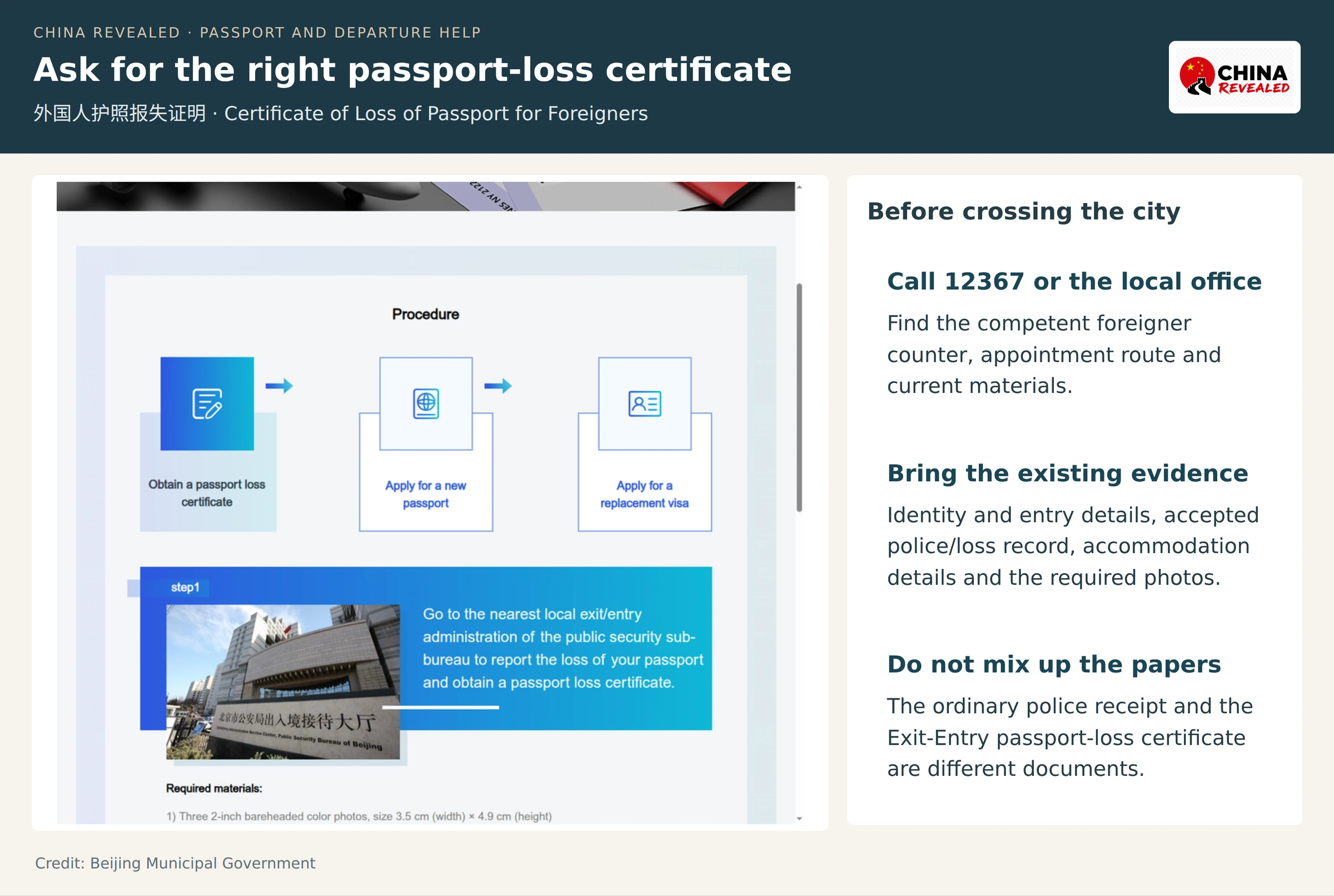
The department to look for is 公安局出入境管理部门, the Public Security Bureau’s Exit-Entry Administration. Ask about 外国人护照报失证明: the Certificate of Loss of Passport for Foreigners, also called a Passport Loss Report on some local English pages.
This certificate is not the same as the ordinary police receipt. It is the Chinese immigration-side loss document used for consular replacement and, where needed, reissuing Chinese visa or stay/residence documents. Do not leave the first police station assuming that every piece of paper called a “report” will do the same job.
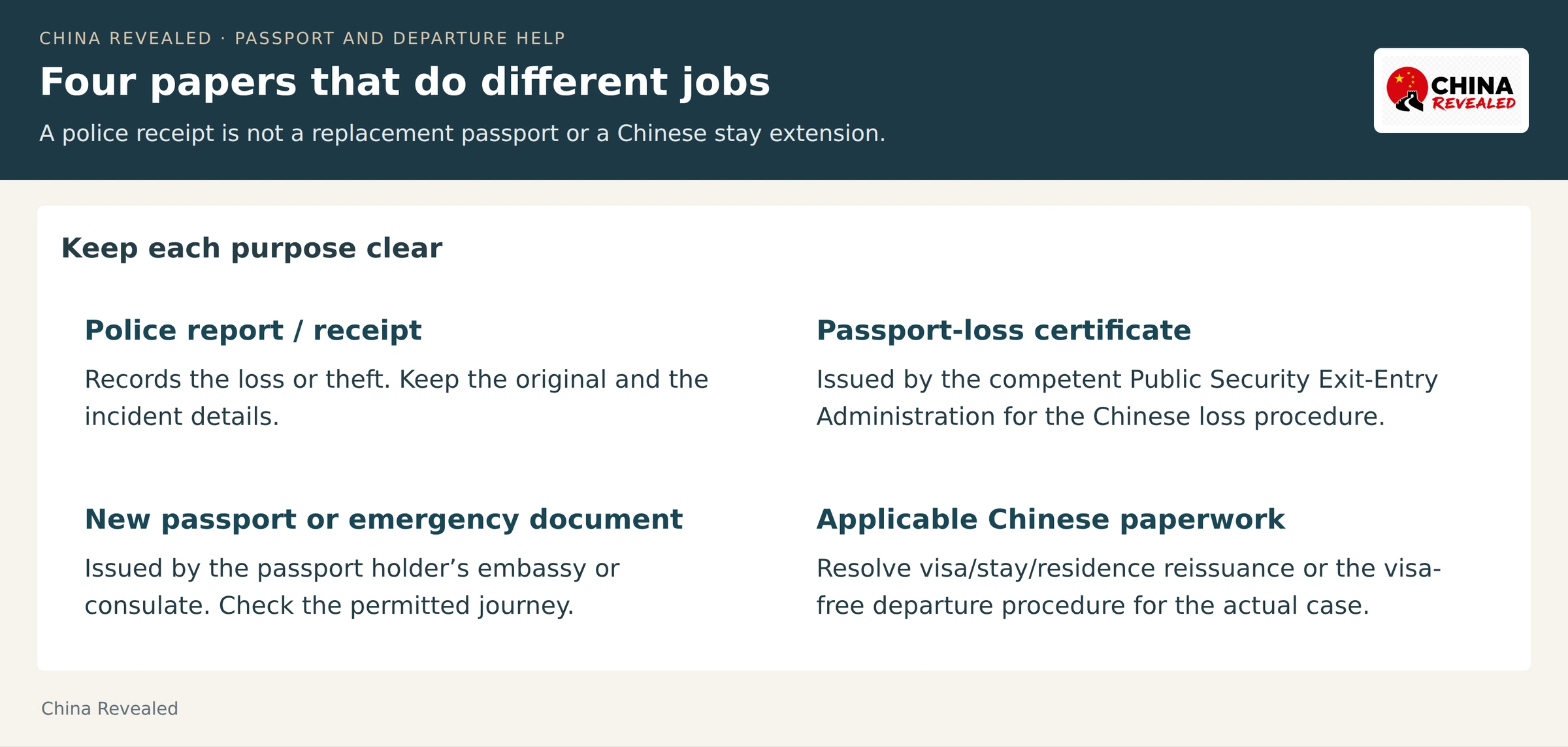
Before travelling across the city, ask 12367 or the local department which foreigner-services counter handles passport-loss certificates, whether an appointment is required, and what photograph specifications apply. Some offices mainly handle Chinese citizens’ passports; the nearest document hall is not necessarily the competent foreigner counter.
Prepare the police receipt or accepted loss declaration, proof of identity, old passport and visa copies if available, entry details, accommodation registration and photographs. Bring the original papers already issued. The precise checklist is local: Beijing’s published example asks for three 3.5 × 4.9 cm photographs; another city or an embassy may use a different size. For a child, also prepare the parent’s identity documents and evidence of the parent-child relationship.
The Beijing government’s passport-loss guide and Shenzhen’s bilingual guide are useful local examples. Use the instructions for the city handling the case, not another city’s address or opening hours.
Step 2: contact the embassy and choose the replacement
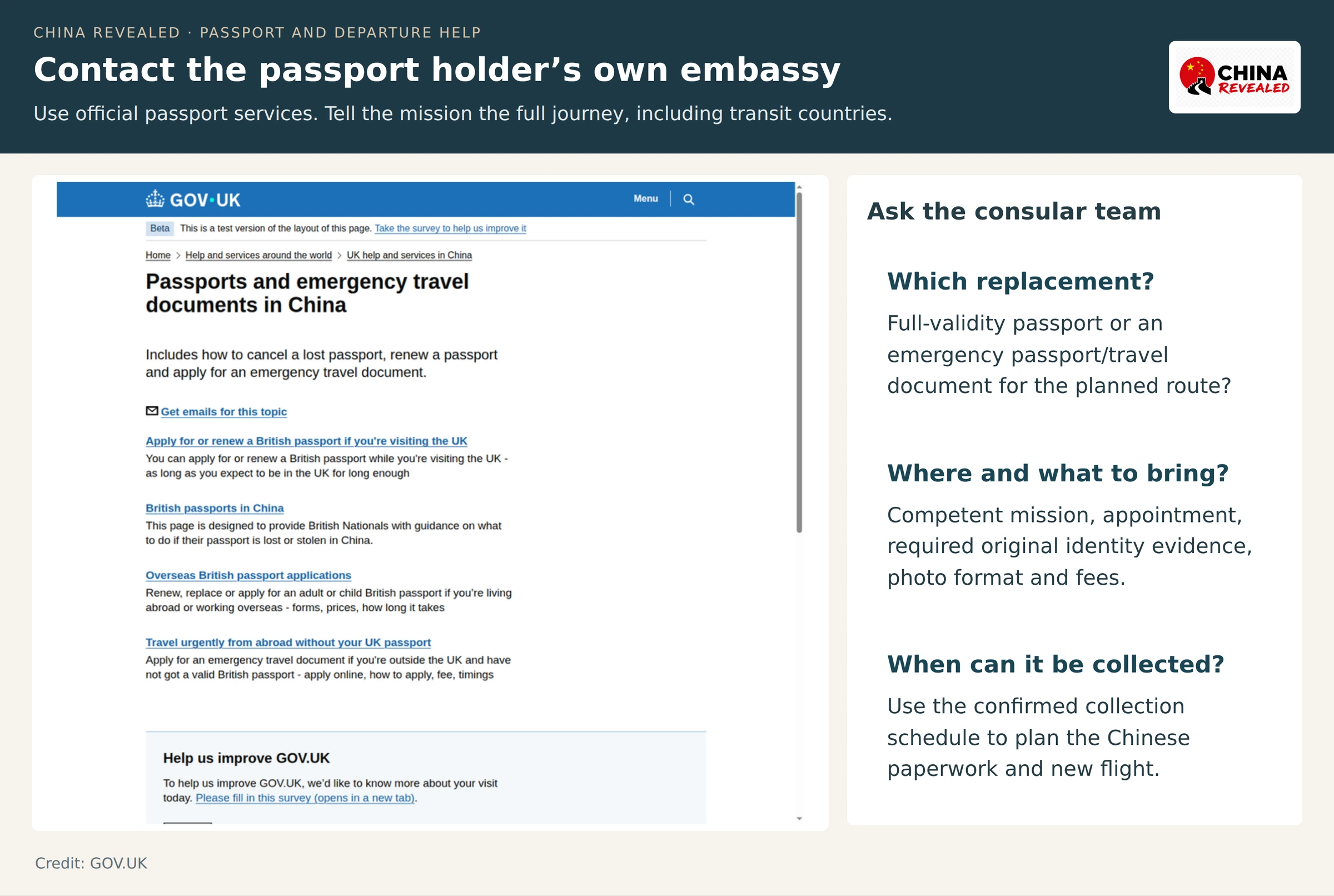
Contact the passport holder’s own embassy or consulate as soon as the loss is discovered; there is no need to postpone that initial call until every Chinese paper is ready. Explain the nationality, current Chinese city, next departure, intended destination and every transit stop. Ask which mission can accept the application and whether an appointment is needed.
Use the mission’s official website and consular contact channel. An advertisement for “passport assistance” is not the embassy. If language is the immediate problem, ask the hotel to help with the Chinese calls and use a translation app for addresses and short counter requests.
There are two common choices:
A full-validity replacement passport is the better fit when there is time to obtain it and the trip will continue. It usually needs a fuller identity and citizenship check, photographs and the mission’s application forms.
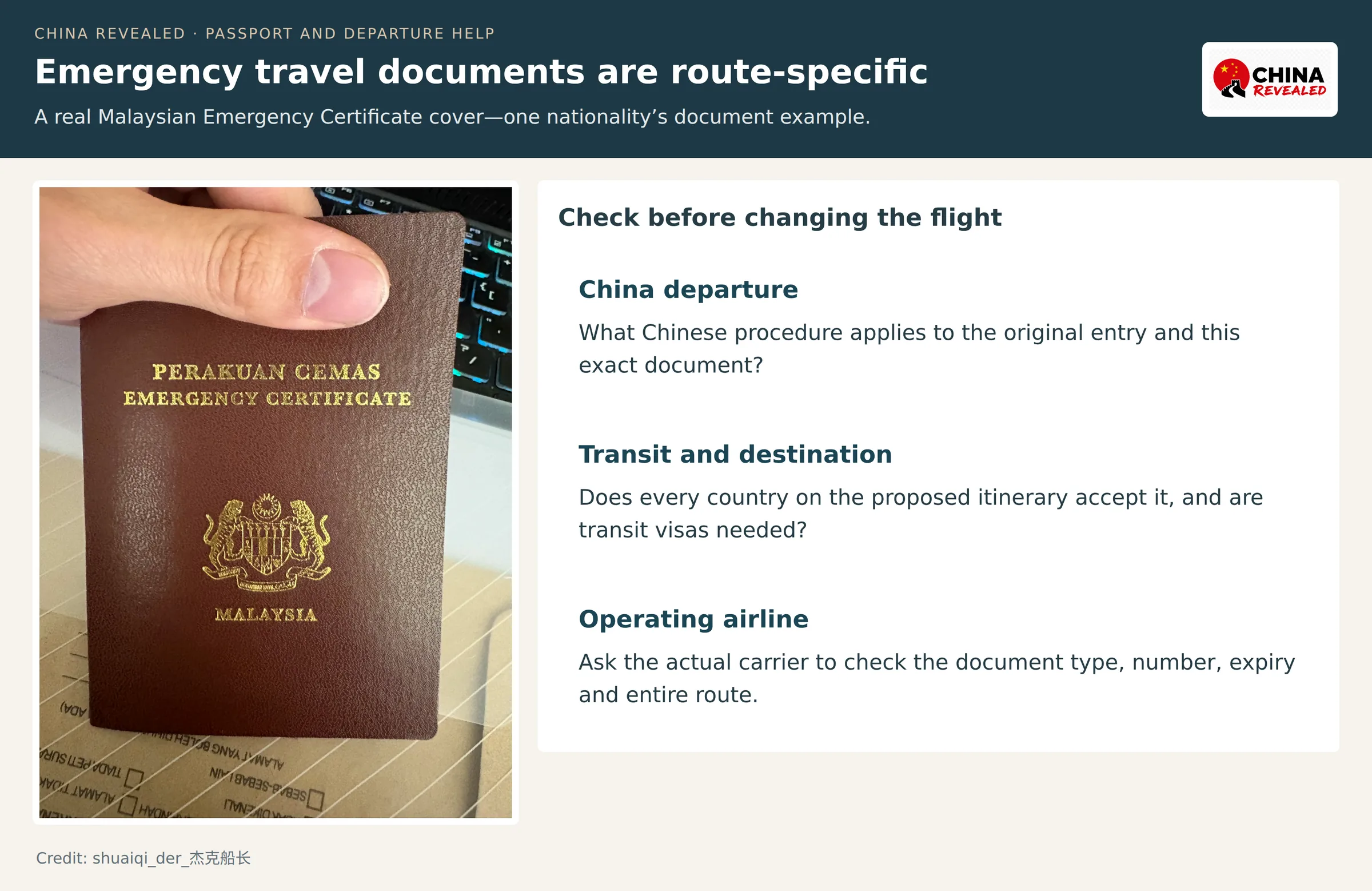
An emergency passport or emergency travel document is for urgent travel when a normal replacement cannot arrive in time. Its validity, permitted route and acceptance vary by issuing country. It may be limited to getting home or a specified journey, rather than replacing the lost passport for the rest of a holiday.
Do not buy a new nonrefundable route before asking whether that exact emergency document is accepted by China, the destination, every transit country and the operating airline. A direct journey home may be simpler than a connection through a country that requires an ordinary biometric passport.
Why nationality matters
U.S. citizens: start with U.S. passport services in China. A consular officer can discuss a limited-validity emergency passport when urgent travel cannot wait for a regular replacement. U.S. passport procedures do not make a police report universally compulsory, but the Chinese passport-loss and immigration steps still matter.
British citizens: the official China passport and emergency-document page separates normal replacement from an Emergency Travel Document, or ETD. An ETD is tied to an allowed journey; changes to the itinerary can affect the document. The British Embassy’s China guidance says an Exit Visa from the Chinese Public Security Bureau is needed before leaving mainland China on an ETD and may take up to 10 working days. Raise that extra step immediately.
Australian citizens: use Australian passport services in China. An Australian emergency passport has no electronic chip, which can affect transit and entry rules. The Beijing mission publishes its own application and processing instructions; do not turn those into a promise for every Australian consular location.
Other nationalities should follow their own mission’s instructions. Photo size, forms, identity evidence and fees are not interchangeable. Ask what must be brought as an original and what a scan can support; do not arrive with only a phone photograph if the mission requires physical evidence.
Step 3: deal with the Chinese visa or stay documents
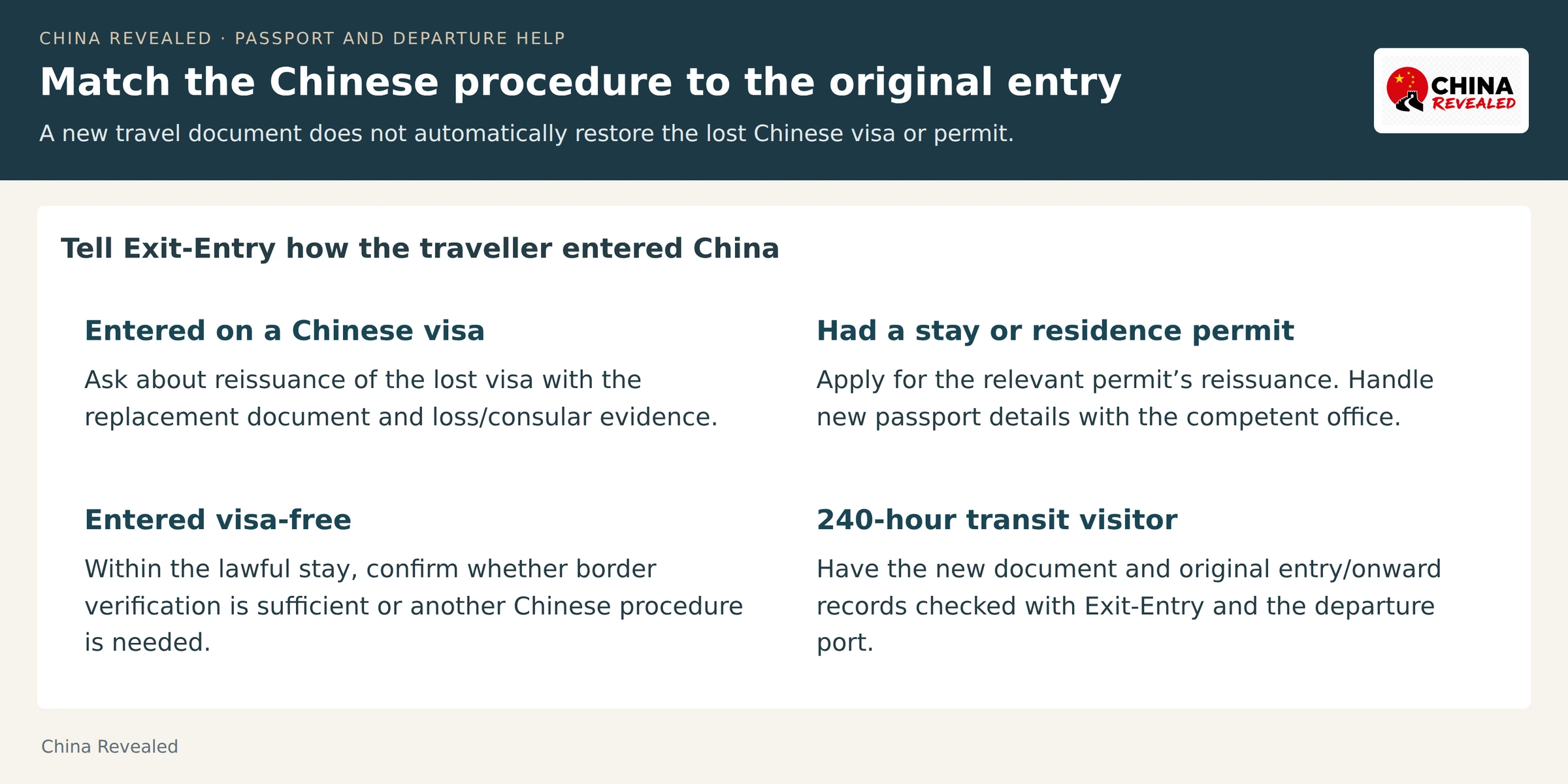
When the new passport or travel document is ready, take it back to the competent Chinese Exit-Entry office together with the loss certificate or consular note, entry evidence and current accommodation information. The question is not simply “Where is an exit visa?” It is “What Chinese procedure applies to the entry and document in this case?”
Entered on a Chinese visa
If the Chinese visa was in the lost passport, ask for visa reissuance, or 签证补发. The national procedure calls for the new valid passport or other valid international travel document, together with the passport-loss certificate or a note from the issuing country’s mission. Prepare the local application/photo materials and documents supporting the original visit.
A new passport does not recreate the lost visa by itself. Ask what will be issued, when it can be collected and what evidence should be carried to border inspection. The broader China visa extension and residence-permit guide explains the separate Chinese document categories.
Held a Chinese stay or residence permit
Ask for reissuance of the relevant permit, not a new tourist visa by default. If a residence permit is involved, the new passport number is also a registered-detail change; those changes generally need reporting to the competent department within 10 days. Deal with it during the replacement visit rather than assuming that the embassy updates China’s records.
Entered visa-free, including a short tourist visit
Do not assume that every visa-free visitor must obtain a replacement Chinese visa. Within the permitted stay, border inspection can in eligible cases verify the new travel document, original entry record, loss evidence and consular evidence and process departure. The replacement document must be acceptable under the applicable exemption arrangement.
Tell Exit-Entry or border inspection the exact entry scheme and show the exact new document. Ask whether departure can proceed on that basis or whether a Chinese stay document or another procedure is needed first. This is especially important with an emergency document rather than an ordinary passport.
Entered under 240-hour visa-free transit
Contact the local authority and planned departure port before going to the airport. The published transit scheme requires an ordinary passport and a confirmed onward itinerary; an emergency replacement cannot simply be assumed to preserve the original transit eligibility. Keep the original transit-entry record, onward booking, loss certificate and consular evidence together, and have the departure requirements checked for that case.
If the embassy cannot issue a replacement travel document
Ask the competent Exit-Entry Administration about a Foreigner’s Exit-Entry Permit, 外国人出入境证. This is a separate Chinese procedure for eligible people unable to obtain a replacement passport or international travel document from their country’s mission. It is not another name for a police report or passport-loss certificate.
The national service guide allows a decision period of up to 30 working days after acceptance and a document validity of no more than 30 days. These are different figures. This is not a same-day shortcut for a flight already leaving tonight.
Processing time and the stay deadline
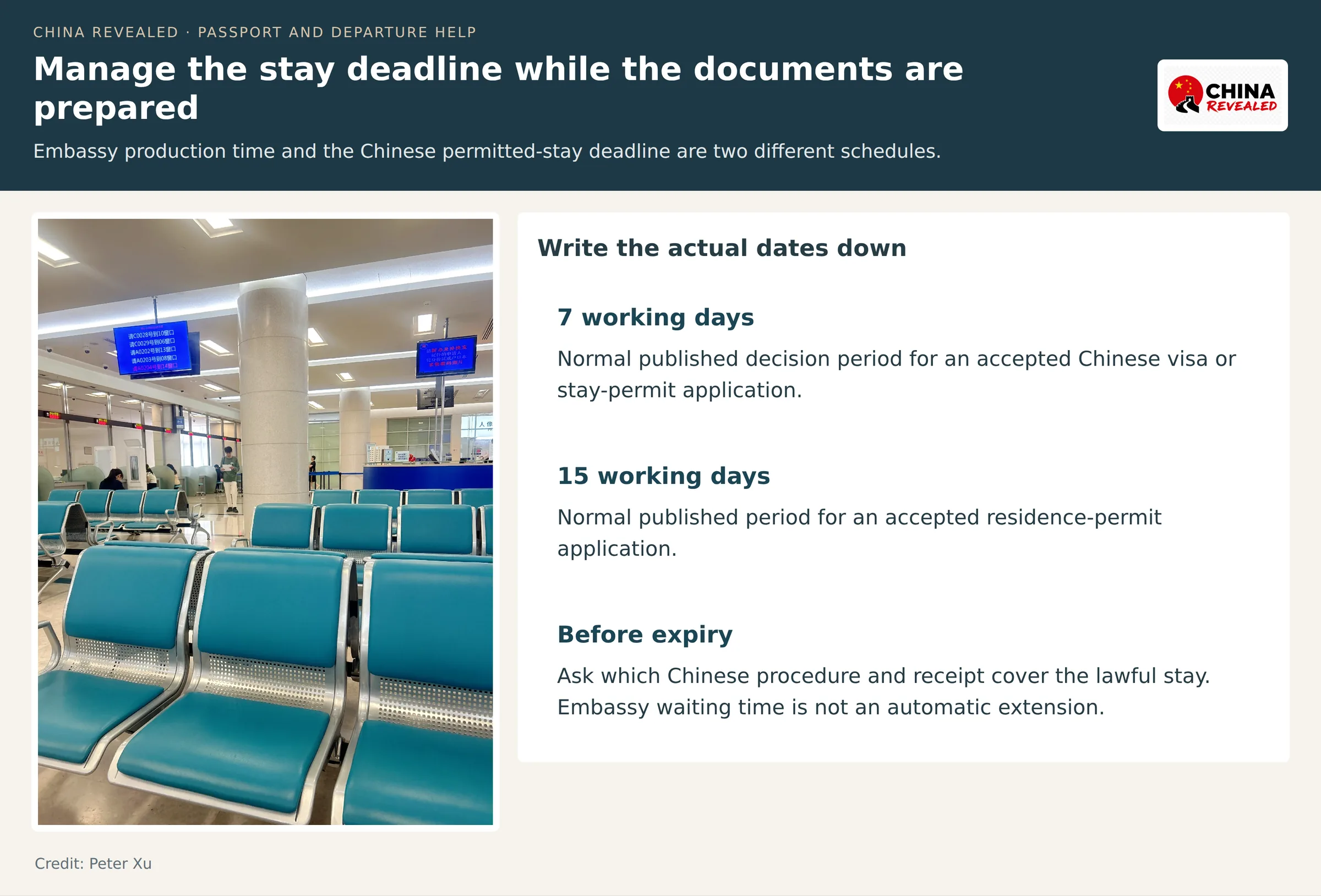
There are two schedules to manage: the embassy’s replacement schedule and China’s permitted-stay deadline. Write the actual dates down. A consular appointment confirmation does not extend a visa or visa-free stay.
For accepted Chinese visa or stay-permit applications, the normal published decision period is up to 7 working days; for residence-permit applications, up to 15 working days. These periods start after formal acceptance, not on the day the passport went missing. Embassy production time, weekends and public holidays are separate.
If departure is urgent, take the confirmed itinerary to Exit-Entry and ask whether the urgent-processing channel applies. The national guidance refers to confirmed-date/seat transport evidence and an explanation from the inviting organization where required. Ask the local office how an independent tourist should document the urgency. There is no point buying a new ticket only to discover that the necessary letter or appointment is missing.
If the stay expires while the embassy is still working, seek the appropriate Chinese stay procedure before expiry. Also ask what document supports lawful stay during processing. A Chinese application acceptance receipt can support lawful stay while the Chinese authority holds a passport or travel document for processing; an ordinary police receipt does not do that job.
One local detail is often copied incorrectly: Shenzhen’s published passport-loss guide describes its loss certificate as valid for 30 days and tells applicants to complete the subsequent replacement procedures within that period. It is a Shenzhen instruction, not a nationwide extra 30 days added to every visitor’s stay.
Hotels, friends’ homes and accommodation registration
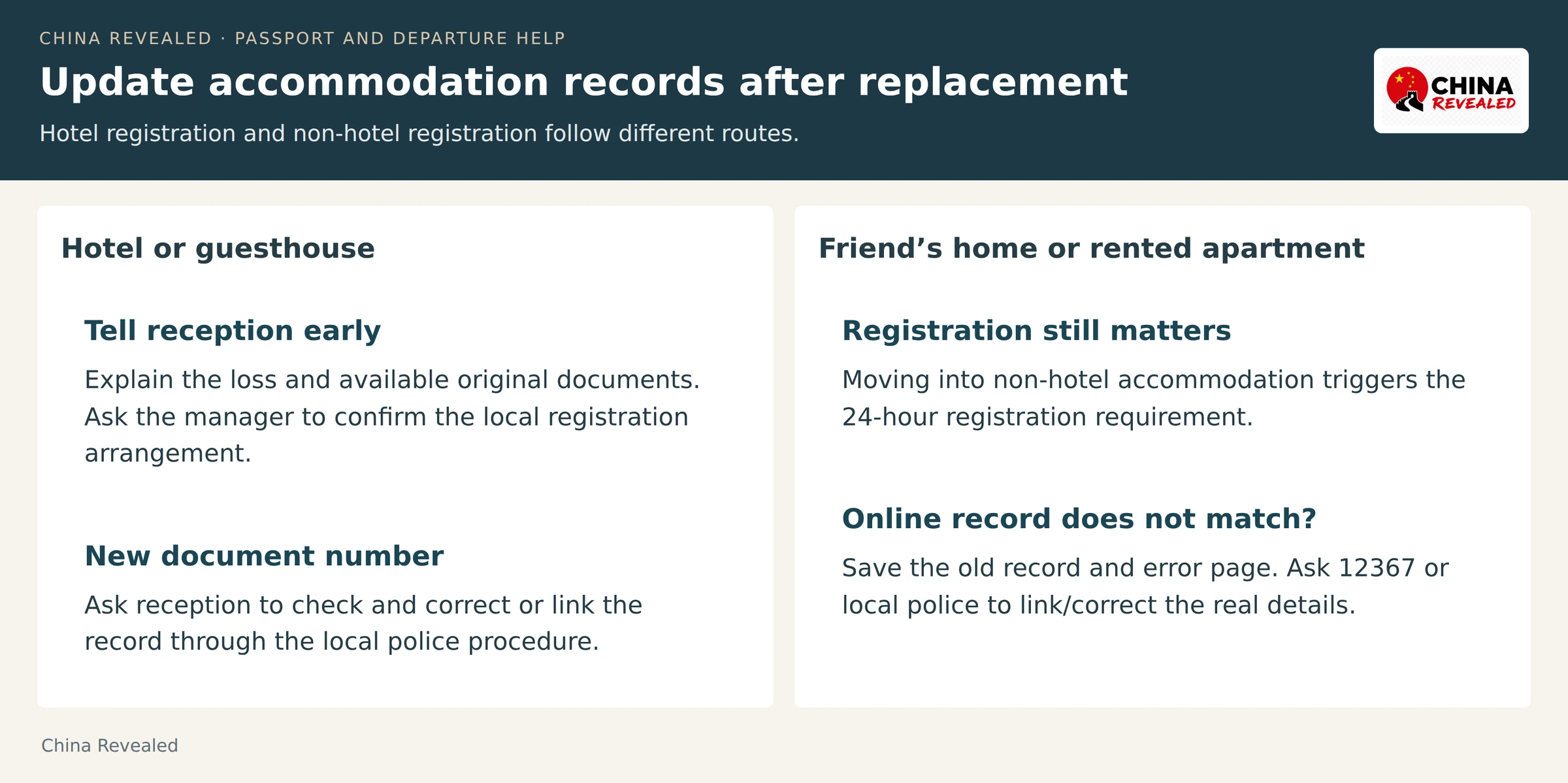
Tell the existing hotel before the next night’s registration or any extension of the stay. Show the actual documents available and ask the manager to confirm the arrangement with the hotel’s local police contact. Remaining at a hotel that already has the original entry and registration details is generally less work than changing properties during replacement.
When the new document arrives, ask reception to check the name, nationality, date of birth and new document number against the guest record and correct or link the record through the local procedure. Bring the loss certificate and Chinese visa/stay paperwork too. A copy of the lost passport helps find the old record; it should not continue to be treated as the current valid document.
For a friend’s home, rented apartment or other non-hotel address, accommodation registration remains a separate task. The 24-hour registration requirement after moving into a non-hotel address still applies. Since September 21, 2026, national online channels have been rolled out through the NIA service website, the NIA 12367 app, and official WeChat/Alipay mini-programs; in-person registration remains available.
A new passport number may fail to match an existing online record. Save the old record and the error screen, then ask 12367 or the local police to correct or link the records using the real arrival and residence details. Do not invent a new move-in date simply to make the form accept it. The accommodation-registration guide covers hotel versus non-hotel responsibilities and the national online route.
Can a train or domestic flight still be used?
High-speed trains: go to the staffed counter
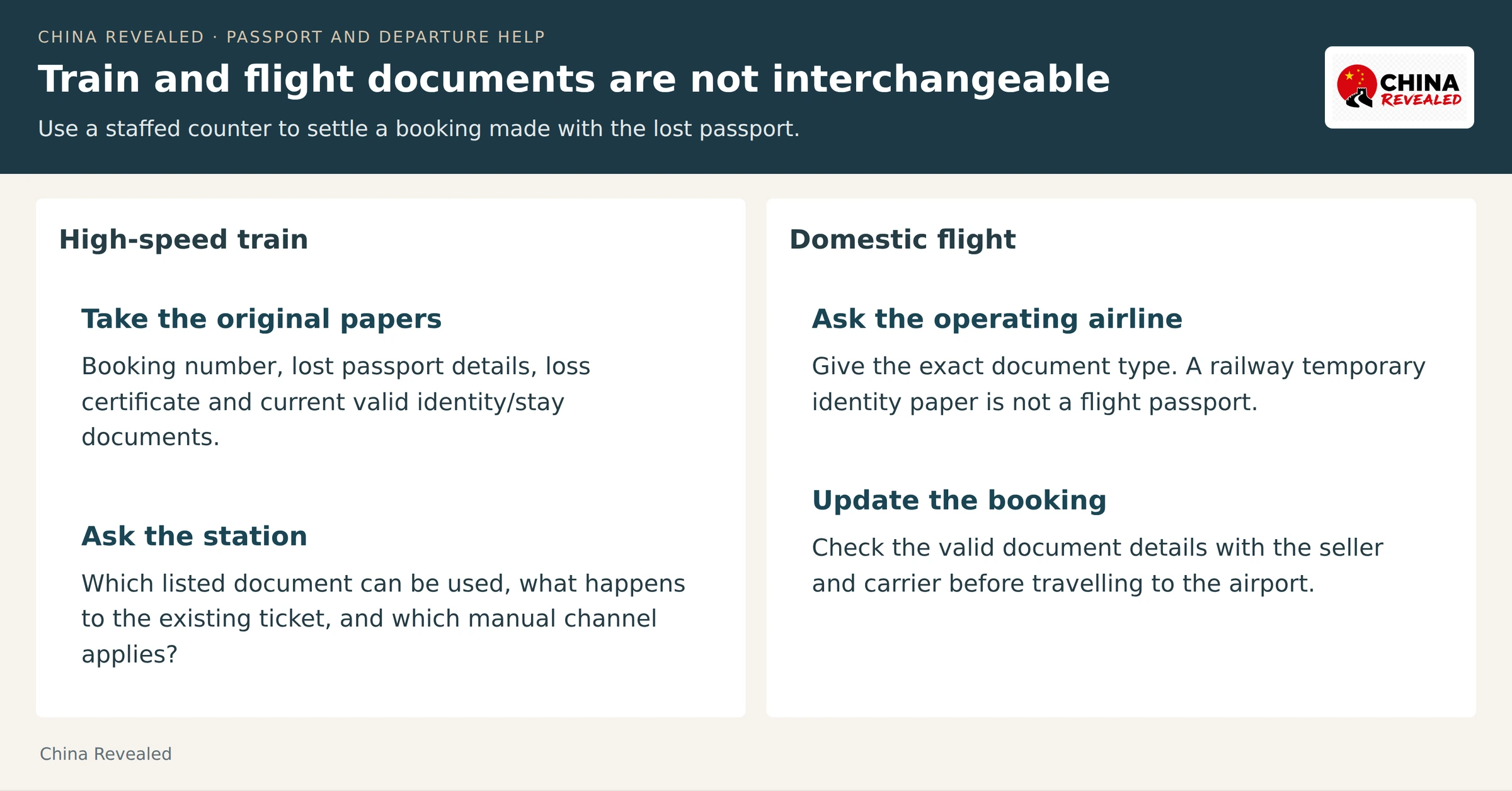
There is a practical railway route to investigate, but do it before departure. The 12306 real-name document list includes a passport-loss certificate, a Foreigner’s Exit-Entry Permit and certain Chinese acceptance receipts. It also lists temporary international travel documents issued by foreign missions, with the required valid Chinese visa or stay document attached.
Take the booking number, lost passport number, loss certificate and current original documents to the departure station’s ticket window and railway-police document desk. Ask how the existing ticket must be handled and which identity document will be used. Use the staffed/manual identity-check channel as directed; do not expect a paper certificate to work in an automatic passport reader.
A railway temporary passenger identity certificate, if available for the case, is a railway document. It is not a passport for a flight or international departure. If the consular appointment is in another city, explain that need to Exit-Entry and the station before booking the train.
Domestic flights: ask the actual carrier first
Do not apply the familiar Chinese-resident “lost ID card at the airport” procedure to a foreign passport. Contact the operating airline and departure airport about the exact current document, then ask the ticket seller how the booking’s document details must be updated.
If it is not yet possible to fly on the available documents, postpone the flight rather than arriving with only a photograph and hoping airport staff can waive the check. The domestic-flight guide explains the usual passport, check-in and security sequence.
Book hotels, flights, train tickets, attractions and other travel services on Trip.com.
Change the international flight without losing the remaining booking
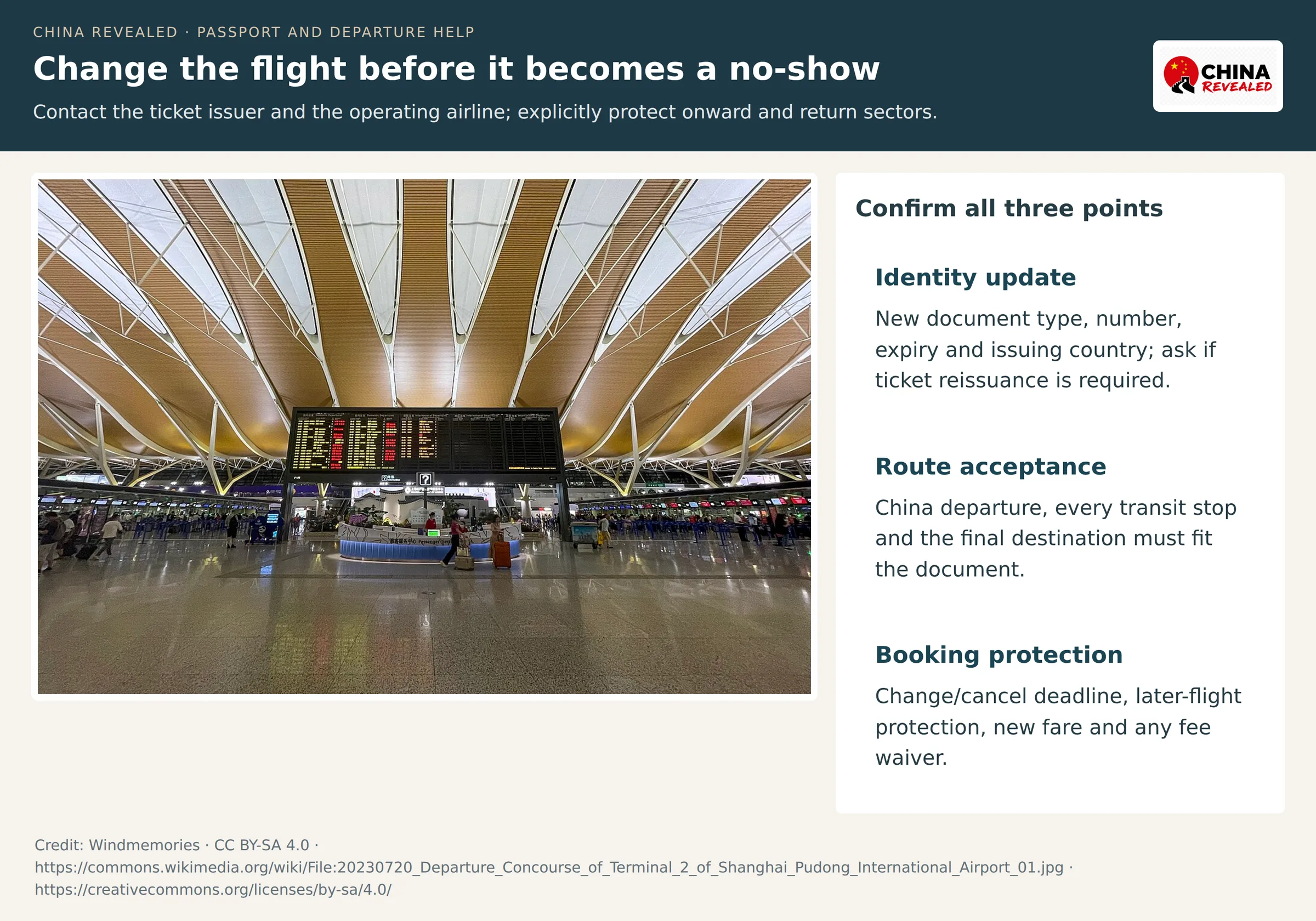
Contact both the company that issued the ticket and the operating airline. If Trip.com sold it, open the actual booking and contact order support; if the airline sold it, start with its own booking team. For a codeshare, confirm which airline operates each flight.
Say that the old passport has been lost or cancelled and identify the replacement document type. A new passport number is not the same issue as a passenger-name change. Ask whether the number, expiry and issuing-country details can be updated, whether the ticket needs reissuance, and whether the document must be reviewed by a specialist team. Keep the case number or written confirmation.
For an emergency document, give the complete route—not just the final destination. A connection can require different document acceptance or a transit visa even when the traveller does not plan to leave the airport. Ask the mission and airline about each leg before committing to the replacement flight.
If the original departure will be missed, ask for the cancellation/change deadline and explicitly protect the onward and return sectors. On a linked ticket, missing the first flight without contacting the airline can result in later reservations being cancelled. Passport loss does not automatically make the ticket changeable without a fee; request a waiver where available, but check the actual fare difference and new ticket conditions.
Make the new flight follow the confirmed document-collection date with a sensible buffer. Do not replace an impossible departure with another equally tight one. The Trip.com booking guide is useful for the normal order and customer-support workflow, while passport acceptance must still be settled with the carrier.
Keep the receipts and contact the insurer
Call the insurer’s assistance line early and ask which document-replacement or trip-delay sections apply. Some policies have prompt-reporting requirements. Keep the police and passport-loss records, consular confirmation, original and changed itineraries, support case numbers and proof of extra costs.
Useful receipts include passport or emergency-document fees, Chinese document fees, photographs, necessary transport, extra hotel nights, ticket-change fees and fare differences. Ask for itemized receipts and retain the originals. Record why each extra night or journey was necessary; a dated embassy collection instruction is more useful than a vague note saying “passport problem.”
Separate three costs when deciding what to change: the document fee, the time spent waiting, and the transport/hotel changes. A cheaper new flight can still be a poor choice if its connection does not accept the emergency document.
Chinese phrases to show at the counter
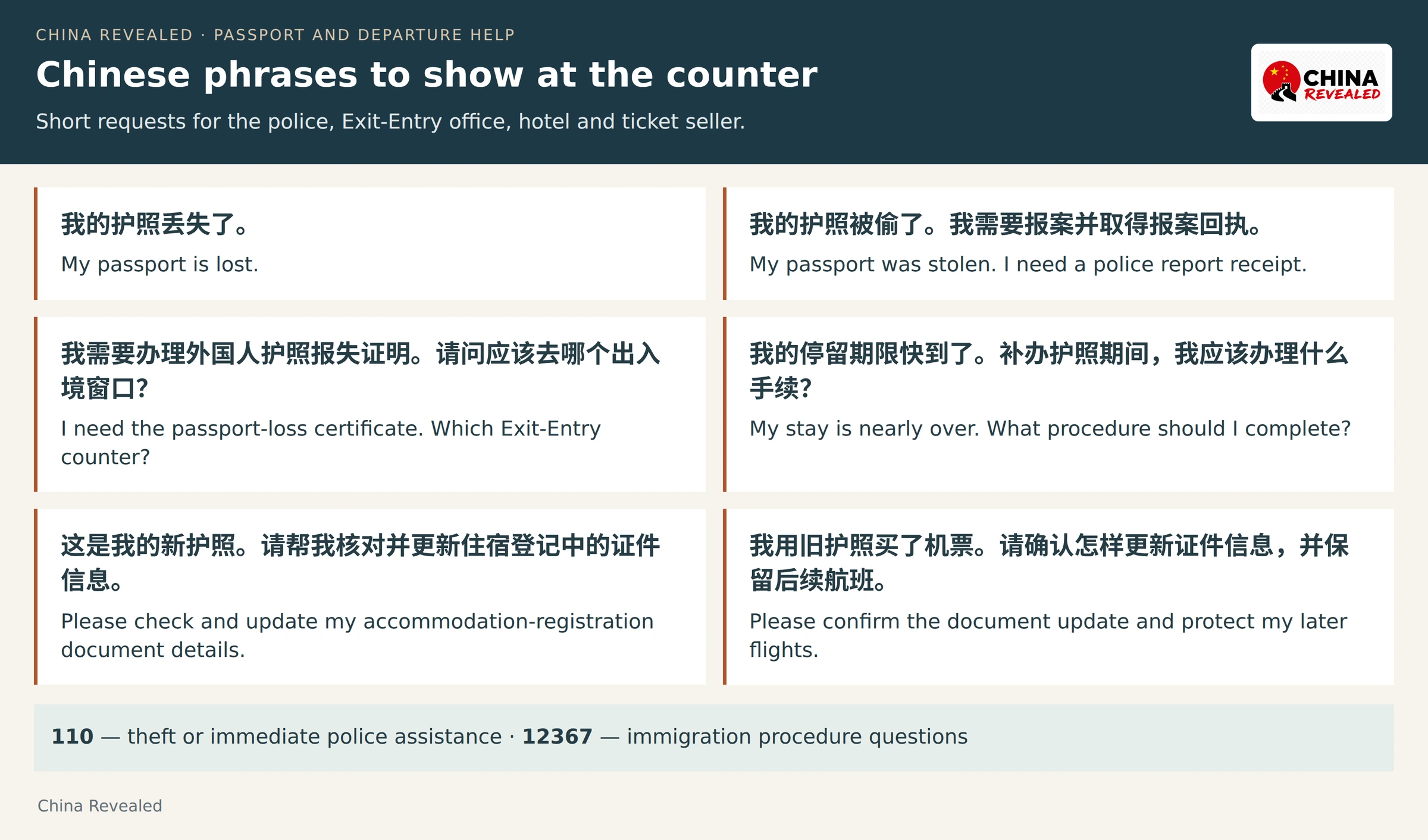
Keep these in a phone note alongside the actual passport number and Chinese address. Replace “lost” with “stolen” when that is what happened.
我的护照丢失了。
My passport is lost.
我的护照被偷了。我需要报案并取得报案回执。
My passport was stolen. I need to report it and obtain a police report receipt.
我需要办理外国人护照报失证明。请问应该去哪个出入境窗口?
I need a Certificate of Loss of Passport for Foreigners. Which Exit-Entry counter should I visit?
我的停留期限快到了。补办护照期间,我应该办理什么手续?
My permitted stay is nearly over. What procedure should I complete while replacing my passport?
这是我的新护照。请帮我核对并更新住宿登记中的证件信息。
Here is my new passport. Please help check and update the document information in my accommodation registration.
我用旧护照买了机票。请确认怎样更新证件信息,并保留后续航班。
I bought the flight with my old passport. Please confirm how to update the document information and preserve the later flights.
Before going to the airport
Check that the replacement travel document is valid for the planned journey, the Chinese departure/stay procedure is complete, every transit and destination requirement has been checked, and the airline booking now reflects the accepted document. Carry the original replacement document, loss certificate, consular evidence and applicable Chinese paperwork together, with copies stored separately.
Give a document-sensitive departure more time than an ordinary airport visit and go to a staffed check-in counter. Any outstanding immigration issue belongs with the competent authority before airport day, not with the gate agent minutes before boarding.
The way out of a lost-passport problem is a clear file and a realistic schedule: police loss record, the correct Chinese loss certificate, consular replacement, the appropriate Chinese stay/departure procedure, and updated accommodation and transport records. Finish those steps, and the return journey becomes manageable again.
About China Revealed
China Revealed is an independent English-language travel guide dedicated to China.
We bring together China travel guides, destination information, local insights and practical travel resources in one place.
Our travel database covers China's provinces, cities, famous attractions, hidden gems, local cuisine, transportation, accommodation, visa requirements, digital payments, mobile connectivity and the other practical details travelers need to explore China.
We focus on depth, careful research and accuracy. Our guides combine official sources, detailed destination data, local knowledge and regularly updated information to give reliable, practical travel advice.
Whether you're visiting China for the first time or exploring beyond the popular destinations, China Revealed is an all-in-one resource for discovering the real China.
China Revealed — Your practical guide to China.
Some links on China Revealed, such as Trip.com booking links, are affiliate links. If you book through them, we may earn a commission at no extra cost to you. This does not change what we recommend.