

China 240-Hour Visa-Free Transit: Rules and Routes
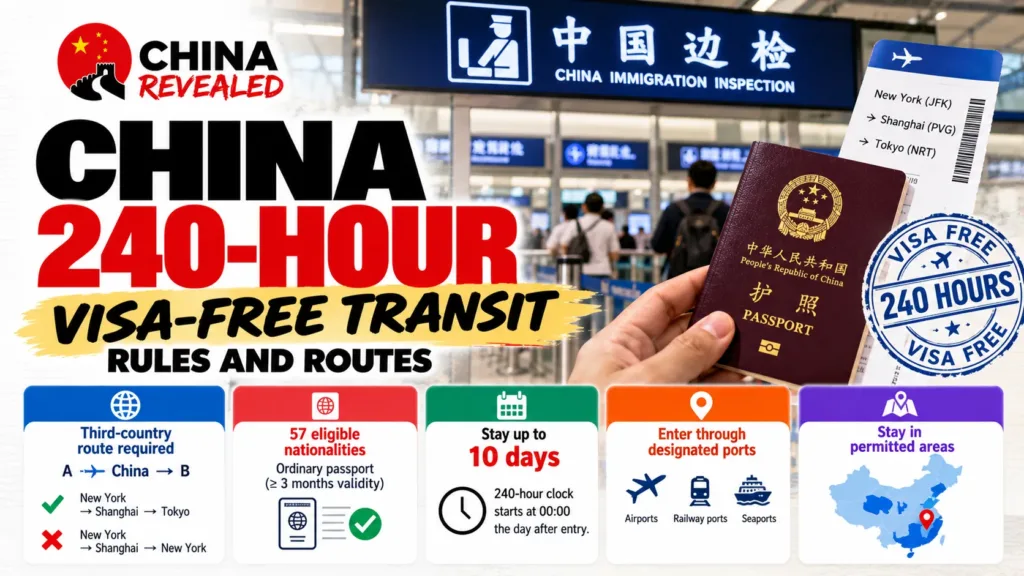
China’s 240-hour visa-free transit lets eligible travelers visit mainland China for up to 10 days without applying for a Chinese visa in advance, when China is the stop between two different countries or regions.
The useful part is that this is not just permission to spend a night near an airport. After admission, a traveler can visit the Great Wall, take a train to Xi’an or combine Shanghai with Hangzhou and Suzhou—within the policy’s permitted areas and the same stay deadline.
The part to get right is the journey on either side of China. New York → Shanghai → Tokyo fits the third-country pattern. New York → Shanghai → New York does not. A connecting airport outside China can change that answer, even when the final ticket destination looks different.
Policy checked October 18, 2026: the current National Immigration Administration, or NIA, list covers 57 nationalities, 65 designated entry ports and permitted areas in 24 provincial-level regions. Kyrgyzstan and Vietnam joined on August 20, 2026. Older guides saying 54 or 55 countries are out of date.
Quick takeaways
- Check the route first: Country/Region A → mainland China → a different Country/Region B. Check the international connections immediately before and after mainland China.
- Use an eligible ordinary passport: the current list has 57 nationalities; the passport needs at least three months of validity remaining, plus any longer requirement for the onward destination.
- Book confirmed onward travel: the departure date and itinerary must be fixed, within the allowed stay, with the necessary permission to enter B.
- Enter through a designated port and stay in permitted areas. Cross-province travel is allowed; nationwide travel is not. Guangdong has a broader rule for exits, not for entries.
- Apply for temporary entry at border inspection. The online Arrival Card is a separate form. The 240-hour clock starts at 00:00 on the day after entry; check the permitted departure deadline before leaving the counter.
In this guide
- 1. Is this the right visa-free policy for the trip?
- 2. Does the route pass the third-country test?
- 3. The 57 eligible nationalities and passport rules
- 4. How the 240-hour clock works
- 5. Where travel is allowed
- 6. Airports, railway ports and the Guangdong exit exception
- 7. Tickets and documents to prepare before boarding
- 8. The Arrival Card and the actual arrival procedure
- 9. Hotel check-in and private-stay registration
- 10. Practical trips that fit the policy
- 11. Flight changes, delays and the departure deadline
- 12. Useful Chinese and common questions
1. Is this the right visa-free policy for the trip?
There are several ways to enter China without a visa, and they are not interchangeable. 240-hour transit is specifically for a journey onward to a third country or region. It is useful for eligible travelers whose passport does not give them a more convenient ordinary visa-free visit, or whose trip naturally includes a stop in China between two places.
Some nationalities qualify for separate unilateral or bilateral visa-free entry. That may allow a straightforward return trip without arranging a third-country transit. Check the China visa and entry overview before adding another country merely to make a route qualify.
The other frequently mentioned policy is 24-hour direct transit. It has a wider nationality scope in principle, but a different time limit and rules for leaving the port’s restricted area. It is not a shorter name for the 240-hour visit.
For the 240-hour route, tourism, ordinary business visits, exchanges and visits to friends or family are permitted. Work, study and news reporting requiring prior approval need the appropriate visa or approval. A longer holiday also needs an entry basis that actually covers it: a 14-day itinerary does not fit one 240-hour transit stay.
2. Does the route pass the third-country test?
Identify A and B—not just the cities on the ticket’s first page
A is the country or region immediately before the mainland-China segment. B is the country or region immediately after it. They must differ. The traveler’s nationality does not have to match A.
Hong Kong, Macao and Taiwan can be A or B for this routing test. This is about the itinerary; it does not turn every resident of those places or every travel document into an eligible foreign passport.
For an eligible passport holder using suitable ports, these examples explain the route test:
| Journey | Third-country route test | Why |
|---|---|---|
| United States → Shanghai → Japan | Passes | A is the United States; B is Japan. |
| United States → Beijing → Xi’an → Shanghai → Japan | Passes | The mainland stops form one China visit; A and B differ. |
| Hong Kong → Shanghai → Japan | Passes | Hong Kong can be A and Japan can be B. |
| Japan → Shanghai → Hong Kong | Passes | Japan and Hong Kong are different endpoints. |
| Hong Kong → mainland China → Macao | Passes | The two route regions are different; use the applicable ports and confirmed onward evidence. |
| United States → Shanghai → United States | Fails | It returns to the same country. Changing U.S. cities does not help. |
| Hong Kong → mainland China → Hong Kong | Fails | It returns to the same region. |
| United States → Seoul → Beijing → Seoul → United States | Fails | The places immediately around China are both South Korea. |
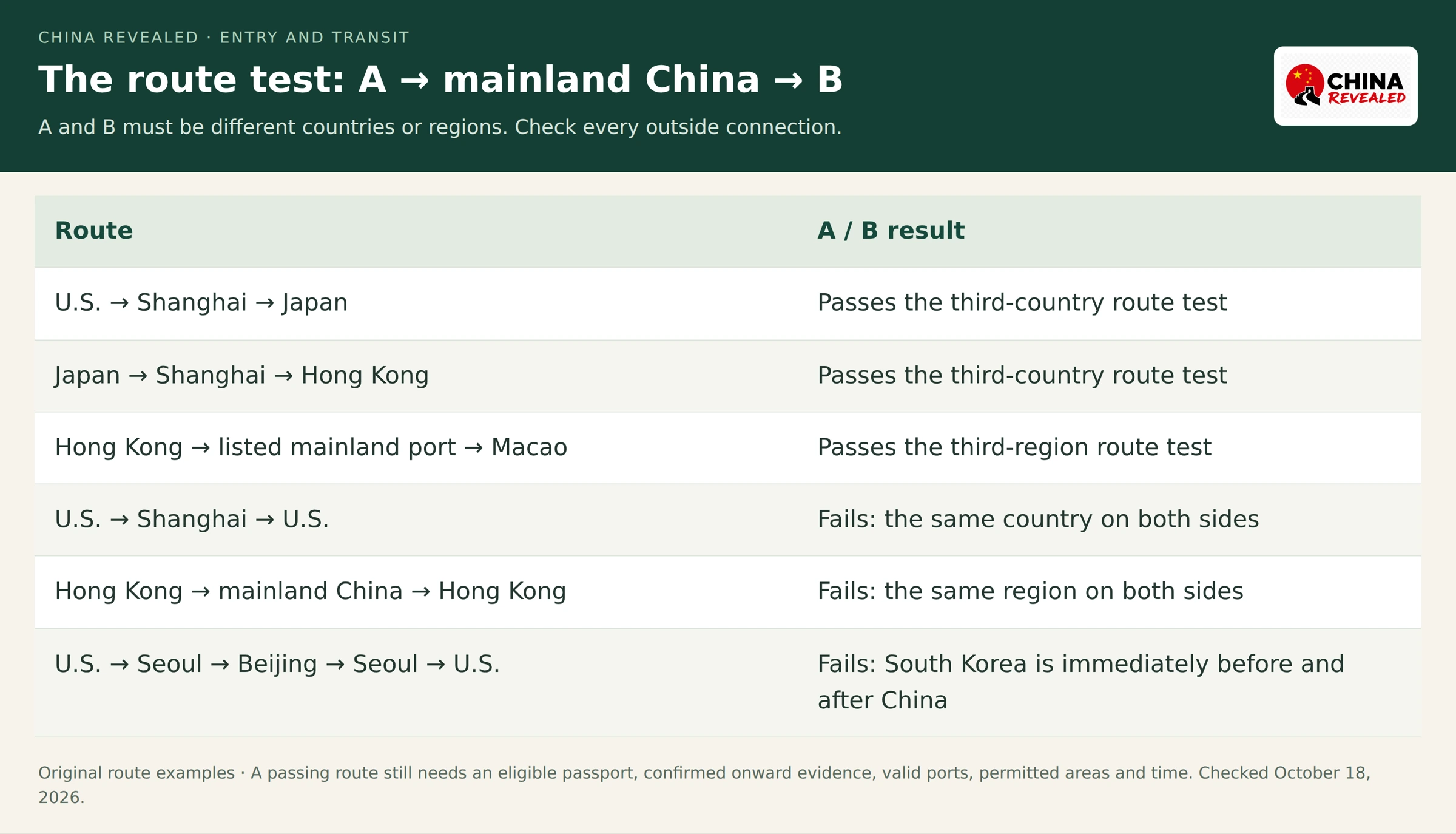
A passing row answers the route question. The passport, documents, ports, activity areas and time limit still have to fit. A flight confirmation is not a substitute for those checks.
The connecting-flight trap
Suppose the booking says Hong Kong → Guangzhou → Canada, but the Guangzhou-to-Canada flight connects in Hong Kong. The actual sequence around mainland China is Hong Kong → mainland China → Hong Kong. Canada being the final destination does not repair that immediate return to Hong Kong.
The same issue occurs with flights through a hub such as Seoul or Dubai on both sides of the China visit. Read every sector, including a short airside connection; do not judge the route only by the holiday’s start and finish.
On the other hand, New York → Seoul → Beijing → Tokyo → New York has South Korea before mainland China and Japan after it. The China transit segment can pass the A/B test even though the larger holiday starts and ends in New York.
Domestic travel does not reset the stay
Beijing → Xi’an → Shanghai remains one mainland-China stay. The train to Xi’an and the domestic flight to Shanghai do not grant a new 240 hours. They also do not change B: B is the country or region reached after finally leaving mainland China.
If the journey involves leaving China and returning later, treat the later entry as a new eligibility check—not as a promised way to extend the first stay.
3. The 57 eligible nationalities and passport rules
The current list is based on nationality shown by a qualifying ordinary passport, not where someone lives. A residence permit for Canada, the United States or an EU country does not turn an unlisted nationality into a listed one.
Europe: 40
Albania, Austria, Belarus, Belgium, Bosnia and Herzegovina, Bulgaria, Croatia, Cyprus, Czech Republic, Denmark, Estonia, Finland, France, Germany, Greece, Hungary, Iceland, Ireland, Italy, Latvia, Lithuania, Luxembourg, Malta, Monaco, Montenegro, the Netherlands, North Macedonia, Norway, Poland, Portugal, Romania, Russia, Serbia, Slovakia, Slovenia, Spain, Sweden, Switzerland, Ukraine and the United Kingdom.
Americas: 6
Argentina, Brazil, Canada, Chile, Mexico and the United States.
Oceania: 2
Australia and New Zealand.
Asia: 9
Brunei, Indonesia, Japan, Kyrgyzstan, Qatar, Singapore, South Korea, the United Arab Emirates and Vietnam.
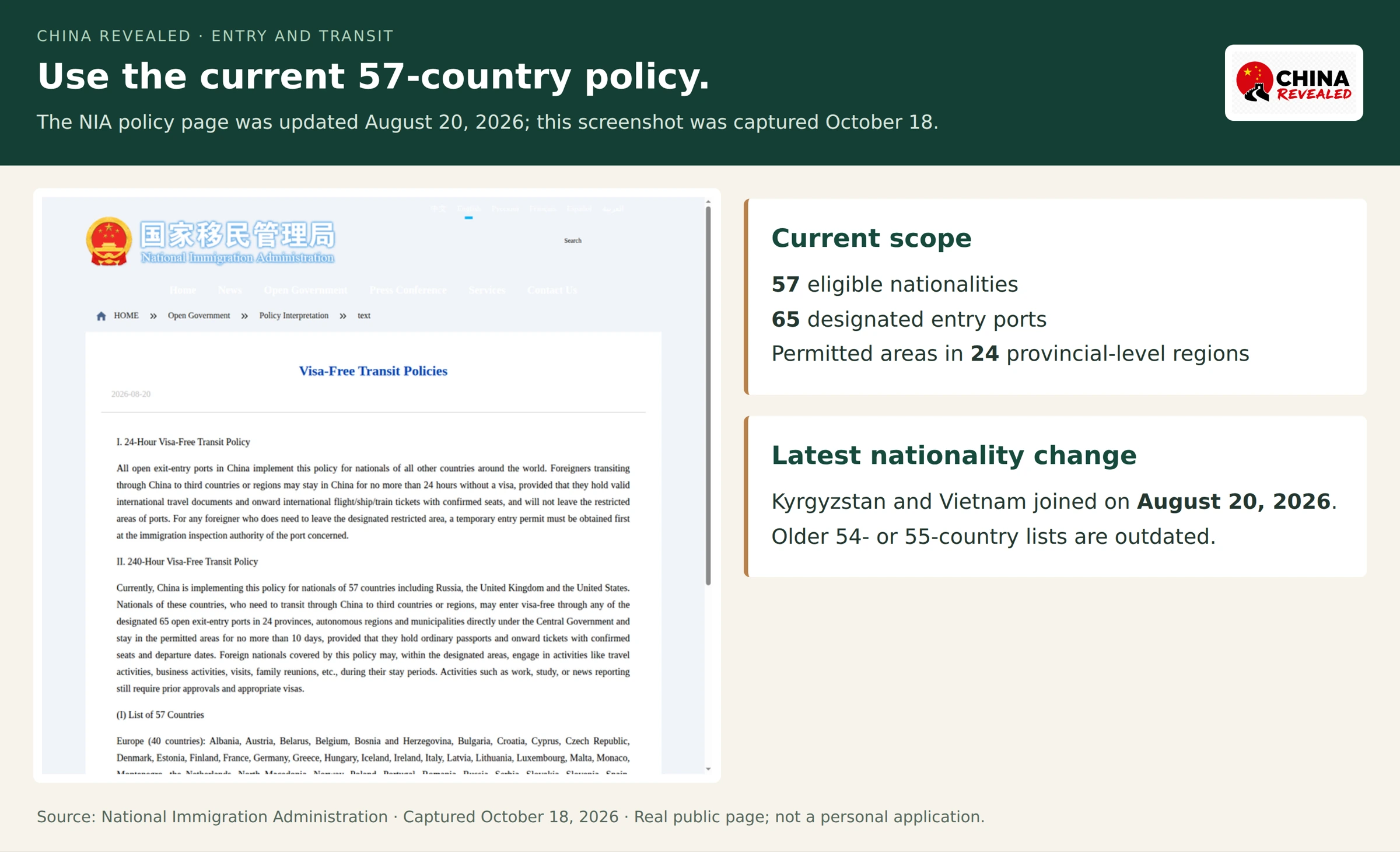
The NIA’s current visa-free transit page is the official place to recheck the nationality and port lists before booking. The Chinese policy page includes the full port and activity-area table.
Passport validity and the onward destination
NIA’s published requirement is at least three months of passport validity remaining. Do not replace it with an invented universal six-month rule—but do check whether the onward destination or carrier requires longer. The passport must also meet that destination’s entry conditions.
The 57-country policy specifies ordinary passports. An emergency travel document, official passport or another special document should not be assumed to qualify simply because its issuing country is on the list.
Each traveler needs their own qualifying documents, including children. A child’s nationality and passport cannot be covered by a parent’s eligibility. Keep every traveler’s name consistent across passport and onward booking.
4. How the 240-hour clock works
The calculation starts at 00:00 on the day after entry, in China’s local time. It does not start when the inbound flight takes off, and a domestic transfer does not restart it.
Here is a concrete example:
| Event | Date and time in China |
|---|---|
| Entry into mainland China | November 5, 2026, at 2 p.m. |
| The 240-hour calculation starts | November 6, 2026, at 00:00 |
| The ten counted days | November 6–15, 2026 |
| 240 hours expires | November 16, 2026, at 00:00 |
| Easy way to read the last full day | Leave before November 15 ends—not during November 16. |
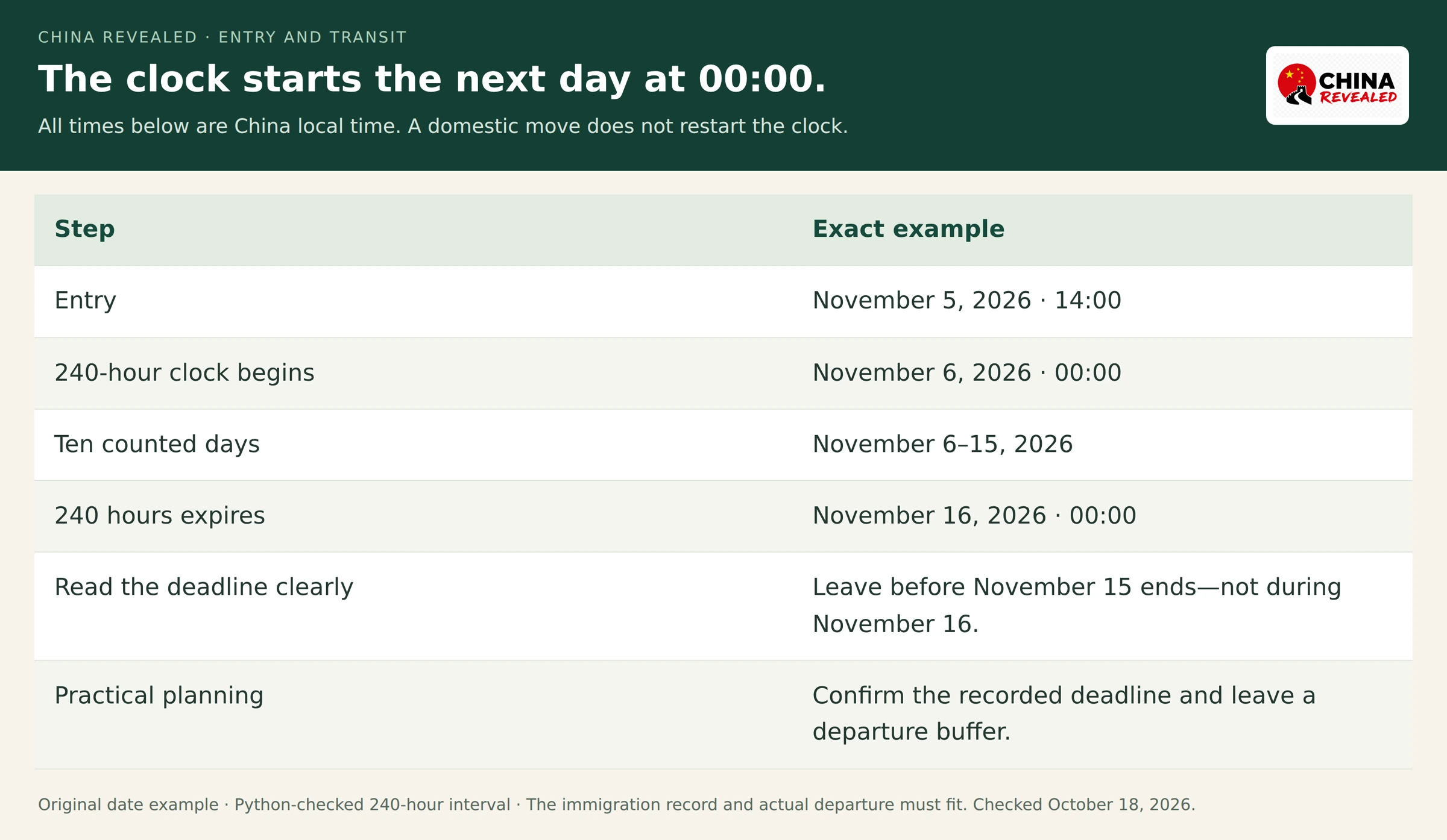
The arrival-day hours sit before the ten counted days, but do not design a trip around extracting every last hour. Choose an onward departure with room for check-in, border inspection and disruption. Being at the airport before midnight is not the same as having completed departure within the permitted stay.
Before leaving the immigration counter, check the last permitted date shown or communicated in the temporary-entry record. If it does not match the itinerary, ask there and then. Do not leave that question for hotel reception or the final airport queue.
For a first visit, seven to nine calendar days is easy to organize with a useful buffer. A ten-day sightseeing plan can also work, but its actual flight dates must be checked against the admission date and permitted deadline—not against a tour’s label saying “10 days.”
5. Where travel is allowed
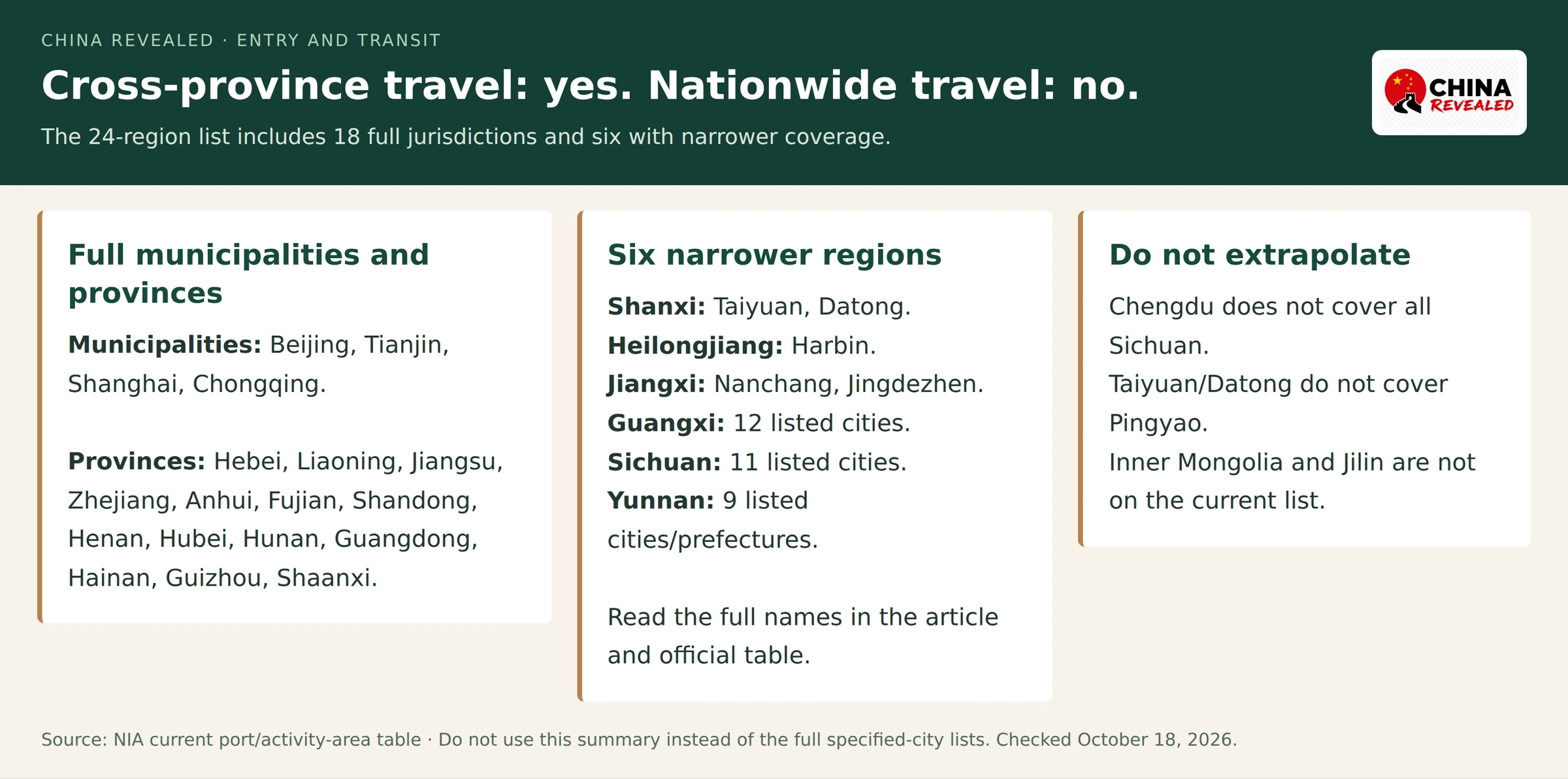
The policy permits travel across the allowed areas in 24 provincial-level regions. It is no longer a rule that confines a visitor to the single city of arrival. It is also not permission to travel everywhere in China.
Full-province or full-municipality coverage
The four municipalities are Beijing, Tianjin, Shanghai and Chongqing.
Full-province coverage applies to Hebei, Liaoning, Jiangsu, Zhejiang, Anhui, Fujian, Shandong, Henan, Hubei, Hunan, Guangdong, Hainan, Guizhou and Shaanxi.
That makes familiar combinations such as Shanghai–Hangzhou–Suzhou, Beijing–Xi’an–Shanghai, and a visit to Zhangjiajie in Hunan possible within the same transit stay. The actual route between stops must also remain within permitted areas.
Six regions have narrower coverage
| Region | Permitted areas under this policy |
|---|---|
| Shanxi | Taiyuan and Datong only. |
| Heilongjiang | Harbin only. |
| Jiangxi | Nanchang and Jingdezhen only. |
| Guangxi | Nanning, Liuzhou, Guilin, Wuzhou, Beihai, Fangchenggang, Qinzhou, Guigang, Yulin, Hezhou, Hechi and Laibin. |
| Sichuan | Chengdu, Zigong, Luzhou, Deyang, Suining, Neijiang, Leshan, Yibin, Ya’an, Meishan and Ziyang. |
| Yunnan | Kunming, Yuxi, Chuxiong, Honghe, Wenshan, Pu’er, Xishuangbanna, Dali and Lijiang. |
Shaanxi, where Xi’an is located, and Shanxi, which includes Taiyuan and Datong, are different provinces. Do not confuse the similar English spellings.
In Yunnan, several listed areas are autonomous prefectures rather than single city centers. Use the administrative area in the official table, not a guess based on a hotel marketing label.
The sightseeing mistake to avoid
Chengdu being allowed does not make all of Sichuan available. Jiuzhaigou is outside the listed Sichuan activity areas. A panda-and-teahouse visit in Chengdu and a trip to Leshan fit a different geographic situation from a northern-Sichuan mountain itinerary.
Likewise, Taiyuan and Datong are allowed, but Pingyao is not under this Shanxi list. Harbin being included does not extend the permission to all of Heilongjiang. Inner Mongolia and Jilin are not on the current 24-region list.
A domestic ticket or a tour booking cannot expand the legal activity area. If a journey goes through a restricted or unlisted area, choose a different route or use an entry basis that permits the intended trip. Do not assume a train corridor is permitted merely because both endpoint cities are.
6. Airports, railway ports and the Guangdong exit exception
Useful gateways for a first visit
Entry must be through a port in the current 65-port list. “International airport” by itself is not the eligibility test. These are selected common gateways—not the complete list:
| Destination or region | Examples of designated entry gateways |
|---|---|
| Beijing | Beijing Capital (PEK); Beijing Daxing (PKX). |
| Shanghai | Shanghai Pudong (PVG); Shanghai Hongqiao (SHA). |
| Guangzhou and Shenzhen | Guangzhou Baiyun (CAN); Shenzhen Bao’an (SZX). |
| Xi’an | Xi’an Xianyang (XIY). |
| Chengdu | Chengdu Tianfu (TFU); Chengdu Shuangliu (CTU). |
| Hangzhou and Nanjing | Hangzhou Xiaoshan (HGH); Nanjing Lukou (NKG). |
| Guilin and Zhangjiajie | Guilin Liangjiang (KWL); Zhangjiajie Hehua (DYG). |
| Chongqing and Kunming | Chongqing Jiangbei (CKG); Kunming Changshui (KMG). |
| Hong Kong high-speed rail into mainland China | Guangzhou–Shenzhen–Hong Kong Express Rail West Kowloon Station port. |
| Macao–Zhuhai crossings | Hengqin port; the Hong Kong–Zhuhai–Macao Bridge Zhuhai highway port. |
A listed airport still needs a usable international or regional service for the planned journey. Hongqiao is not interchangeable with Pudong, and a domestic flight into Chengdu does not by itself constitute entry at the Chengdu immigration port: the first mainland entry already happened elsewhere.
Must entry and exit use the same airport?
No. A traveler can enter through Beijing and leave through Shanghai, or use another valid combination. For exits outside Guangdong, plan around the listed ports rather than extrapolating a nationwide “any open port” rule.
Different transport modes can also be planned: the current list includes airports, passenger ports, railway ports and road crossings. That does not make every ferry terminal or land crossing an eligible entry point. Keep the actual onward departure and evidence clear, particularly for rail-and-road combinations.
Guangdong: wider exits, specifically listed entries
The official table permits departure from all ports in Guangdong that are open to foreign travel. This broader exit rule is why entering at a listed port and leaving through another open Guangdong crossing can be possible.
It does not mean Guangdong has the same broad rule for entry. The distinctions around Hong Kong and Macao are important:
| Crossing | Listed for 240-hour entry? | Practical distinction |
|---|---|---|
| West Kowloon high-speed rail port | Yes | Apply for the mainland temporary-entry formalities there; reserve time before the train. |
| Hengqin | Yes | A specifically listed mainland entry port from Macao. |
| Hong Kong–Zhuhai–Macao Bridge Zhuhai highway port | Yes | A specifically listed entry port; check the actual crossing and onward arrangement. |
| Luohu, Futian and Gongbei | No | Do not use them as entry points under this policy. As Guangdong ports, exits fall under the broader rule when open and accepting the planned journey. |
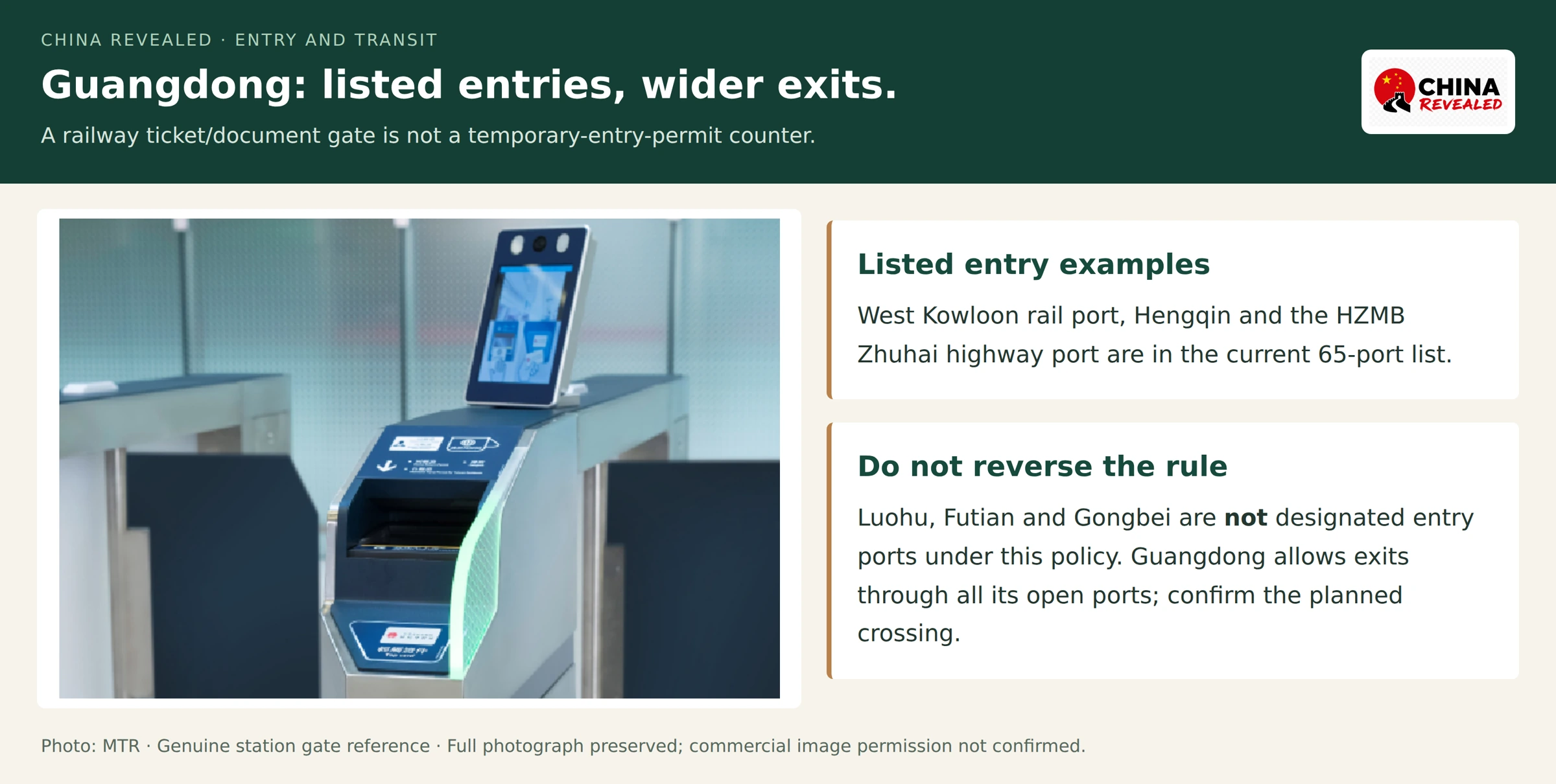
For example, Hong Kong → West Kowloon → Guangzhou/Zhuhai → Macao has two different regions around mainland China and uses a listed entry port. Keep confirmed onward-travel evidence and the documents required to enter Macao. Do not turn it into a “go to Shenzhen and return to Hong Kong” itinerary: that would fail the A/B test.
West Kowloon’s ticket/passport gates do not issue immigration permission. Hong Kong and mainland border formalities are part of the station journey; follow the temporary-entry directions and allow time for the extra document check. See the Hong Kong and Macao to mainland China border guide for the station and crossing basics.
7. Tickets and documents to prepare before boarding
Do this before booking nonrefundable hotels or domestic transport. Save a readable document folder on the phone, with a printed backup of the onward itinerary.
The useful set is:
- Original ordinary passport meeting the nationality and validity requirements.
- Confirmed onward booking showing the traveler’s name, date, route and confirmed seat or booking status, leaving within the permitted stay. An unpaid reservation or a payment screenshot without an issued itinerary is weak evidence.
- The complete international routing, including connections on both sides of mainland China. Include domestic sectors if they explain the planned visit and departure port.
- Proof of eligibility to enter B, including its visa when required. China’s transit exemption does not waive Japan’s, Korea’s or another destination’s rules.
- The first accommodation’s full address and contact details, plus the short China itinerary.
- The Arrival Card filing, if completed online. If not, use the official on-arrival options.
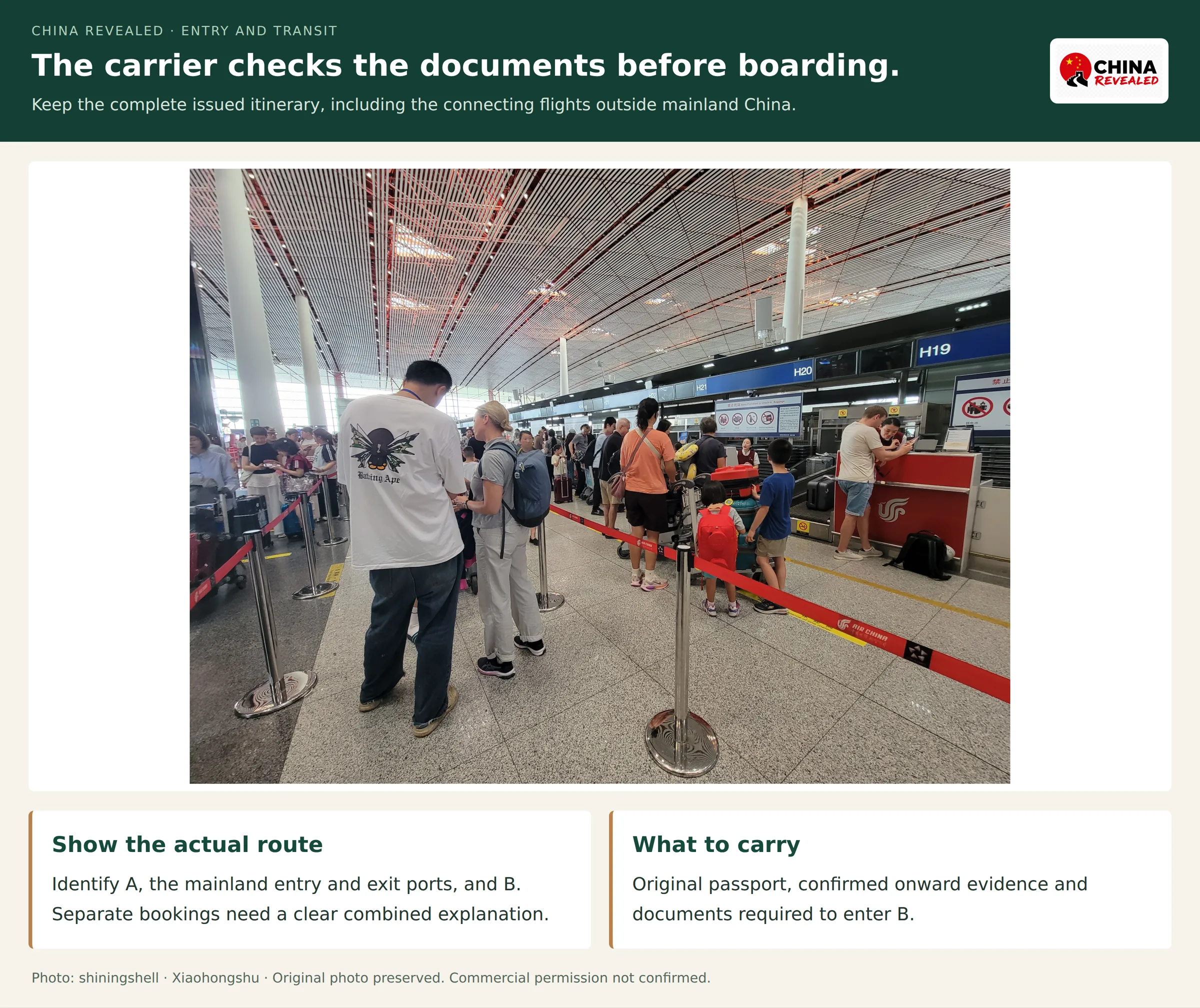
Separate bookings and different airlines
NIA’s conditions refer to a confirmed interline/onward ticket or other relevant proof. They do not expressly impose one airline or one booking reference, but this is not a promise that any two separate tickets will work.
A coherent through-booking is easier to explain. With separate bookings, ask the first carrier to review the complete A → China → B itinerary before travel. Send both issued itineraries, identify the China entry and exit ports, and mention the 240-hour policy. Check baggage collection and self-transfer time separately; visa eligibility does not protect a missed connection.
Do not rely on a flight listing, a standby seat, or an intention to buy the onward ticket after arrival. The outbound journey is part of the entry case, not an optional task for later.
What to say at check-in
“I plan to use China’s 240-hour visa-free transit. Here is my confirmed itinerary from A through China to B, and my onward entry documents.”
Have the carrier check the relevant current rule if staff are unfamiliar with it. An airline does the document check for boarding; Chinese border inspection makes the temporary-entry decision after arrival. For past illegal entry/exit, overstay or illegal employment in China within the preceding five years, check the official eligibility rules before committing to the journey.
8. The Arrival Card and the actual arrival procedure
Complete the official Arrival Card—not a paid “transit approval”
China’s online Arrival Card has been available since November 20, 2025. Use the official NIA Arrival Card service, the NIA 12367 app or the official WeChat/Alipay mini-programs.
On the current English website, an ordinary foreign visitor selects Entry Declaration. The separate Entry Declaration for Border Area Residents is for holders of the specified border-resident certificates, not a shortcut for an ordinary tourist passport.
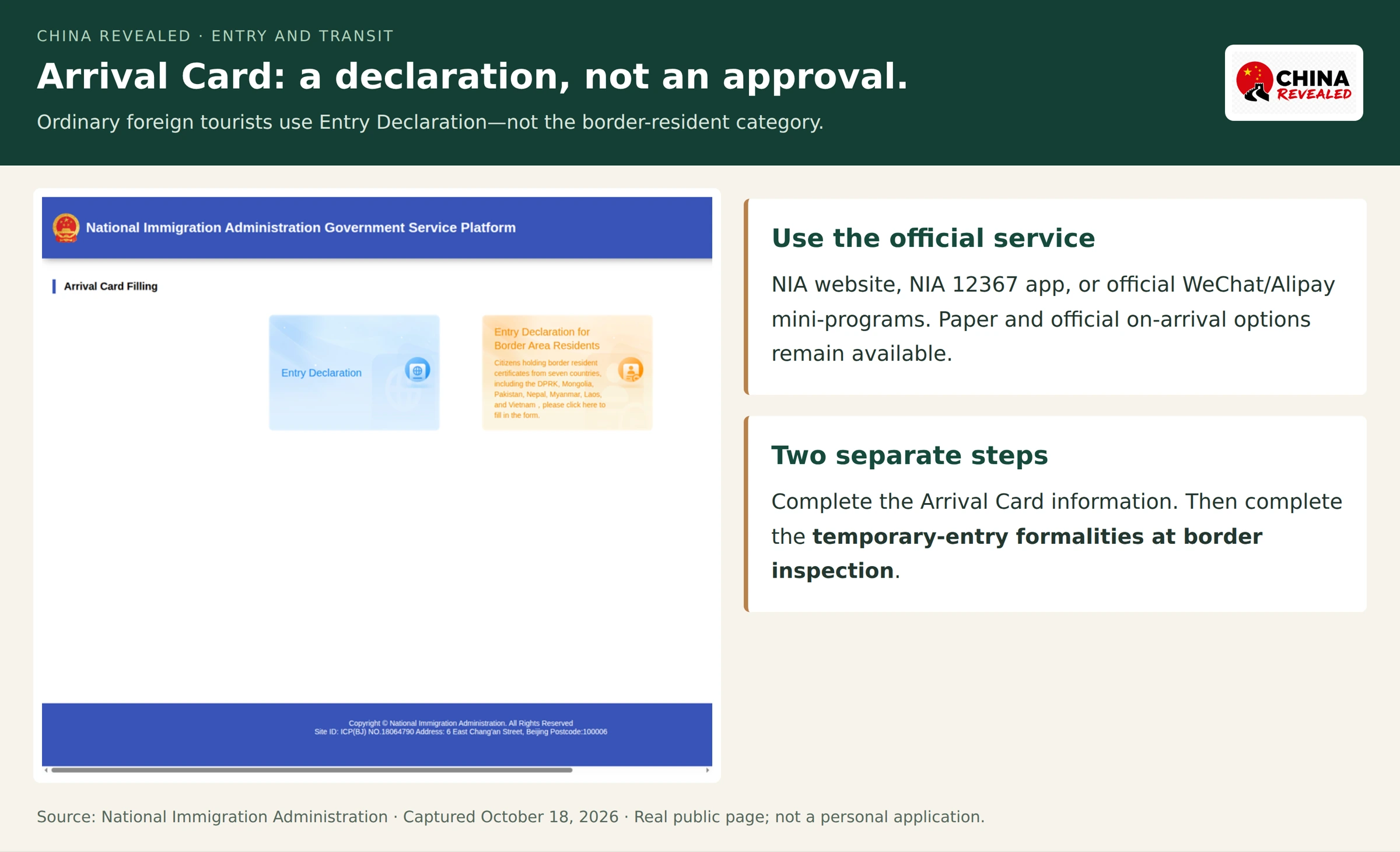
Fill the actual passport, arrival and accommodation details. The online form is an entry-information declaration, not an eVisa, a temporary-entry permit or advance approval of the 240-hour trip. The official form is free of charge; paid imitation websites do not create immigration permission.
If it was not completed online, the official arrangements include an on-arrival QR route, a port device or a paper card. A 240-hour visitor is not automatically exempt from the Arrival Card simply because no advance visa is needed. The separate exemption for direct 24-hour transit without leaving the restricted port area does not apply to an ordinary 240-hour sightseeing visit.
The practical sequence after landing
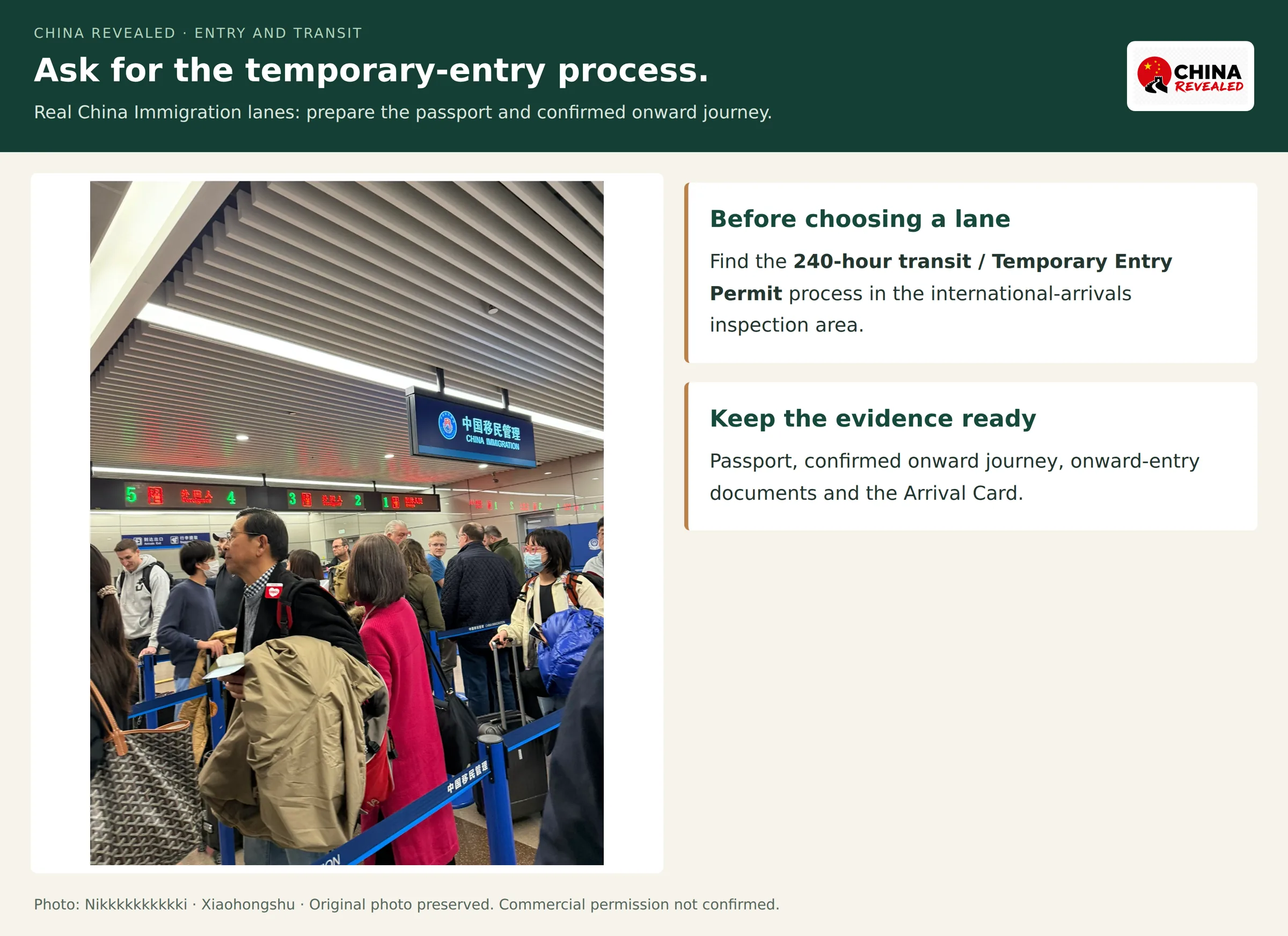
- Follow international-arrivals and immigration signs. Ask for the 240-hour transit or Temporary Entry Permit / 临时入境许可 process before joining a lane intended for another type of passenger.
- Show the passport and confirmed onward evidence. Complete the Arrival Card if necessary. Explain the China route, accommodation and onward destination clearly.
- Answer the border officer’s questions and complete temporary-entry formalities. The counter layout differs by port; some steps may be handled together rather than at two visibly separate desks.
- Check the permitted stay deadline. Resolve any date or route question before leaving the inspection area.
- Collect baggage as directed and complete customs. Then take the airport transfer to the actual hotel or private address.
At Beijing Capital, the airport’s published instructions identify temporary-entry-permit counters in the arrival inspection areas of Terminals 2 and 3. Follow the current terminal signs rather than looking for a city visa office after leaving the airport.
Keep the passport and the permitted-stay record available throughout the trip. Do not fill a Chinese visa number into a later form if no visa sticker was issued. Where a hotel or ticket system needs help interpreting the temporary-entry record, ask staff to check the actual document.
For airport transport, mobile setup and the first hotel arrival, use Your First Day in China. A payment app is useful once outside, but it does not replace the immigration documents at the counter.
9. Hotel check-in and private-stay registration
Visa-free transit still requires accommodation registration. Keep this separate from the Arrival Card and the temporary-entry permission.
At a properly operating hotel, bring the original passport for each foreign guest and have reception complete its foreign-guest reporting during check-in. The hotel handles that hotel stay; a second police-station registration by the guest is normally unnecessary.
At a friend’s home, a rental or other non-hotel accommodation, the guest or host must register the stay within 24 hours of checking in. A booking confirmation or an address entered on the Arrival Card is not that registration.
China expanded the national online non-hotel registration service on September 21, 2026. For a first stay at someone else’s home, ask the host to use the correct host-registration route. If the online route does not work, arrange registration with the responsible local police station rather than leaving the deadline to expire.
The accommodation registration guide explains the actual categories, electronic records and local-police fallback. It also matters on a short transit stay: ten days in China is not an exemption from registering a private address.
Book hotels, flights, train tickets, attractions and other travel services on Trip.com.
10. Practical trips that fit the policy
The best transit itinerary is one that leaves useful time for China rather than spending every day in an airport or railway station. For most first visits, one to three bases is enough. These are independent-travel frameworks, with transport days included.
A Shanghai base with Hangzhou and Suzhou: 5–8 days
This is the easiest choice for a traveler who wants less packing and fewer long transfers. Enter through Shanghai Pudong, keep several nights in Shanghai, then choose Hangzhou’s West Lake, Suzhou’s gardens or both. Shanghai, Zhejiang and Jiangsu have full-region coverage.
Return to the actual departure city before the final day if the international flight leaves early. A hotel near a metro line is more useful than a cheap room with a long taxi ride to every station. Check whether the departure is PVG or SHA; the two airports are not adjacent.
An example of the full international pattern is Japan → Shanghai and nearby cities → Singapore. The China visit can be the interesting middle of the journey without adding a domestic flight.
Beijing and Xi’an: 7–9 days
Choose this for imperial history, the Great Wall and the Terracotta Army. Give Beijing enough time for the Forbidden City and a separate full Great Wall day. Move to Xi’an by high-speed train on a transfer day, then leave room for the out-of-town Terracotta Army visit and the city itself.

The Great Wall is not an activity to squeeze between airport arrival and a same-evening flight. Likewise, the Terracotta Army is outside central Xi’an; keep it separate from the day of a major intercity move when possible.
Beijing and Shaanxi are within the permitted areas, but inspect the selected travel route too. The confirmed international departure may be from Xi’an if a suitable service exists, or from another designated gateway reached within the same permitted stay.
Beijing → Xi’an → Shanghai: a full 10-day framework
This is the classic history-to-modern-city combination, but it needs two sensible transfer days. A workable rhythm is:
- Days 1–3, Beijing: arrival and a gentle first evening, one central sightseeing day, then a separate Great Wall day.
- Day 4: high-speed train to Xi’an; a simple evening in the city rather than an ambitious museum schedule.
- Days 5–6, Xi’an: Terracotta Army on one day; the wall, neighborhoods and food on the other.
- Day 7: fly to Shanghai; settle in and take a relaxed evening walk if arrival time allows.
- Days 8–9, Shanghai: the Bund, a garden or museum, and neighborhoods, with no distant final-day excursion.
- Day 10: depart to B through the confirmed designated gateway.
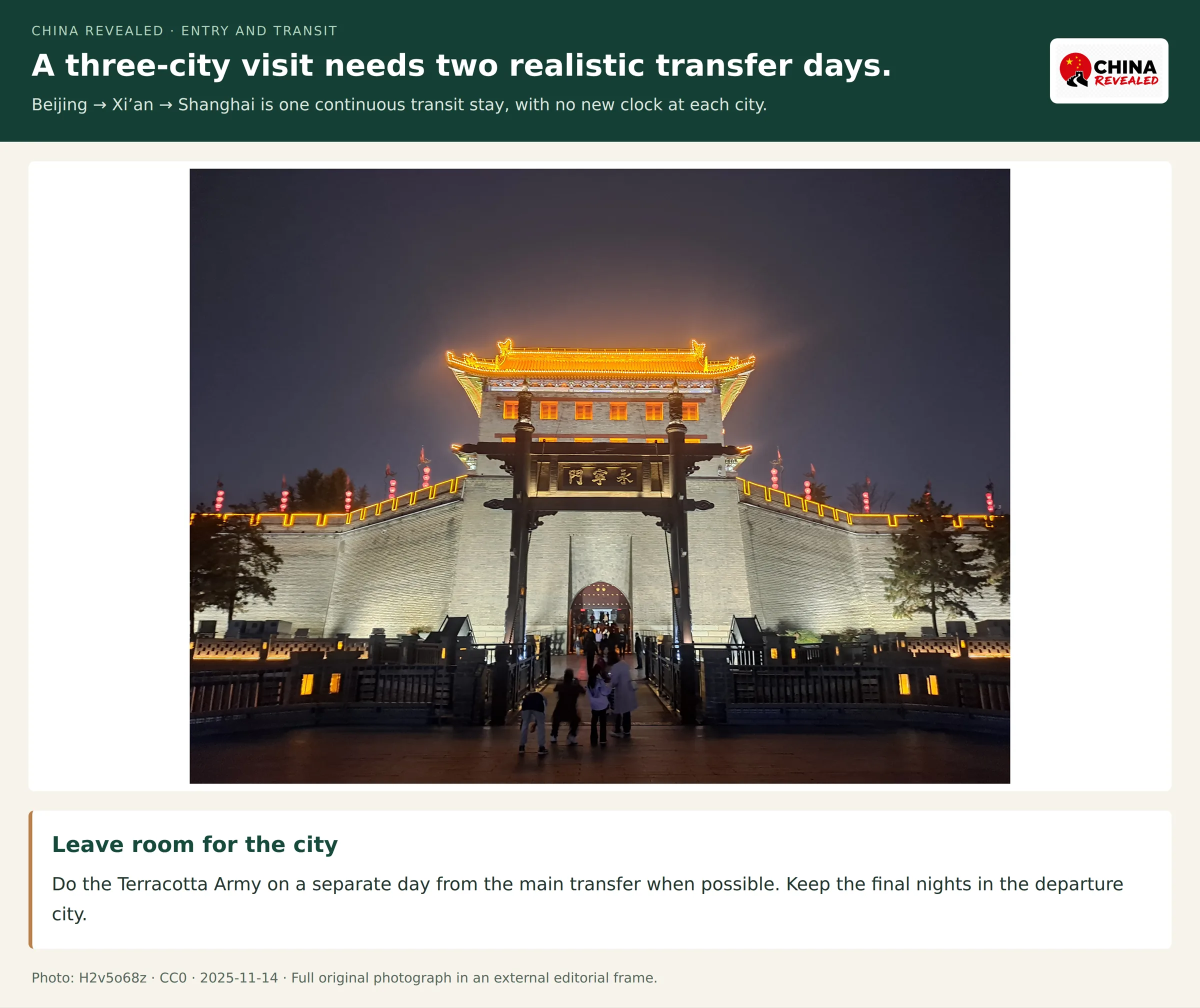
Enter through Beijing Capital or Daxing and leave through Shanghai Pudong or a suitable listed service at Hongqiao. Confirm the international A/B sequence and the exact deadline first. Do not add Chengdu, Yangshuo and Zhangjiajie to this route just because all sound appealing; the journey already uses much of the available time.
Use the high-speed train guide and domestic flight guide for the transport details. Transfer days include reaching the terminal, security, boarding and the trip to the next hotel—not only the advertised time on the train or plane.
For the Forbidden City and other busy attractions, use the actual passport details and date/time slot required by that venue. The attraction booking guide explains the official, app and supported English-platform routes. Transit permission does not reserve a museum ticket.
11. Flight changes, delays and the departure deadline
Before entering China
If the airline changes a sector, rerun the A/B test and the date calculation. A rebooking through the same outside hub on both sides can break an otherwise valid route. An onward departure moved beyond the allowed stay also needs attention before boarding.
Keep the revised issued itinerary, not only the original confirmation email. Make sure the airline is checking the route that will actually be flown.
After entering China
A cancelled flight does not automatically add days to the temporary-entry permission. Keep the cancellation notice and rebooking evidence, contact 12367, and approach the local public-security Exit-Entry Administration / 公安机关出入境管理部门 before the permitted stay expires.
For force majeure or another urgent justified reason requiring extra time or travel outside the permitted area, the official route is to apply in advance for the appropriate stay document. Do not wait until the last airport queue, assume the airline has updated immigration records, or treat a new hotel night as an extension.
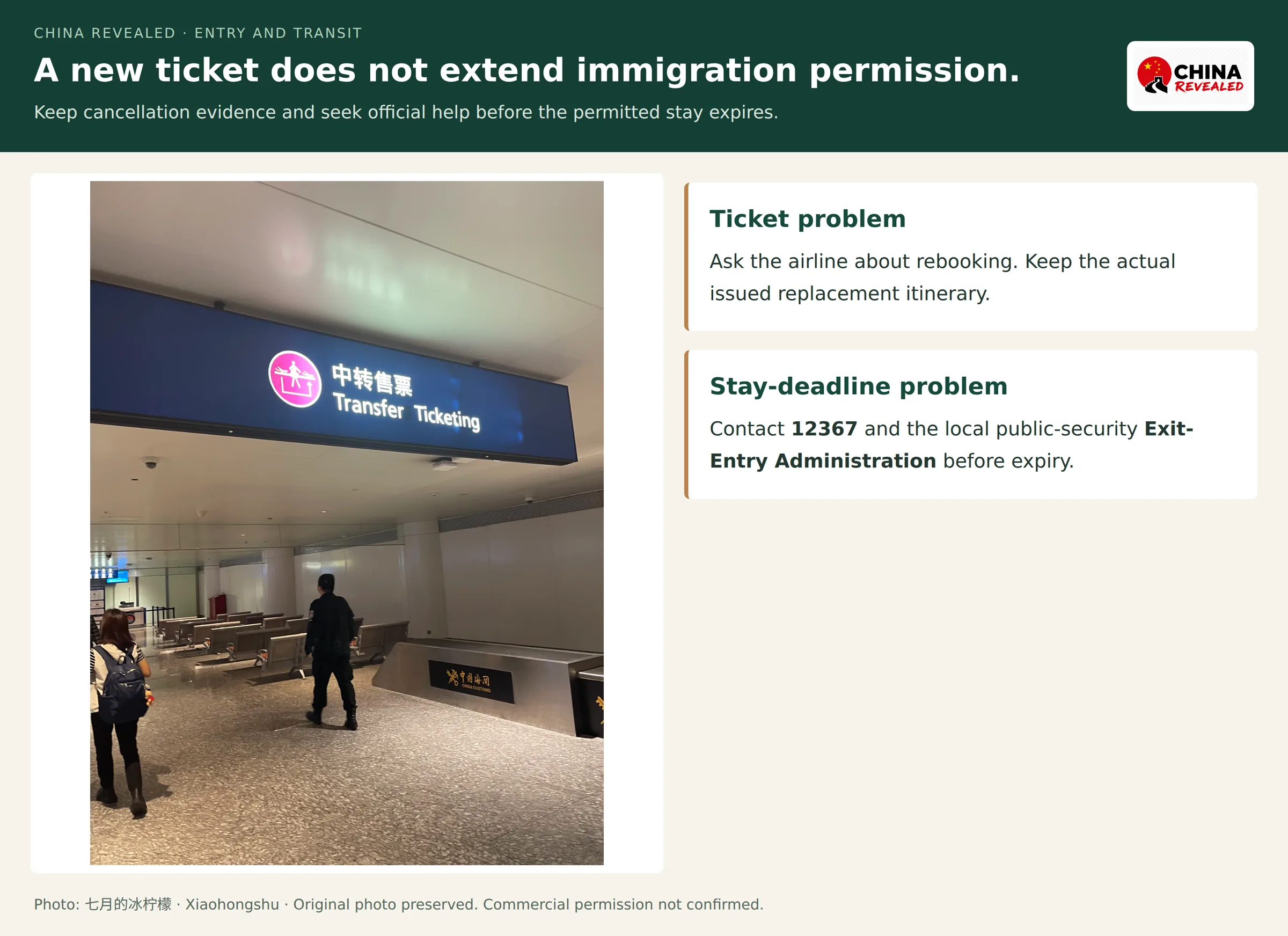
A transfer-ticketing desk helps with the ticket. The immigration issue belongs to border inspection or the relevant exit-entry authority. Ask each to handle its own part and retain the records.
For the last night, stay in the departure city and check the actual airport, terminal and reporting time. If leaving through a land or rail port, confirm that crossing’s operating arrangements and allow time for the required border formalities. The end of a holiday is a poor time to discover that the booked exit was the wrong port.
12. Useful Chinese and common questions
Show these short requests at the right place
At airline check-in or immigration:
我计划使用240小时过境免签。这是我的护照和前往第三国或地区的已确认行程。
I plan to use 240-hour visa-free transit. Here are my passport and confirmed onward itinerary to a third country or region.
To find the temporary-entry process:
请问,240小时过境免签的临时入境许可在哪里办理?
Where do I complete the temporary-entry formalities for 240-hour visa-free transit?
To confirm the deadline:
请问我最晚必须在哪一天、几点之前离境?
By which date and time must I leave China?
If the onward flight is cancelled:
我的离境航班取消了。我需要在停留期限到期前联系出入境管理部门办理相关手续。
My outbound flight was cancelled. I need to contact Exit-Entry Administration about the required formalities before my permitted stay expires.
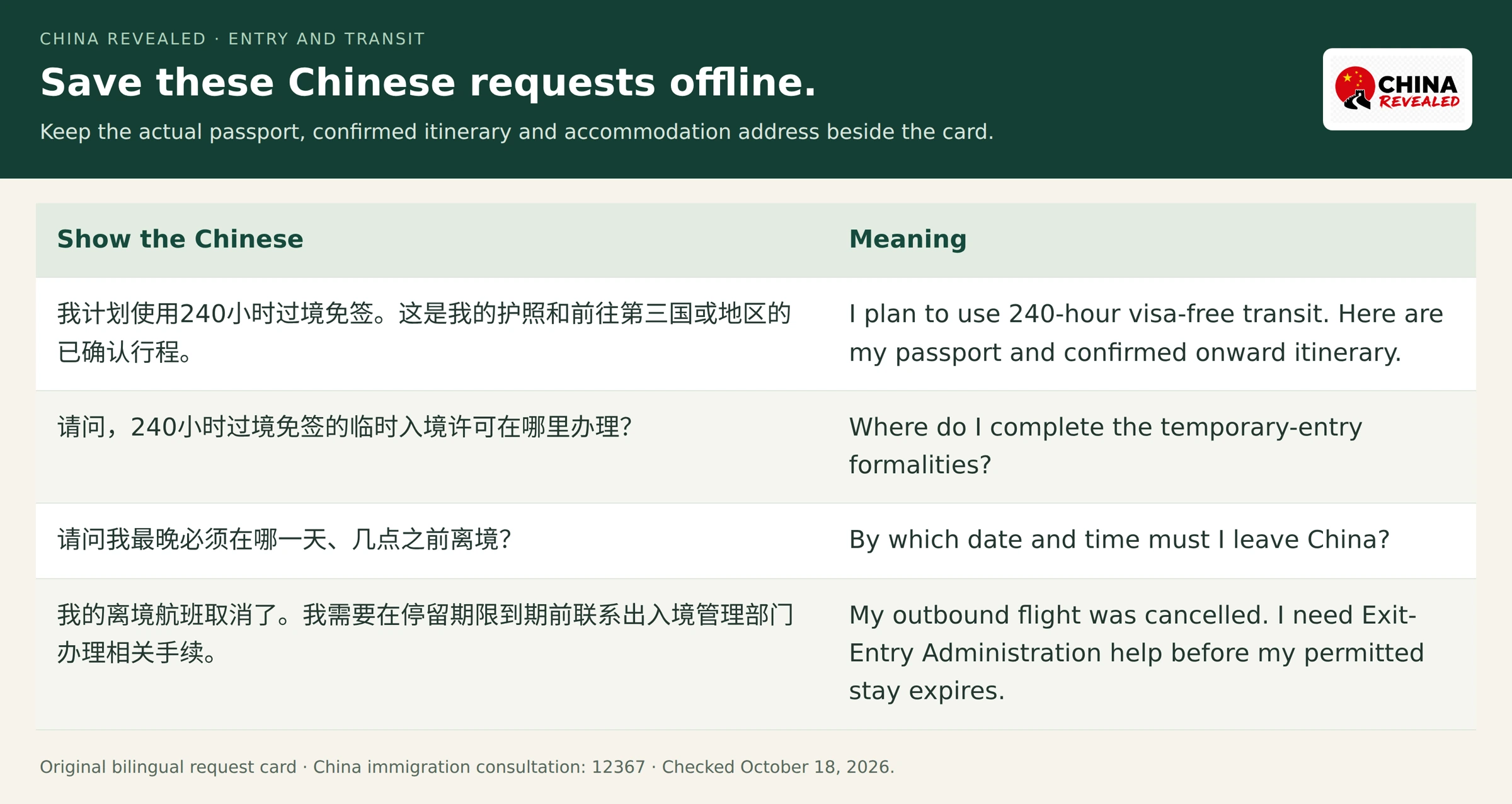
Keep the actual itinerary and accommodation address next to these phrases. The translation apps guide can help with a conversation, but the facts supplied to the carrier or border officer must match the real booking.
Is 240-hour transit the same as a Chinese tourist visa?
No. It waives the need to obtain a visa in advance for an eligible transit journey and provides temporary entry after inspection. It has its own nationality, route, area and time limits.
Can a U.S. citizen use it?
Yes, U.S. nationality is on the current list. An ordinary passport, the onward route and all the other conditions still need to fit. A U.S. green card is not a substitute for an eligible nationality.
Can the trip begin and end in my home country?
The larger holiday can, but the immediate places around mainland China must differ. New York → Seoul → Beijing → Tokyo → New York has a different A/B situation from New York → Beijing → New York.
Can I go to Hong Kong after China?
Yes, Hong Kong can be B when it differs from A and the documents and exit fit. If Hong Kong was also A, a simple return there does not meet the third-region test.
Can I leave the airport and stay in a hotel?
Yes, after the temporary-entry formalities are completed. The 240-hour policy is not airport-only. Hotel or private accommodation registration remains necessary.
Must I leave through the airport where I arrived?
No. Different qualifying entry and exit ports can be used. Guangdong’s wider open-port exit rule is a specific exception; it is not a nationwide permission to enter or leave anywhere.
Can I travel between provinces?
Yes, within the permitted activity areas. Entire provinces are covered in some cases; only specified cities or prefectures are covered in others. Train and flight bookings do not expand those limits.
Do the old 72-hour and 144-hour guides still apply?
Those earlier stays were extended to 240 hours in December 2024. Their old country counts, port lists and city-only restrictions should not be used as the current planning rule.
Do I need an online approval before arrival?
There is no general online 240-hour transit pre-approval in the NIA process described here. The online Arrival Card is separate; temporary entry is handled at border inspection. Do not pay an imitation website for an “Arrival Card visa.”
Is onward travel allowed to be booked after arrival?
Not as a substitute for the required confirmed onward evidence. Have the issued onward itinerary ready for the carrier and border inspection before entering.
Is there a fixed limit on how often it can be used?
The published policy does not state a fixed annual quota. Every entry must independently qualify. Do not build a long stay around repeated short trips and assume fresh admission will be automatic.
What is the best way to make this trip straightforward?
Choose a clear A → mainland China → B journey, keep the China route modest, and carry the confirmed onward evidence in one easy-to-read folder. Use the official list for the passport and entry port, stay within the allowed areas, and leave a real departure buffer. Once those pieces fit, the visit can be planned as a normal short China holiday rather than an airport layover.
About China Revealed
China Revealed is an independent English-language travel guide dedicated to China.
We bring together China travel guides, destination information, local insights and practical travel resources in one place.
Our travel database covers China's provinces, cities, famous attractions, hidden gems, local cuisine, transportation, accommodation, visa requirements, digital payments, mobile connectivity and the other practical details travelers need to explore China.
We focus on depth, careful research and accuracy. Our guides combine official sources, detailed destination data, local knowledge and regularly updated information to give reliable, practical travel advice.
Whether you're visiting China for the first time or exploring beyond the popular destinations, China Revealed is an all-in-one resource for discovering the real China.
China Revealed — Your practical guide to China.
Some links on China Revealed, such as Trip.com booking links, are affiliate links. If you book through them, we may earn a commission at no extra cost to you. This does not change what we recommend.