

Toilets in China: Squat Toilets, Paper and Amap

Toilets in China are easier to deal with than their reputation suggests: better shopping malls, hotels and airports usually provide toilet paper, while a street-side public toilet may have a shared dispenser, a QR paper machine or no paper available. Carry a little backup paper, use Amap to find the next restroom, and choose a modern mall when you want a comfortable seated toilet.
You do not need a special toilet-survival kit or a sightseeing day built around bathroom anxiety. What helps is knowing where to look, where the paper is, and whether the cubicle has a squat pan or a seat. Those three checks solve most of the practical problems.
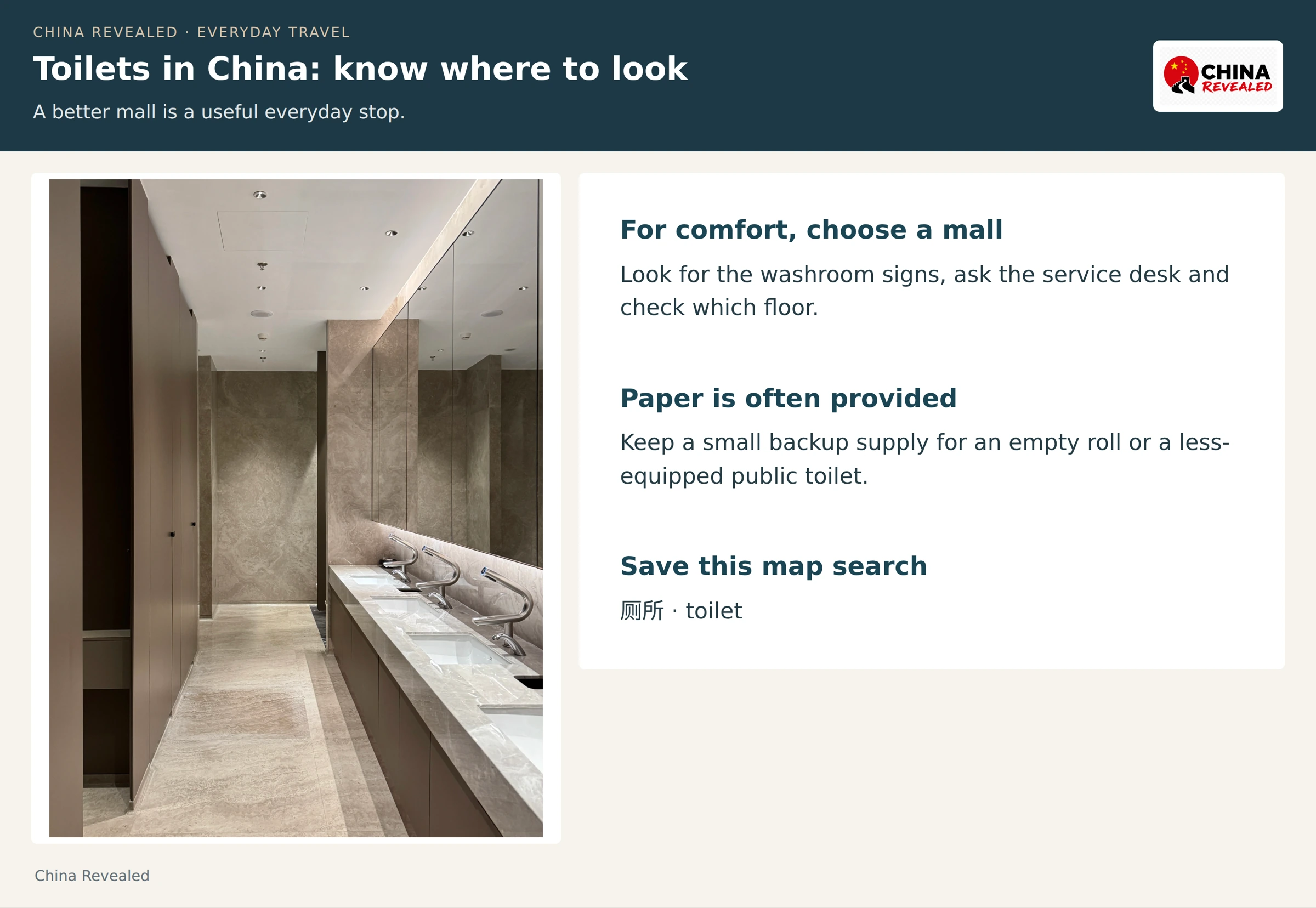
Quick takeaways
- Good malls are the easiest everyday option. Look for the restroom signs or ask the service desk; you can often combine the stop with food and an indoor break.
- Bring backup paper, not the assumption that China has none. Paper may be in the cubicle, near the entrance or dispensed by a machine.
- Search 厕所 in Amap. Open a result, check access, then choose Walking / 步行—not a driving route.
- Squat and seated toilets both exist. If you cannot squat comfortably, ask for 坐便器, a seated toilet, before the situation becomes urgent.
- Follow the local paper-disposal sign. Ordinary toilet paper, pocket tissues and wet wipes are different products; do not flush wipes or sanitary items.
In this guide
- Where to find a comfortable toilet
- How to find a toilet with Amap
- Toilet paper: supplied, shared or your own
- How QR paper dispensers work
- How to use a squat toilet
- Finding a seated toilet
- Children, older travelers and accessible toilets
- Small problems and easy alternatives
- Chinese phrases to save on your phone
- Frequently asked questions
- References
Where to find a comfortable toilet
For a city sightseeing day, I would choose a well-managed shopping mall before an older street-side toilet, especially if you want a seat, paper and a clean place to wash your hands. This is a practical way to choose a stop, not a reason to avoid public toilets altogether.
China has everything from excellent airport bathrooms to basic rural facilities. Even two toilets on the same street can feel quite different. The building, upkeep and current queue matter more than a sweeping rule about the whole country.
| Where you are | What to look for | A useful check |
|---|---|---|
| A modern shopping mall | Washroom signs, floor directory or service desk | Which floor, whether there is a seated cubicle, and closing time |
| An airport or major railway station | Restroom symbols along the concourse | Whether the toilet is on your side of security or the ticket gates |
| A museum, park or attraction | Site map, visitor center and signs | Whether the toilet is inside a ticketed area or farther along the route |
| A street or older neighborhood | 公共厕所 or 公厕 signs; Amap results | Actual entrance, paper supply and available cubicle type |
| A restaurant, café or hotel | Ask a member of staff | Whether visitors may use it; some small outlets have no customer toilet |
A mall restroom is often off a corridor near the lifts or at one end of a floor. If you can see the mall but not the restroom, ask “请问洗手间在哪一层?”—“Which floor is the restroom on?” Walking around the outside of the building will not help if the toilet is upstairs.
Restaurants and hotel lobbies can be useful alternatives, but ask rather than assume. A small takeaway shop may not have a customer bathroom at all. A hotel can direct non-guests to a public facility instead. If a café’s toilet is for customers, buy something or choose another location.
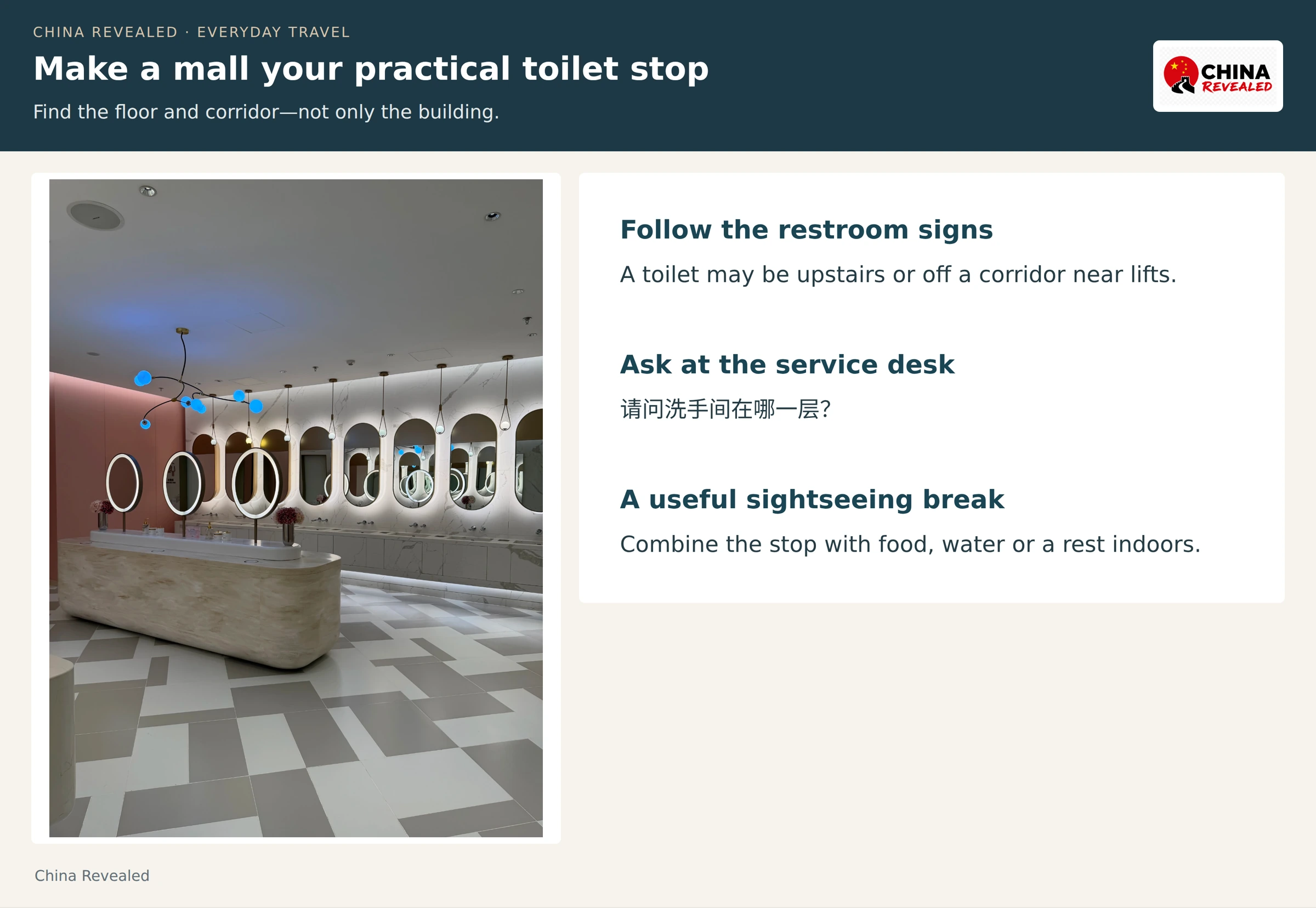
Recognize the signs
Look for WC, Toilet, Restroom, the familiar male/female symbols, or the Chinese words 厕所, 卫生间 and 洗手间. A street-side facility may say 公共厕所 or simply 公厕.
男 means male and 女 means female. Some buildings have shared sinks outside separate toilet areas, so follow the cubicle-area signs rather than guessing from who is standing at the washbasin. An accessible or family room may have its own entrance beside them.
Ordinary public toilets are usually free to enter. A charge for a packet of paper is not the same as an admission charge. If a particular site has a fee, it should be explained at the entrance; do not assume every QR code near a toilet is a payment for using it.
How to find a toilet with Amap
The most useful search is 厕所. Copy those two characters now and keep them in a phone note. Shenzhen’s municipal guidance specifically recommends searching this term in map apps including Amap to find nearby public toilets and navigation.
Amap’s overseas English version is helpful, but Chinese category searches are worth keeping even when the menus are in English. You can try toilet or restroom; if the results are sparse or irrelevant, paste 厕所 or 公共厕所 instead. For downloading the genuine app and changing its language, use our Amap guide for foreign visitors.
1. Check your starting location
If you are already on the street, allow location access while using Amap and check that the blue position marker makes sense. Underground or inside a large building, compare it with the station, road or entrance you can actually see.
If you are planning tomorrow’s outing from a hotel in another part of the city, do not search as though your current location were tomorrow’s destination. Search the planned neighborhood or landmark first, then look for toilets around it. In route planning you can also enter the intended starting point manually.
2. Search the keyword and open the list
Tap the search bar, paste 厕所, and run the search. 公共厕所 is a useful more specific alternative; 卫生间 and 公厕 are other terms to try.
Read the result names and addresses. A row of identical “Public Toilet” labels can still represent different buildings, streets and entrances. Do not choose solely by the nearest-looking pin.

3. Open a result and check the last few minutes
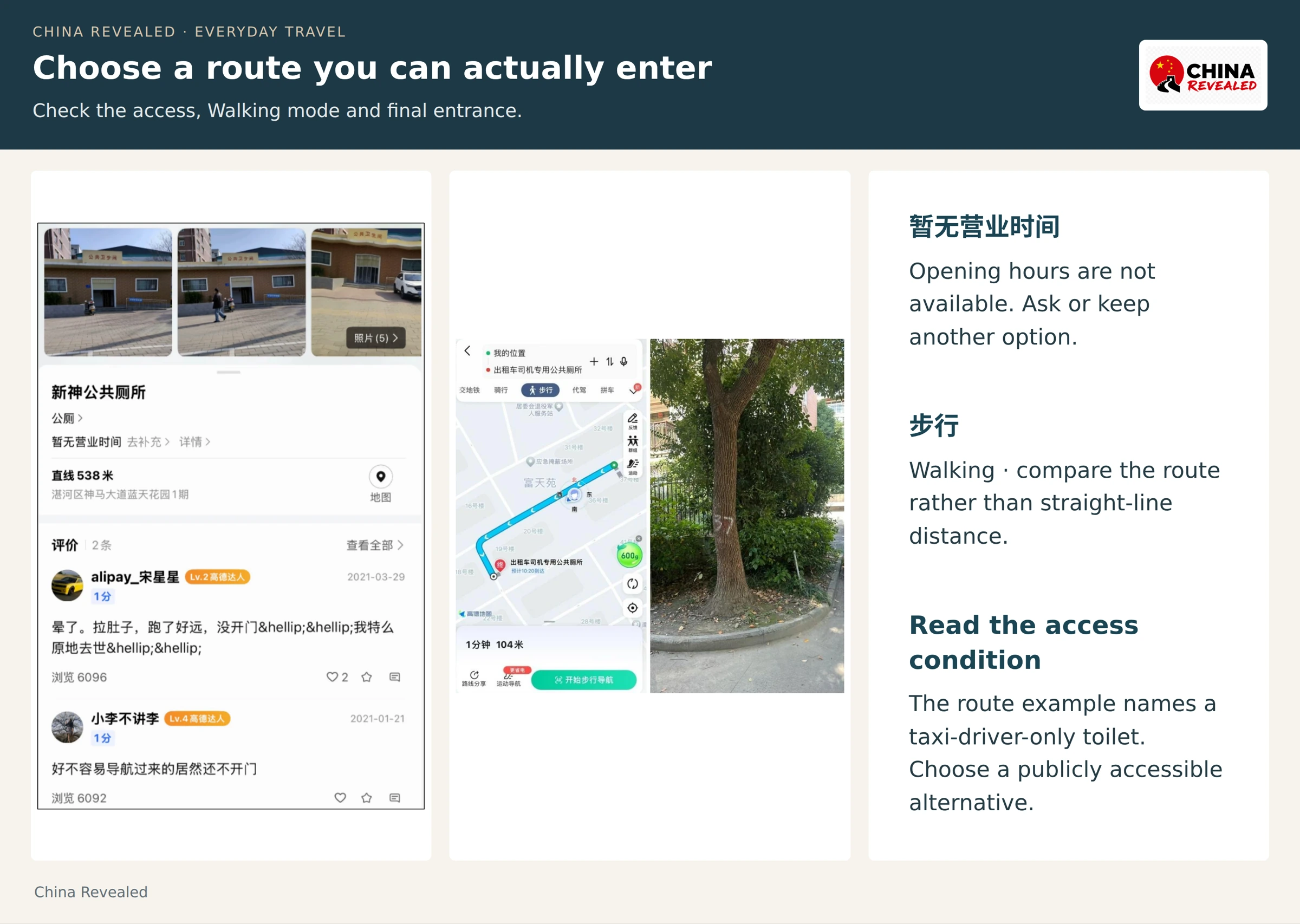
Look at the address, any available photos, opening information and access notes. A point inside a mall may need an upstairs walk. A point inside a railway station may be beyond security. A toilet behind a museum’s ticket gate is not an easy street-side stop if you do not have admission.
Photos can help you recognize the entrance or spot a seated fixture, but they do not tell you whether the cubicle is free or stocked with paper right now. If opening hours are missing, 暂无营业时间 means there is no opening-hours information in the listing—not that the toilet is definitely open all day.
Avoid results marked for staff, taxi drivers or other restricted users. A public-toilet keyword can still bring up a point with an access condition in its name. Pick a place you can actually enter.
4. Tap Route, then Walking
Open Route / 路线, check the starting point, and select Walking / 步行. Compare the walking time and route rather than a straight-line distance. A toilet across a main road, river or fenced compound can take longer to reach than the pin suggests.
Follow the walking route to the building, then use the venue signs for the final corridor or floor. Amap gets you close; a service desk or cleaner can often solve the last detail immediately.
5. Keep a second option
If the door is locked or the entrance is blocked, switch to another nearby result or a mall. Do not spend an urgent ten minutes trying to prove the map correct. For a planned walk, save one convenient toilet stop near lunch and another near the afternoon’s main attraction.
Toilet paper: supplied, shared or your own
“China has no toilet paper” is bad travel advice. Better malls often have ordinary rolls or dispensers, established hotels normally stock their bathrooms, and airports commonly provide paper. The problem is variation: a roll can run out, a street toilet can use a communal dispenser, and a machine can be out of service.
A Beijing newspaper investigation found ordinary free paper holders in several malls alongside more complicated QR dispensers at others. A Jiangmen government report described free paper boxes at public-toilet entrances. Both are good reminders to check outside the cubicle before deciding there is no paper.
Check before locking the cubicle
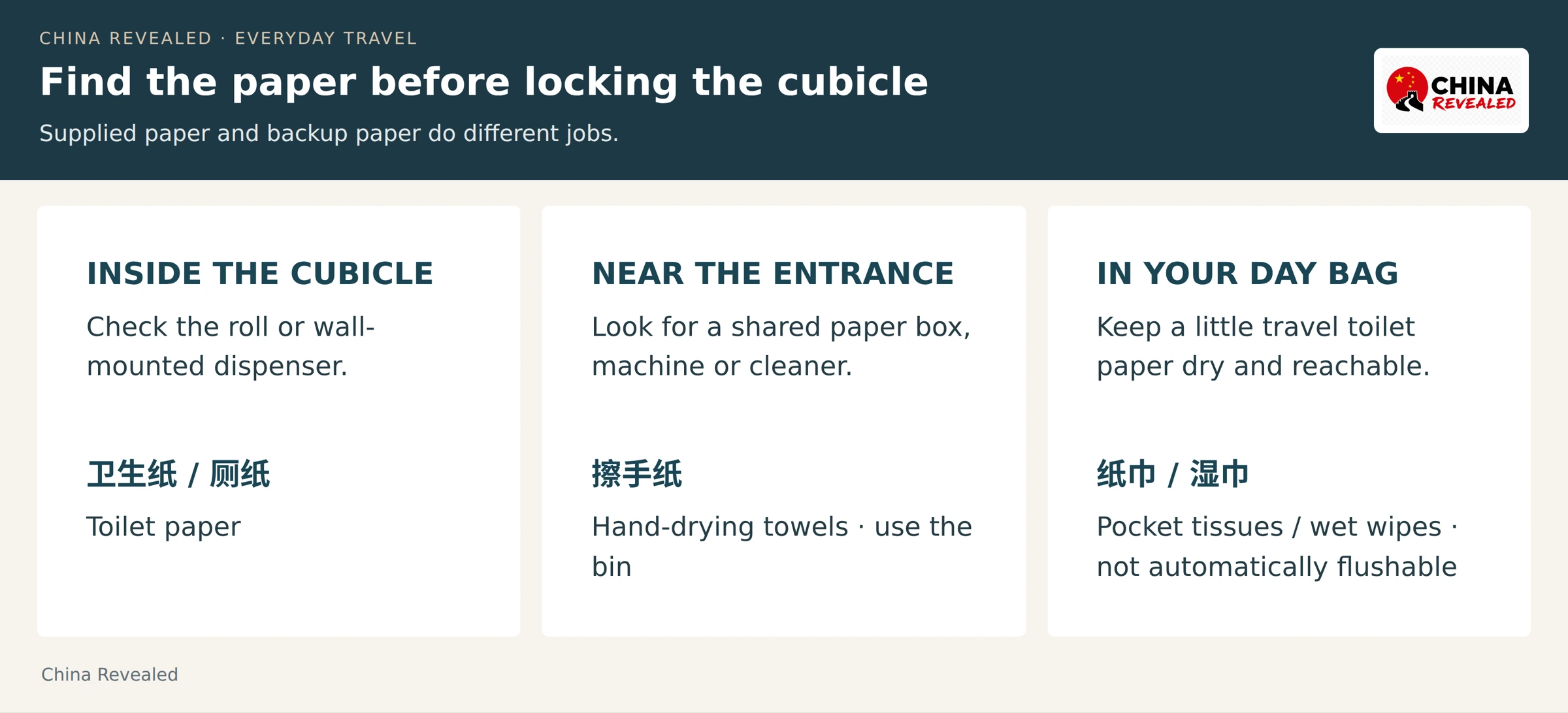
Look for the roll beside the seat or squat pan. If there is none, check the wall near the washbasins or entrance, or ask the cleaner. Some facilities expect you to take enough paper before entering the cubicle.
Do not confuse a large stack of 擦手纸—hand-drying towels—with toilet paper. It is there for your hands and should go in the waste bin. 卫生纸 or 厕纸 refers to toilet paper; 纸巾 is the broader word for tissues.
What I would carry
Put a small supply of travel toilet paper in a dry, reachable pocket of your day bag. A packet of pocket tissues is a useful emergency alternative, but it is not automatically flushable toilet paper. Keep a few wipes for other cleaning needs and a small bottle of hand sanitizer as backup when washing facilities are incomplete.
You can buy replacement paper in convenience stores and supermarkets. There is no need to carry a full household roll around the Forbidden City. Our China packing guide covers the rest of a sensible day bag.
Can you flush toilet paper in China?
There is no useful nationwide “always flush” or “never flush” rule. Ordinary toilet paper is designed to disperse, and modern plumbing may accept a modest amount. Older systems or a particular venue may ask you to use the paper bin instead. Chinese science guidance also distinguishes toilet paper from stronger tissues and other paper products.
Follow the sign beside the toilet. If it says 请将厕纸投入纸篓, put the paper in the bin. If you are unsure in an older facility, ask the attendant or use the provided paper bin. A bin beside a modern toilet can also be intended for sanitary waste, so its presence alone is not proof that every kind of toilet paper is forbidden in the bowl.
Keep wet wipes, sanitary pads, tampons, diapers and hand towels out of the toilet. For travel, I would bin moist toilet wipes too rather than assume that a “flushable” claim on a packet suits the local plumbing. Use the sanitary-waste container or appropriate bin provided.
For buying pads or tampons in China and the Chinese words on the packet, see our solo female travel guide.
How QR paper dispensers work
In some public toilets—and some malls—you will see 扫码取纸, “scan to get paper.” A nearby machine may offer free limited paper, an advertisement-supported free option, or a paid packet. Free paper and paper for sale can sit side by side.
This is not a national system with one app and one fixed process. Reporting from Beijing and Shanghai has documented different machines, advertising steps, paid shortcuts and equipment failures. Treat the machine’s current instructions as the instructions for that machine.
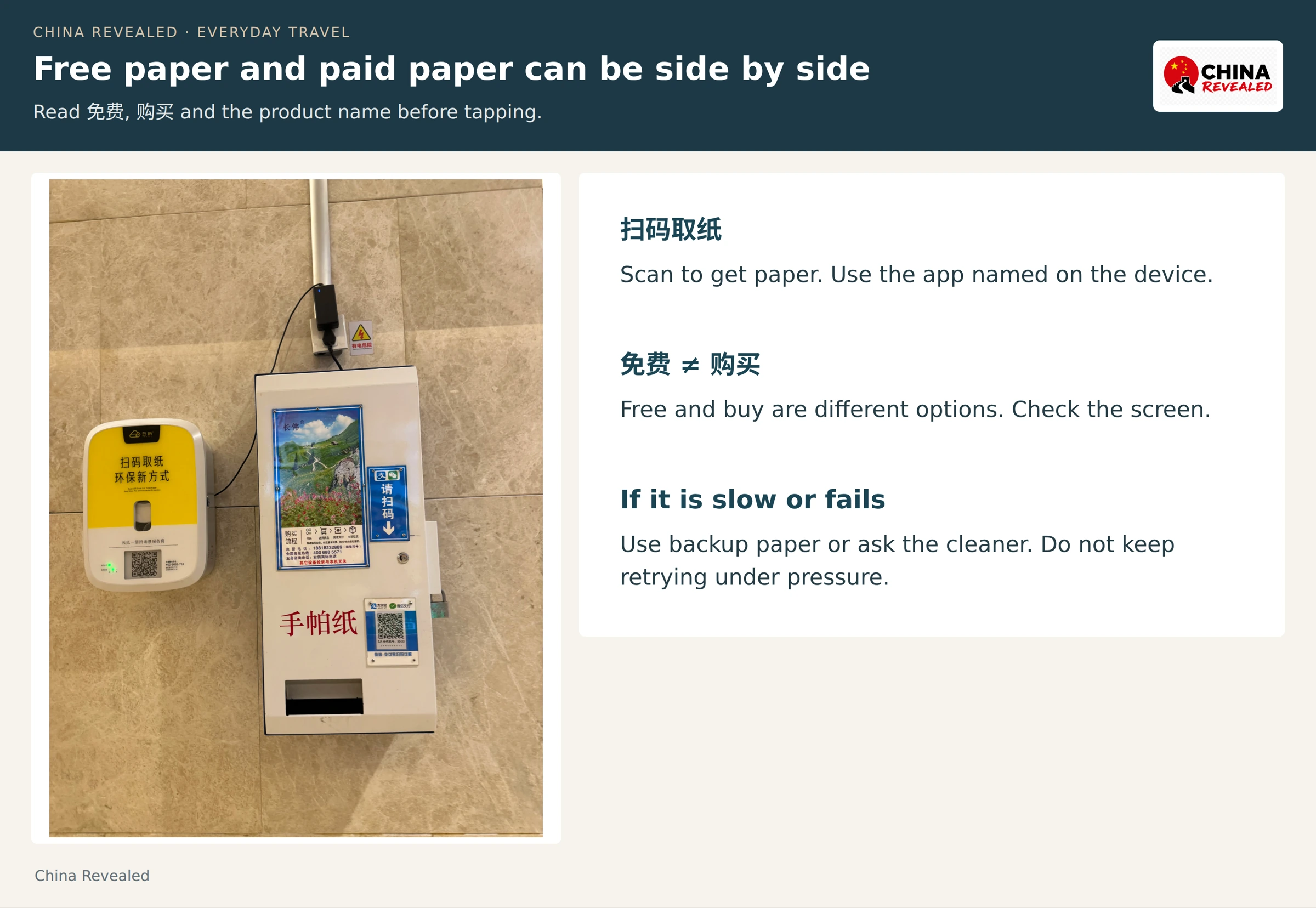
Here is the practical sequence:
- Read what it dispenses. 普通厕纸 or 卫生纸 is ordinary toilet paper; 湿厕纸 is moist toilet tissue; 卫生巾 is a sanitary pad. They are not the same product.
- Look for 免费, meaning free, and distinguish it from 购买 or 付费, meaning buy or pay. A large payment button can appear alongside a smaller free option.
- Use the scanner named on the machine. If it specifies WeChat or Alipay, use that app’s Scan function rather than assuming your phone camera completes the whole process.
- Read the next screen before tapping. There may be a free-claim button, a short advert, a follow-account step or a limit on repeat dispensing. Do not assume the first prominent button is the free choice.
- Collect the paper from 出纸口, the outlet, once it is released. Follow any displayed waiting instruction or physical-button step; do not pull hard on an unreleased roll.
If the process needs a phone-number login you cannot complete, the signal is poor, the machine is empty or the page asks for information you do not want to provide, use your own paper or ask the cleaner. It is not worth creating a new account under pressure. You do not need to provide a passport or bank-card details just to solve a toilet-paper problem.
For paid paper, check the price and product before authorizing a payment. Buying a packet is optional; it does not turn an otherwise free toilet into a paid toilet.
Book hotels, flights, train tickets, attractions and other travel services on Trip.com.
How to use a squat toilet
A squat toilet is a floor-level pan with a foot position on either side. It is still common in street-side public toilets, stations, older buildings and some attractions. A new mall can have squat cubicles too; an attractive washbasin area does not tell you which fixture is behind every door.
If squatting is comfortable for you, the basic technique is straightforward. If it hurts, you cannot balance securely or you need assistance, choose a seated toilet rather than treating it as a travel challenge.
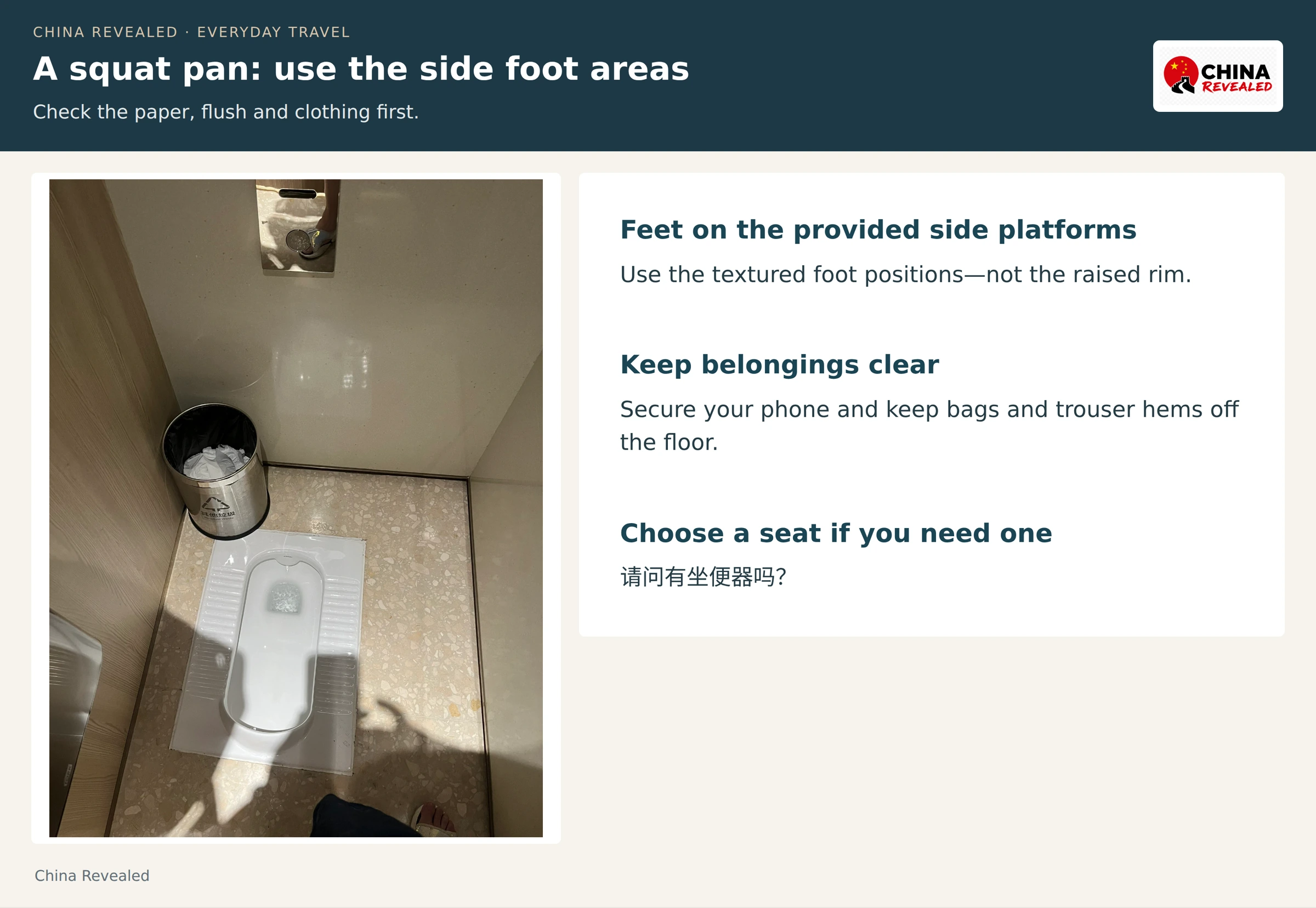
Before you squat
Check that the door locks, the pan flushes and you have paper. Put your bag on the hook or keep it securely with you—not on a wet floor. Move your phone and anything loose out of pockets that could empty into the pan.
Roll up long trouser hems if necessary. Keep clothing clear of the floor and the opening. You want both hands available for balance, not a phone in one hand and a shopping bag in the other.
Position your feet and lower yourself
Put one foot on each textured side platform or marked foot area. Do not balance on the raised rim. Where the pan has a raised hood or splash guard, the usual position is facing that end; the flush pipe’s position is not a reliable direction guide. Follow any diagram supplied for the particular fixture.
Lower into a stable squat over the opening. Keep clothing gathered clear; many travelers find it easier to lower trousers and underwear to around knee level rather than let them pool at the ankles. Adjust only as far as you can remain balanced and comfortable.
You do not sit on the squat pan. Stand up slowly when finished, put yourself clear of the flush splash, flush using the actual button, lever, pedal or sensor, and check that the pan has cleared.
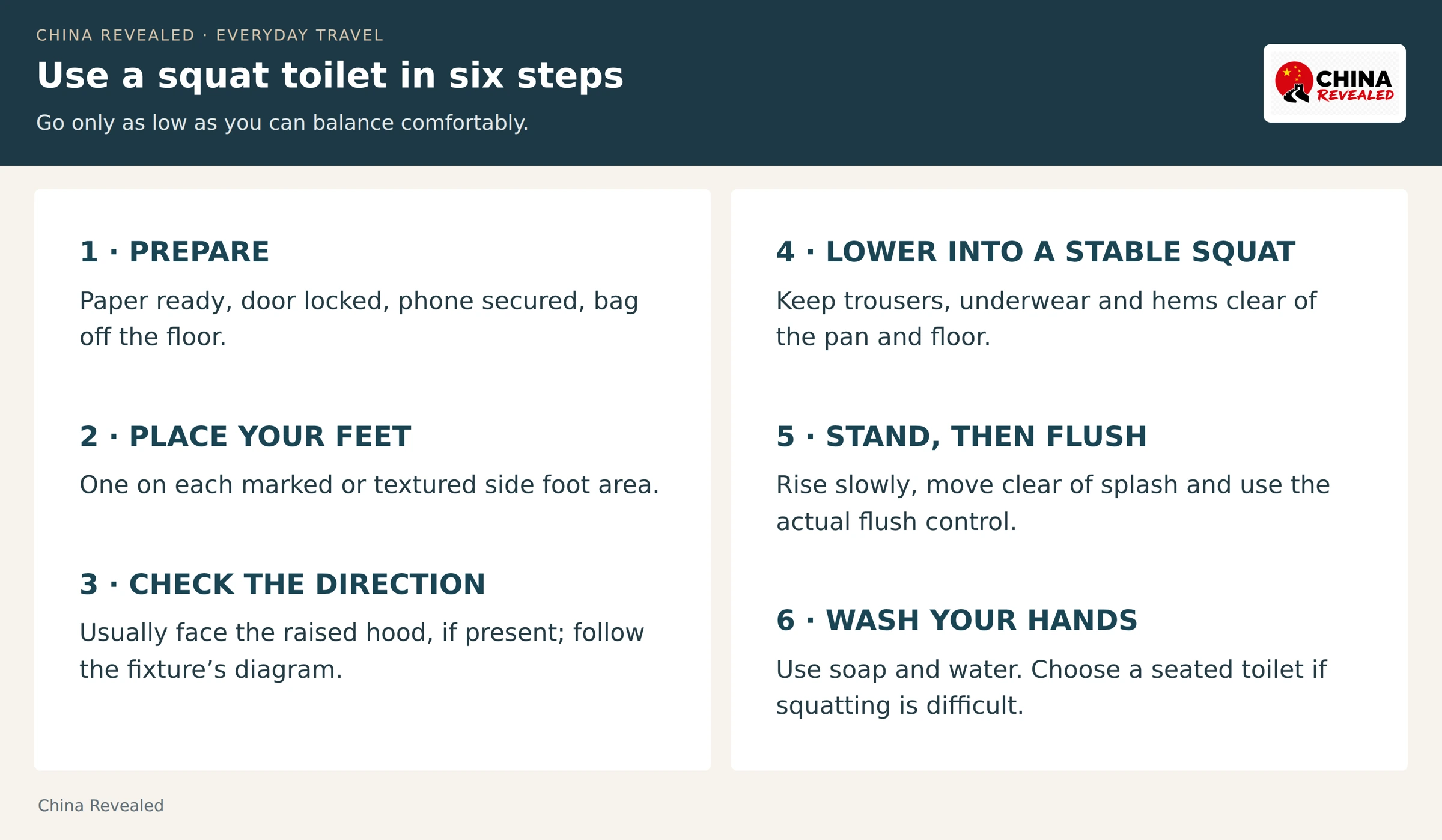
Wash your hands with soap and water. Hand sanitizer is useful backup, but it is not a reason to skip a functioning washbasin.
Finding a seated toilet
Ask for 坐便器—a seated toilet. 马桶 is another everyday word people will understand, but “坐便器” makes the contrast with a squat fixture particularly clear.
Check the cubicle symbols, or ask the attendant which one has a seat. Do not open occupied cubicles to inspect them. Sometimes only part of a toilet area has seated fixtures; sometimes a mall uses seats throughout. The quickest answer is often a cleaner pointing to the right door.
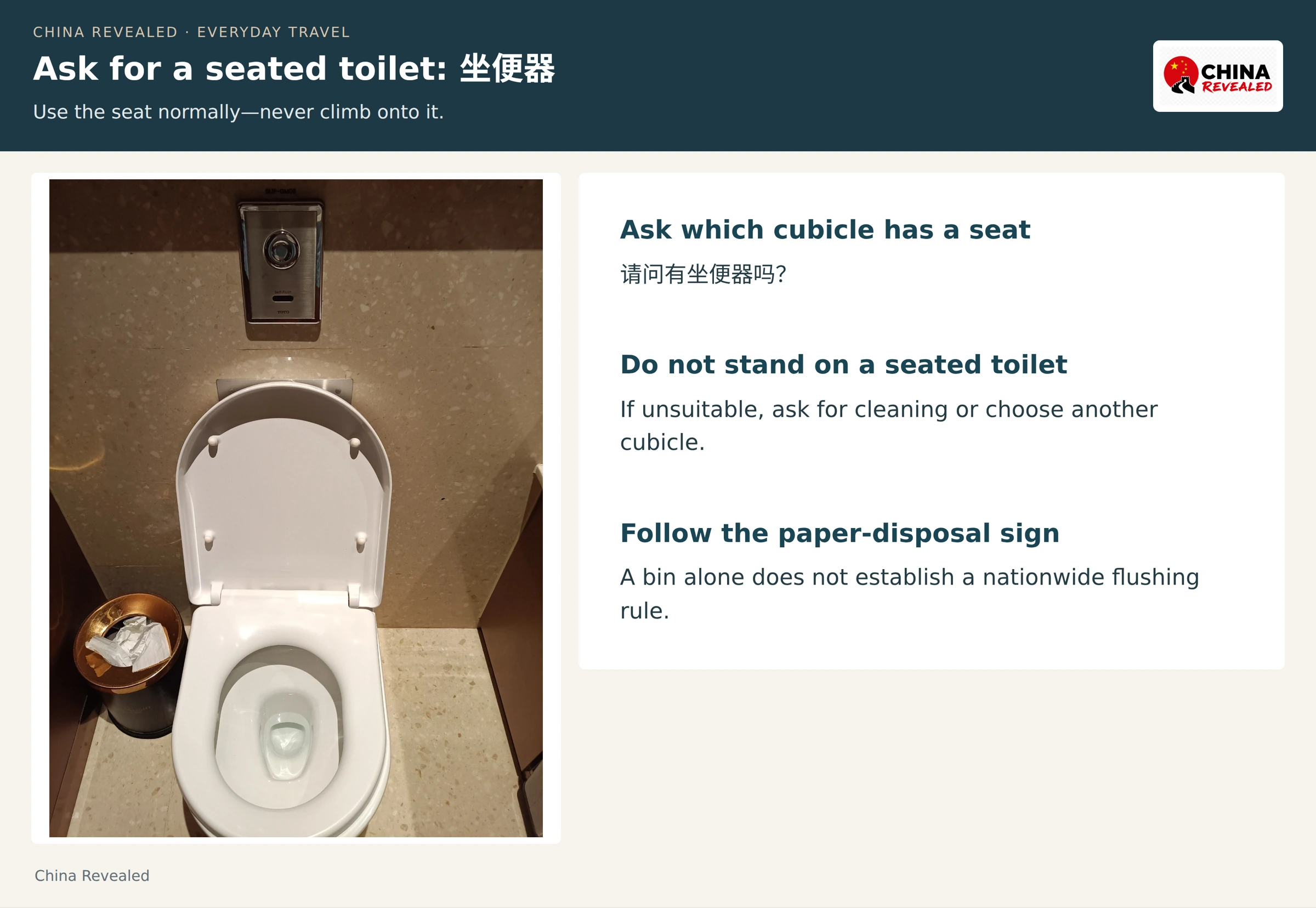
Use the seat in the normal seated position. Never stand or squat on a seated toilet: the fixture is not a platform. If the seat is unsuitable, ask for cleaning or choose another cubicle instead of climbing onto it.
A smart toilet may have separate buttons for washing, drying and flushing. Look for 冲水 for flush and 停止 for stop; a wall button or sensor may control flushing separately. You do not need to experiment with the bidet functions to use the toilet normally.
If a seated toilet is important for your whole trip, ask your hotel about the bathroom fixture before booking and plan mall or visitor-center stops along your day’s route. It is much easier than searching for one only after you urgently need it.
Children, older travelers and accessible toilets
For travelers who cannot comfortably squat, the useful plan is not simply “find any WC.” It is find a seated fixture with the access and assistance you need.
无障碍卫生间 means accessible restroom. Look for an appropriate entrance, grab rails and enough space for the person using it. Ask staff if the room is locked or if the route involves a lift; a wheelchair symbol on a map is not the entire access route.
第三卫生间, 家庭卫生间 and 亲子卫生间 are useful labels for third, family or parent-child facilities. These may help a parent accompany a child or a caregiver assist someone of another gender. Shanghai’s design standard distinguishes the third restroom from an ordinary accessible cubicle and includes child-care facilities in its specification.
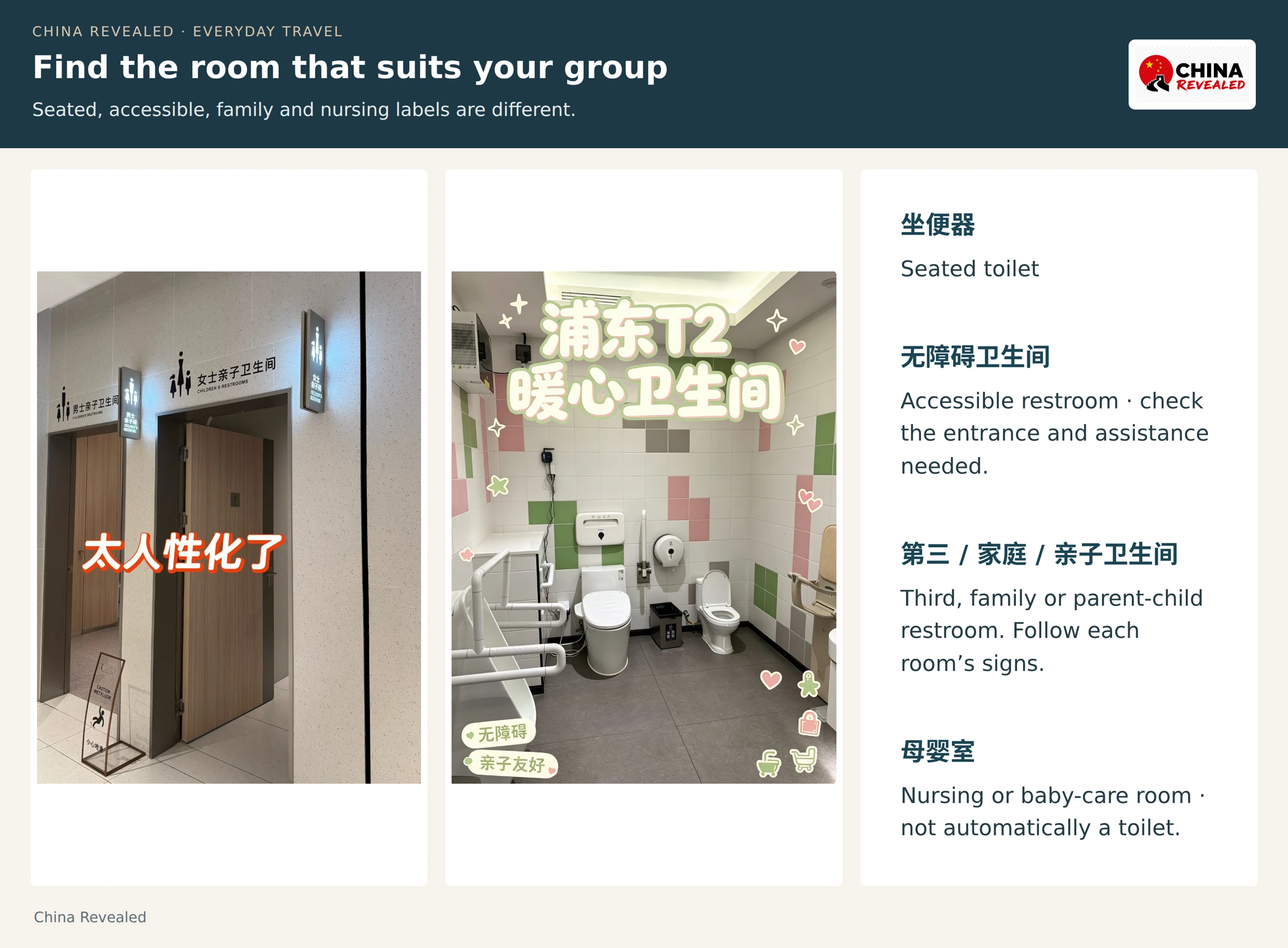
A particular venue may have a shared assisted-use room, separate male and female parent-child entrances, or another layout. Read the sign and ask which room fits your group. Do not assume the phrase “family toilet” means the same arrangement everywhere. Keep accessible facilities available for people who need them; they are not simply a way to skip the ordinary queue.
母婴室 means mother-and-baby or nursing room. It is useful for feeding and changing, but is not automatically a toilet. Public reporting has highlighted problems where nursing and accessible facilities are combined; the labels and actual functions need checking.
For a child, bring their usual changing supplies and stay with them on any changing surface. For an older traveler, make the toilet stop before a long walk through a large attraction. Our guide to China with children or older parents connects this with lifts, transport and an easier daily pace.
Small problems and easy alternatives
| The problem | What I would do next |
|---|---|
| The cubicle has no paper | Check the entrance dispenser; ask the cleaner; use your backup supply |
| The QR machine will not work | Stop retrying, use your own paper or ask staff |
| Every visible cubicle is squat-style | Ask for 坐便器; check an appropriate seated or assisted-use option |
| The mapped toilet is locked or restricted | Choose another nearby point or ask at a mall service desk |
| The toilet is unpleasant or the floor is wet | Use another cubicle or facility if possible; keep bags and hems off the floor |
| You cannot find a restroom inside a mall | Ask which floor and corridor; follow the interior signs, not only the map pin |
In a railway station or airport, use the toilet on your current side of the gates. Do not go looking for a mapped point outside security just before boarding. If you are already on a train, ask the attendant where the seated or accessible toilet is; layouts differ, so avoid assuming every carriage has the same choice.
If a restroom attendant is cleaning a cubicle, ask where to wait or which area is open. Do not squeeze past a cleaning sign into a closed section. Leave the space usable for the next person and keep photographs to empty public areas—never occupied cubicles or people using the facilities.
Chinese phrases to save on your phone
You can show a short sentence without speaking fluent Mandarin. These are more useful in the moment than a long translated explanation.
| Show this | Meaning |
|---|---|
| 请问洗手间在哪里? | Where is the restroom? |
| 请问洗手间在哪一层? | Which floor is the restroom on? |
| 请问有坐便器吗? | Is there a seated toilet? |
| 请问无障碍卫生间在哪里? | Where is the accessible restroom? |
| 请问有第三卫生间吗? | Is there a third/family restroom? |
| 请问哪里可以取卫生纸? | Where can I get toilet paper? |
| 这个可以免费取纸吗? | Can I get paper from this for free? |
| 可以借用一下洗手间吗? | May I use the restroom? |
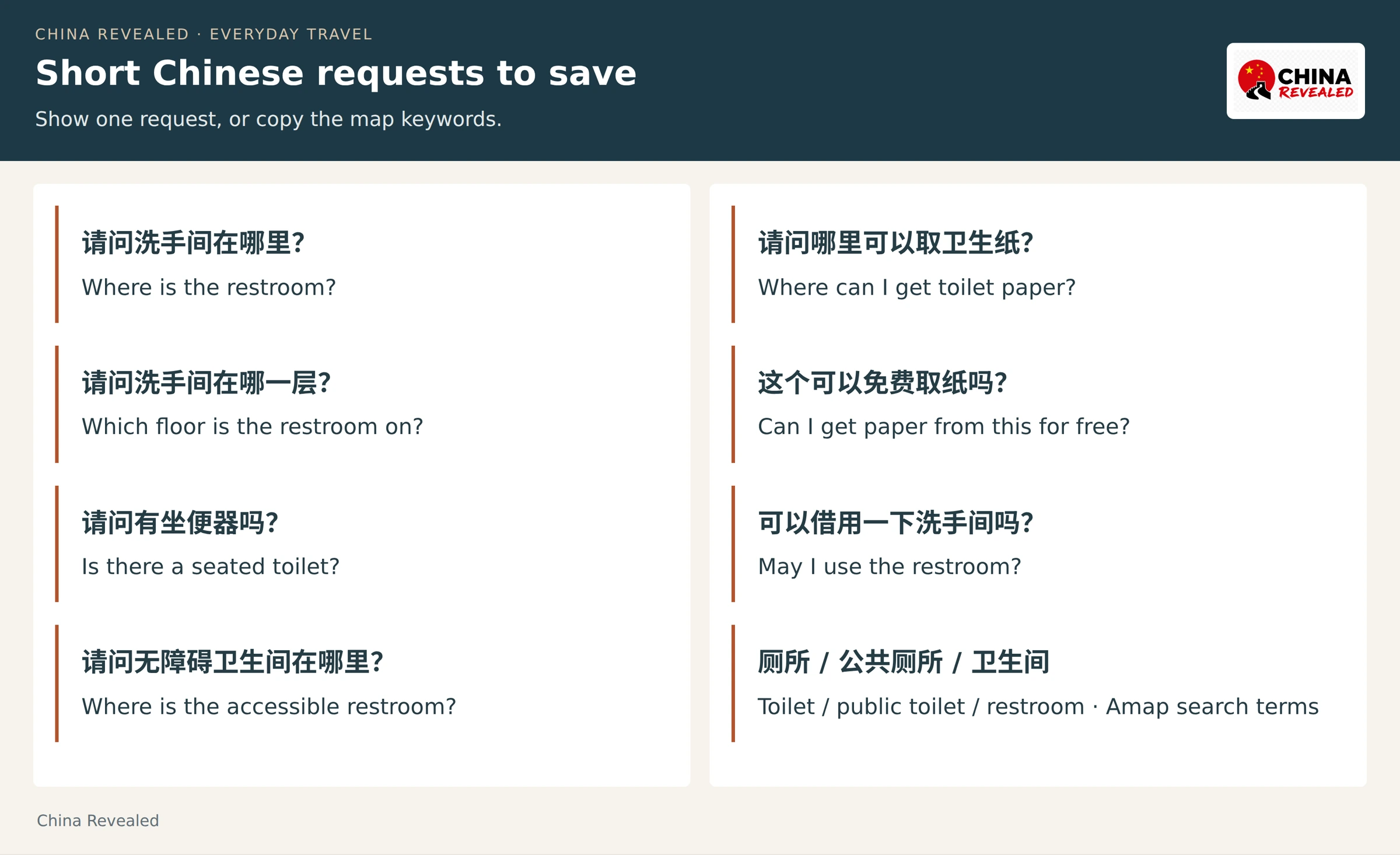
For Amap, save 厕所 / 公共厕所 / 卫生间 as plain text that you can copy and paste. For a person, start with 请问—“Excuse me / may I ask”—and show the sentence you need.
Frequently asked questions
Are all Chinese toilets squat toilets?
No. China has both squat and seated fixtures. Hotels, better malls and airports are useful places to look for a seated option; individual public toilets and cubicles still vary.
Do I really need to carry toilet paper?
Carry a small backup supply. Plenty of good facilities provide paper, but a missing roll, a communal dispenser or a failed QR machine can catch you out. Pocket tissues help in an emergency, but put them in the appropriate bin rather than assuming they flush like toilet paper.
Do I have to pay or scan a QR code to use the toilet?
Usually not. Ordinary public toilets are generally free, and a QR code may be for getting paper or buying a product—not entering the toilet. Read the sign and separate a free paper option from a purchase.
What is the fastest way to find a toilet?
Paste 厕所 into Amap, choose a publicly accessible result and open a Walking route. If you are already inside a mall, asking the service desk is often quicker than another map search.
Can I rely on a café or hotel toilet?
Ask staff first. Some welcome visitors, some serve customers only, and small outlets may have no customer toilet. A nearby mall or clearly signed public toilet is a better fallback than arguing over access.
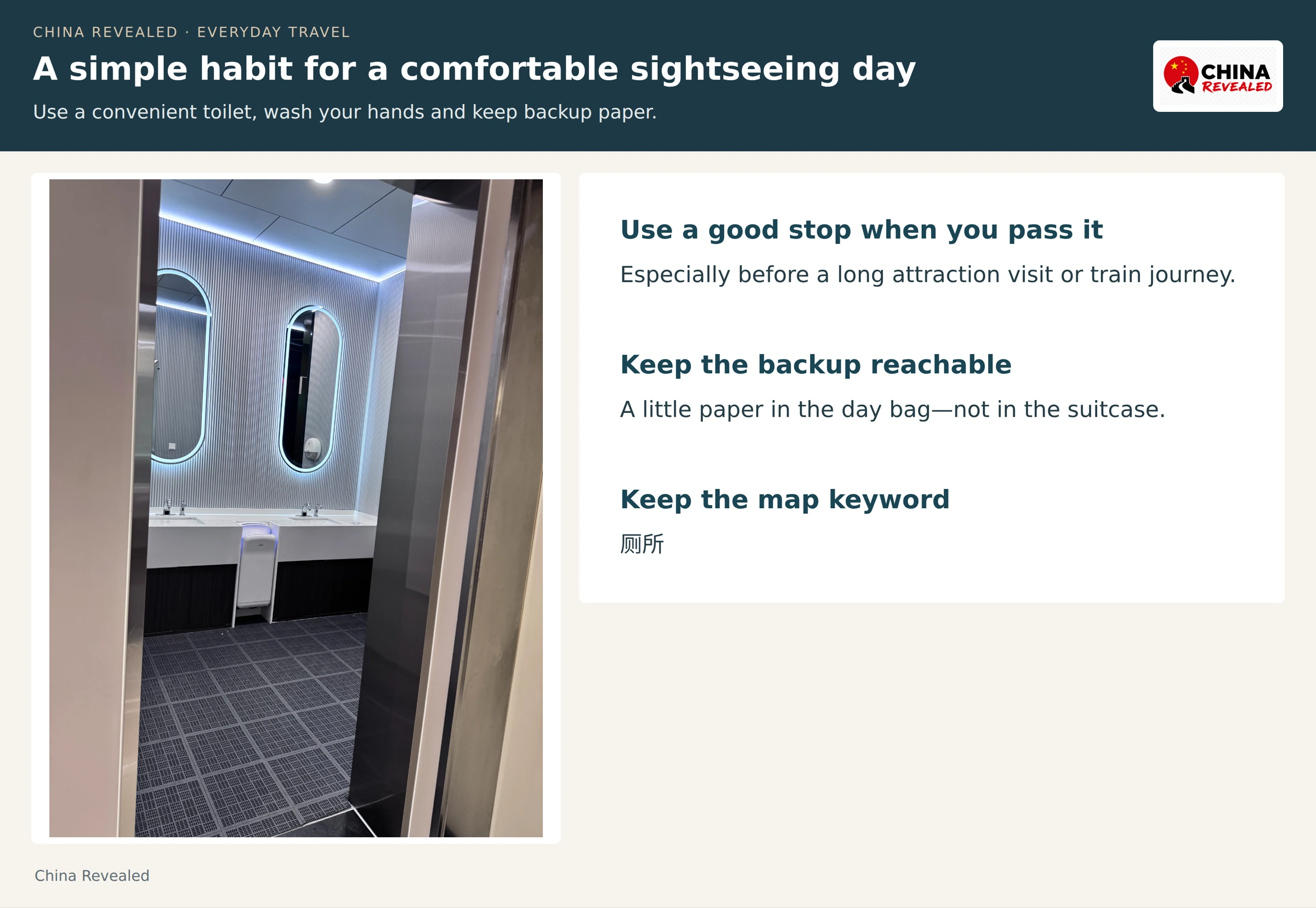
My simplest recommendation: use the comfortable toilet when you pass it, carry a little paper you can reach, and save 厕所 on your phone. That is enough preparation for most ordinary sightseeing days in China.
References
Sources include Shenzhen’s phone-based toilet guidance, Amap’s route-planning help, Beijing News on paper dispensers and Jiangmen’s public-toilet paper service.
For paper disposal and assisted-use facilities, see Science China’s toilet-paper guidance, Shangguan’s Shanghai reporting, Shanghai’s public-toilet design standard and Xinhua on nursing and accessible rooms.
About China Revealed
China Revealed is an independent English-language travel guide dedicated to China.
We bring together China travel guides, destination information, local insights and practical travel resources in one place.
Our travel database covers China's provinces, cities, famous attractions, hidden gems, local cuisine, transportation, accommodation, visa requirements, digital payments, mobile connectivity and the other practical details travelers need to explore China.
We focus on depth, careful research and accuracy. Our guides combine official sources, detailed destination data, local knowledge and regularly updated information to give reliable, practical travel advice.
Whether you're visiting China for the first time or exploring beyond the popular destinations, China Revealed is an all-in-one resource for discovering the real China.
China Revealed — Your practical guide to China.
Some links on China Revealed, such as Trip.com booking links, are affiliate links. If you book through them, we may earn a commission at no extra cost to you. This does not change what we recommend.