

Solo Female Travel in China: A Practical Guide

For solo female travel in China, I would spend more time choosing a convenient hotel and setting up my phone than worrying about walking around alone. China is a reassuring destination for an independent trip: sightseeing, taking trains, eating by yourself and going out for an evening walk are ordinary things to do. The harder parts are usually practical—reading a room listing, finding the right station exit, ordering a sensible amount of food and getting a familiar period product when you need one.
Our China safety guide covers the bigger picture. Here, the focus is on making your own trip comfortable and enjoyable, without treating every conversation or night out as a danger.
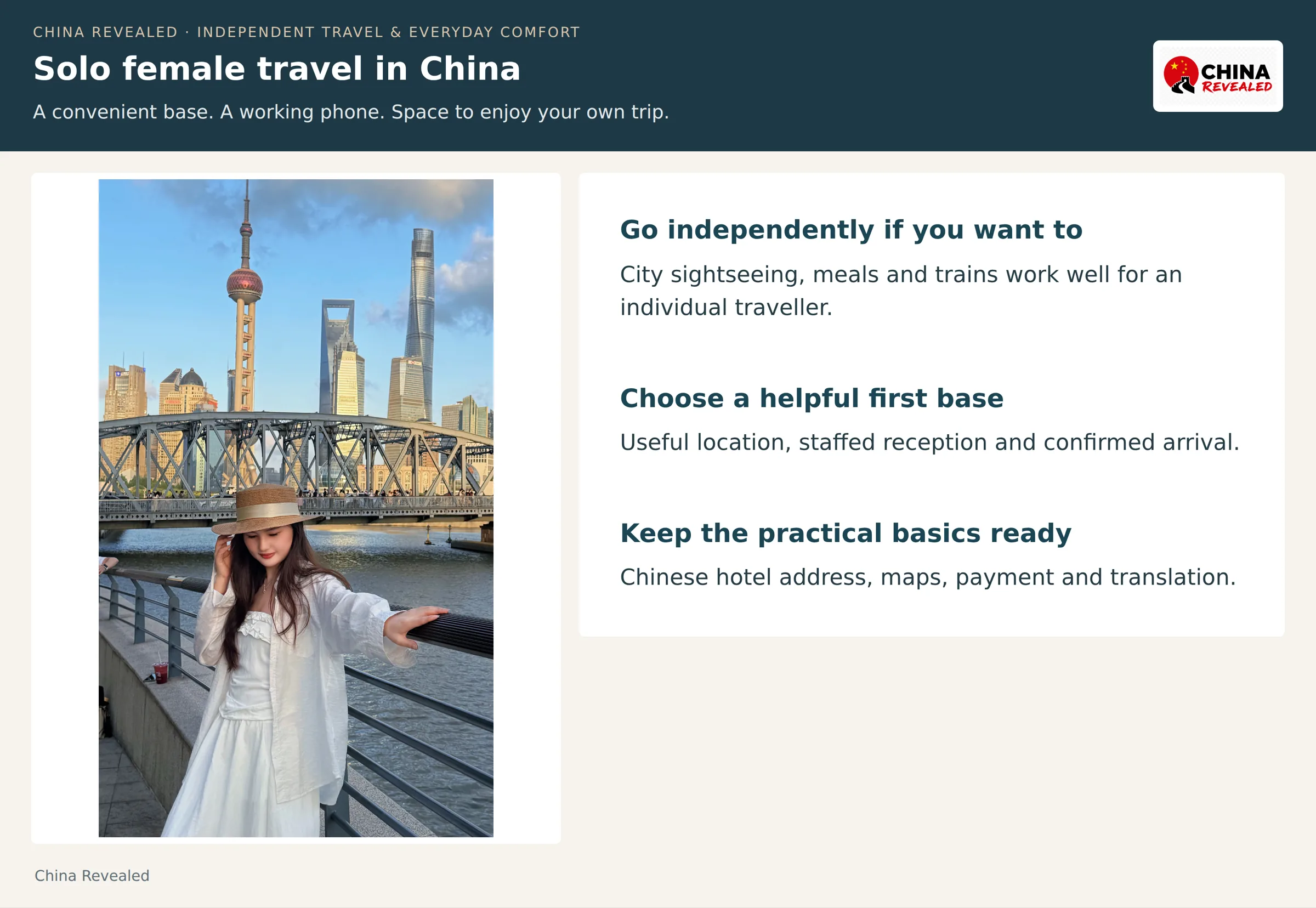
Quick takeaways
- Choose convenience, not a “solo-woman premium.” A well-located hotel or licensed hostel with helpful reception can be more useful than an expensive property far from everything.
- Set up maps, payment, translation and mobile data before landing. Save the hotel’s original Chinese address offline.
- Read the actual room type. A bed in a female dorm is a shared-room bed—not a private room or an all-women property.
- Eat what interests you. Noodles and dumplings are easy, but you can also order one proper regional dish with rice or choose a small portion.
- Bring your preferred tampons or menstrual cup if you use them. Pads are generally easier to replenish locally; keep a few supplies in your day bag.
In this guide
- 1. Start with a trip you actually want
- 2. Your phone is the most useful travel companion
- 3. Choose the right hotel—or the right bed
- 4. Move around independently—without making every transfer a project
- 5. Eat alone—and still eat proper Chinese food
- 6. Enjoy meeting people—without being available to everyone
- 7. Period supplies: know what is easy to buy
- 8. Toilets, clothes, laundry and other comfort details
- 9. Spend on the things that improve a solo trip
- 10. Save a few phrases—and know where help is
1. Start with a trip you actually want
You do not need a male companion, a private driver or an organised tour simply because you are a woman travelling alone. For a first visit, my default would be independent city travel, high-speed trains between the main stops and an occasional guided activity when it genuinely adds something.
A good solo itinerary leaves room to change your mind. Stay long enough in each city to learn the area around your hotel: where breakfast is, which metro entrance has the useful exit, where to buy water and which street you like walking down. Constantly changing cities means repeatedly solving the least enjoyable part of travel—arrival logistics.
Choose the atmosphere you want, rather than a supposed ranking of “safe cities for women.” Shanghai suits an urban trip with cafés, galleries and neighbourhood walks. Beijing suits someone who wants major historical sights and can allow for longer journeys across the city. Chengdu suits a slower food-and-teahouse rhythm. These are different kinds of trips, not different permission levels for women.
For your first afternoon, I would plan one manageable outing near your base, not an ambitious cross-city checklist. Have lunch, find the metro, stop at a supermarket and get back without rushing. Once those everyday things work, the country feels much less unfamiliar.
For a remote hike, mountain stay or rural excursion, choose the transport and guide arrangement on its merits. Weather, trail conditions, phone coverage and the return journey matter to anyone travelling alone. A day tour can solve those problems without turning the rest of your holiday into a package tour.
2. Your phone is the most useful travel companion
The best confidence boost is not a complicated safety gadget. It is being able to look up a route, pay for lunch, translate a question and contact your hotel without searching for Wi-Fi.
Before departure, prepare a small toolkit: Amap for routes, Alipay or another working payment setup, DiDi for rides, your booking app, and a translator. Use our China phone setup guide to separate mobile data from the phone number that receives important messages. A data-only eSIM does not give you a mainland SMS number.
For translation, I would use a quick voice-and-camera translator plus DeepSeek or Doubao for explanations. You can ask in English: “Write one short Chinese sentence asking the receptionist for a quiet, non-smoking room.” Show the useful Chinese line rather than a full screen of AI commentary. Our translation app guide explains the setup and offline backup.
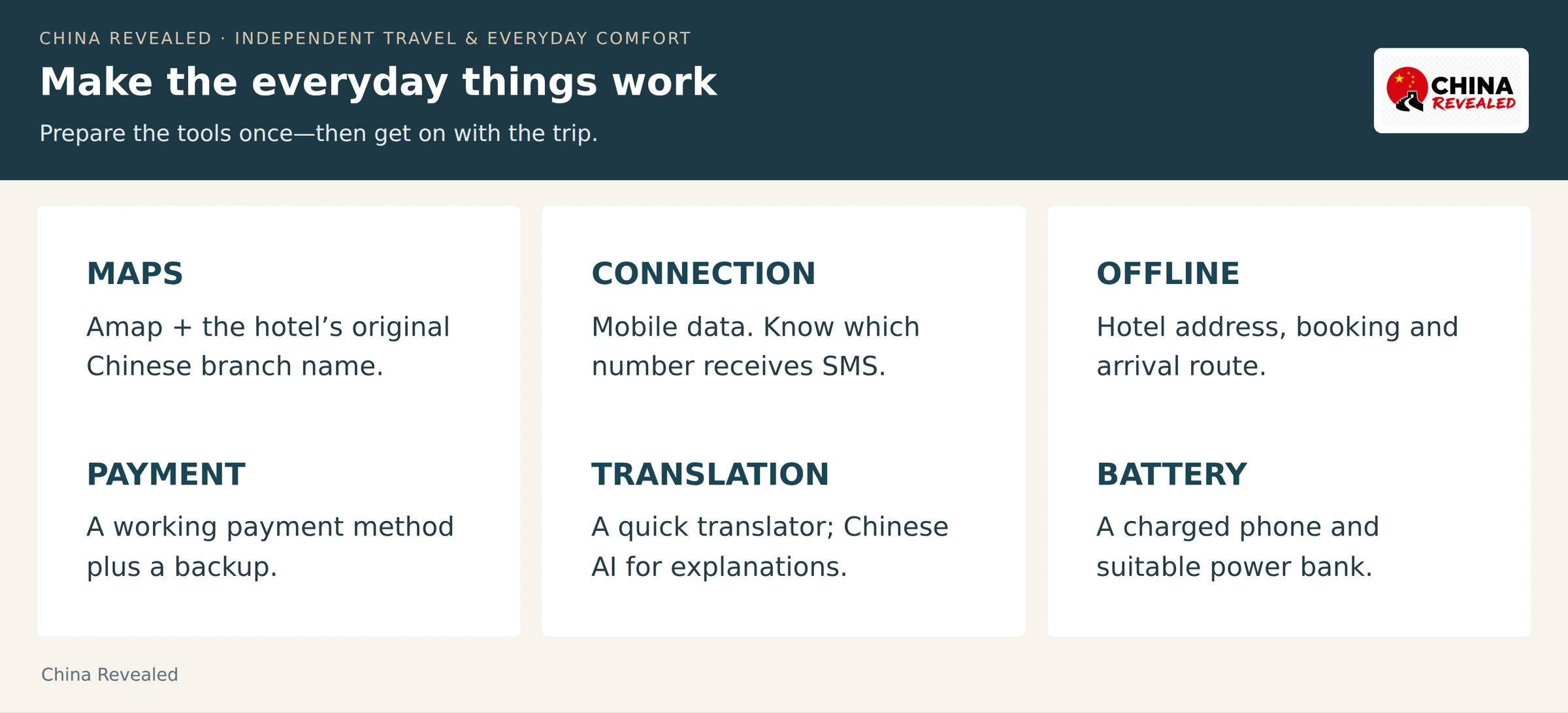
Save a note with your hotel’s full Chinese branch name, address, reception number and booking reference. Add the arrival station or airport, the terminal when relevant, and a screenshot of the route. Open the note with Wi-Fi and mobile data switched off before flying; that is how you know it is genuinely available offline.
Keep your phone charged, carry a suitable power bank and retain an alternative payment method plus a little cash. If an app stops working, move somewhere comfortable—a station service desk, hotel lobby or café—and sort out one issue at a time. You do not need to solve a login problem while dragging a suitcase along a crowded pavement.
For longer solo trips, agree on a simple check-in rhythm with someone at home. “I will message after I reach the next hotel” is useful. A constant live-location feed and an anxious message every few minutes are not requirements for enjoying a normal city trip.
3. Choose the right hotel—or the right bed
For the first night, I recommend a hotel or licensed hostel with staffed reception, a straightforward entrance and useful transport links. This is about support and comfort: someone can explain the room, help with an address, store a bag or contact a driver.
You do not have to book an international luxury chain. A practical local hotel can be a good base. Look at recent room photographs and reviews for cleanliness, noise, smoke, mattress comfort and reception help. Check your actual room’s bathroom and window description: “inner window” is not the same as an outside window.
For one guest, select one adult and one room when comparing rates. You can book a double bed for yourself; a “double room” normally describes the bed or capacity, not an obligation to arrive with a partner. Check the rate for one breakfast rather than paying for extras you will not use.
Female dorm, mixed dorm or private room?
| Listing wording | What you are booking | What I would check |
|---|---|---|
| Bed in a female dormitory | One bed in a women-only shared room | Bed count, upper/lower bunk, curtain, locker and bathroom |
| Bed in a mixed dormitory | One bed in a shared room with mixed genders | Whether you are comfortable with that arrangement and the storage/privacy setup |
| Private room | The room for your own booking | Private or shared bathroom, occupancy, window and reception hours |
| Self-check-in apartment or homestay | A private or shared unit as described | Exact entrance, host response, passport registration and after-hours help |
A female dorm can be a good budget-and-social choice. It does not mean the whole hostel is women-only: common rooms, reception and other dorms may be mixed. Read the bathroom arrangement too. Ensuite means attached to the room; in a dorm, it is still shared with that room’s occupants.
If you sleep lightly, need your own bathroom or simply enjoy solitude, choose a private room without feeling that you are doing solo travel “wrong.” If you want a hostel, ask about a lower bunk and check whether the locker fits your valuable belongings. Bring a small padlock if the property requires your own.
Foreign passport and the first arrival
Foreign visitors can stay in Chinese hotels. The practical check is whether this exact branch can complete your passport registration and receive you at your arrival time. Bring your original passport; a phone photograph is not a substitute at check-in.
I would settle this before committing to a restrictive rate, especially for a small property or an overnight arrival. Send a short message through the booking:
I am one guest travelling with a foreign passport. Can your reception register my original passport? I expect to arrive at [time and date, China local time]. Please confirm that someone will be at reception and the room will be held. I would prefer a quiet, non-smoking room with an outside window.
The first two questions are arrival arrangements; the last sentence is a room preference. Read the answer so you know which items the hotel actually confirmed.

For a private apartment or a friend’s home, ask who will handle the required accommodation registration within 24 hours. A platform booking or a door code does not do that by itself. For your first landing night, a staffed hotel is usually the easier option.
Use our hotel-booking tutorial for the full branch, room, payment and confirmation checks. I recommend comparing your dates on Trip.com for its English booking workflow and support. If you book through this link, China Revealed may earn a commission at no extra cost to you.
The after-midnight rule
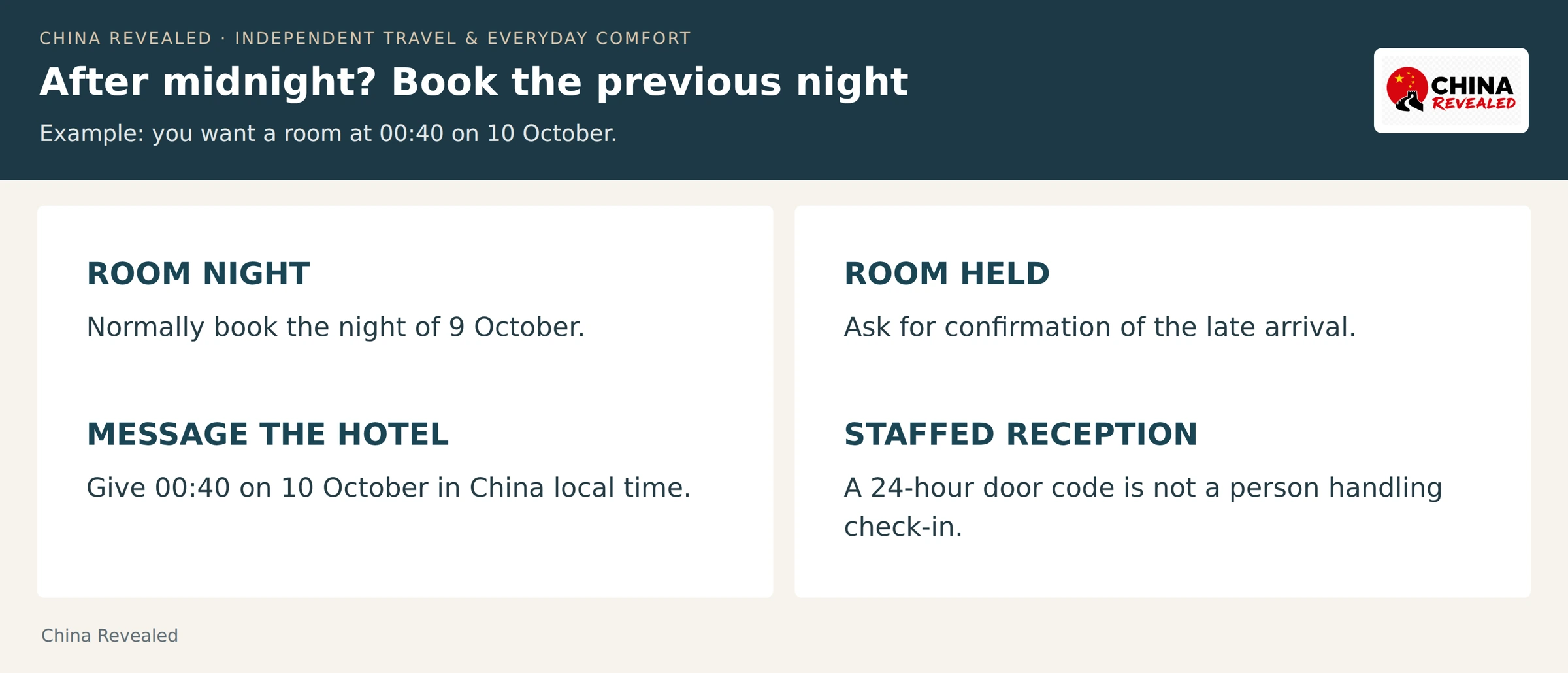
If you want to enter a room at 00:40 on 10 October, you normally need to book the night of 9 October, then tell the hotel you will arrive after midnight. A reservation starting on 10 October usually begins that afternoon, not at 00:01.
Confirm both the date and whether the room will be held. A 24-hour front desk means staff can be there; it does not automatically preserve an unannounced late-arrival booking. If transport is delayed, update the hotel through the original reservation.
On arrival, check the room while changing rooms is still easy: lock, bathroom, noise, smoke smell and any promised feature that matters to you. Ask reception immediately if something is wrong. Use the door’s normal lock, know the exit route and keep valuables out of shared spaces. A door wedge or improvised barricade should not obstruct an emergency exit.
4. Move around independently—without making every transfer a project
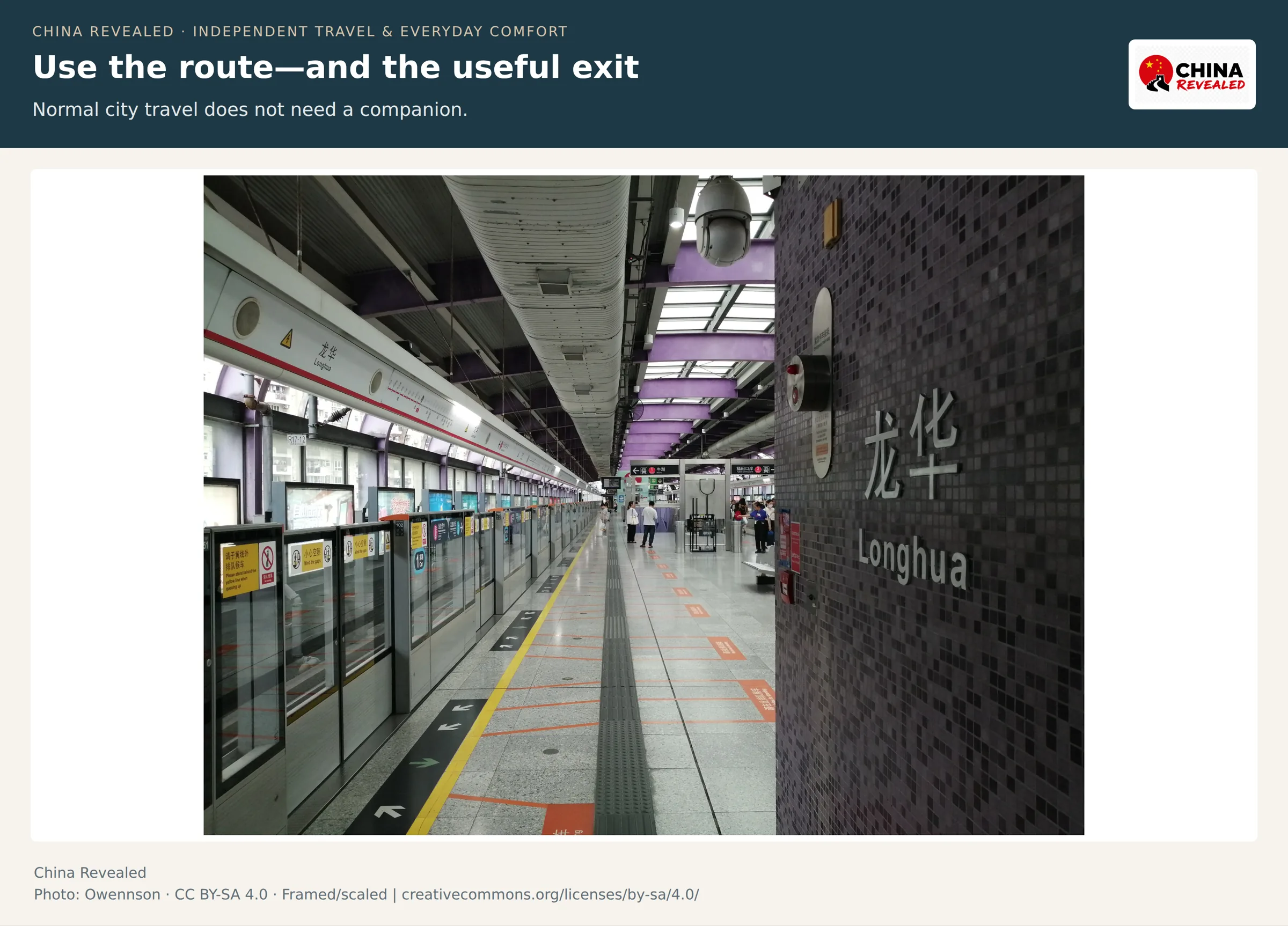
For daytime city travel, the metro is usually an excellent solo option. You do not have to find another traveller to make it worthwhile. Use the route, line direction and correct exit; the nearest station entrance on the map is not always the most useful one for your destination.
On a train day, keep the same original passport used to book, phone, wallet and essentials in your small bag. Allow time for station security, a staffed passport check if needed, and the walk to the gate. My first-time planning allowance at a large station would be around 45–60 minutes, more during a busy holiday. This is a comfortable planning buffer, not a universal boarding deadline.
Pack a suitcase you can manage yourself. You may need to lift it, take an escalator, walk a long platform or move between trains. Fewer awkward bags are more useful than a beautiful oversized case. If you check out before sightseeing, ask your hotel to store it and keep the collection proof; our luggage-storage guide explains the choices.
DiDi and taxis at night
Going out for dinner or returning after dark is not unusual. The practical question is how you will get back when the metro stops running or you are tired. Check the last useful train before going out, or plan a ride to the hotel’s correct entrance.
At a station or airport, follow the 网约车 / Ride Hailing signs for the app’s pickup zone. Match the floor, exit and bay to the order. Requesting a car while you are still inside a huge terminal often creates more confusion than it saves.
Before boarding, match the full plate and car details to the live order. Keep the destination visible, buckle up and use the in-order chat if a short message is needed. If the app asks for a phone-number ending, it is the number associated with that booking—not an SMS security code.
If your version offers a trip-sharing tool, use it when helpful. Otherwise, send the ride details and expected arrival to a trusted person yourself. You can also use the official taxi rank when it is simpler. Our DiDi tutorial covers setup, pickup and payment without assuming every account has identical buttons.
What about sleeper trains?
Daytime high-speed trains are my first choice when the route makes sense. If you want an overnight train, understand the accommodation before buying: ordinary hard- and soft-sleeper arrangements are generally mixed-gender. A soft sleeper’s compartment door does not turn it into a women-only room.
A private compartment is only private when the actual product and booking make it so. Do not assume there is a nationwide “female sleeper” option to tick. If sharing that space would stop you sleeping, choose a daytime train plus hotel, or check a specifically listed private-compartment service.
5. Eat alone—and still eat proper Chinese food
Eating by yourself is ordinary in China. People have lunch between meetings, eat after work and travel alone. You do not need to explain yourself to the restaurant.
Noodles, dumplings, rice bowls and small snacks are easy starting points, but they are not your entire menu. One regional dish with rice is a perfectly reasonable solo meal. The only thing to watch is the serving size: many dishes on a sit-down restaurant’s menu are intended for sharing.

Ask whether there is a 小份 / small portion or 半份 / half portion. If not, choose one dish you really want rather than ordering three because that is how a group eats. Add rice and ask about the portion if it is unclear. Take leftovers away with 打包 where practical.
| What you want | An easy solo approach | Useful check |
|---|---|---|
| A quick local meal | Noodles, dumplings, a rice dish or a canteen-style selection | Choose the portion, spice and any additions |
| A regional restaurant | One main dish plus rice; add a small side if you want it | Ask about 小份 or whether the dish is large |
| Hot pot | Individual-pot or clearly priced one-person set where available | Check minimum spend and what the set includes |
| A slower café break | Counter, window seat or small table | Order normally; you do not need company to occupy a table |
A food court is handy when you want to see dishes before ordering. For a larger restaurant, staff may ask 几位?—“How many people?” Reply 一位 / one person. That is a seating question, not a judgement.
For QR menus, sit first, scan the table’s ordering code and check the selected table. If it requires a login you cannot complete, ask for a menu or show the dish name to a staff member. There is no need to leave a good restaurant because one mini program is awkward.
If you feel conspicuous on the first day, choose a small table or counter, order something familiar and let the meal be ordinary. You may become comfortable quickly. For sociable meals, join an organised food walk or cooking class rather than waiting for a random dinner invitation.
6. Enjoy meeting people—without being available to everyone
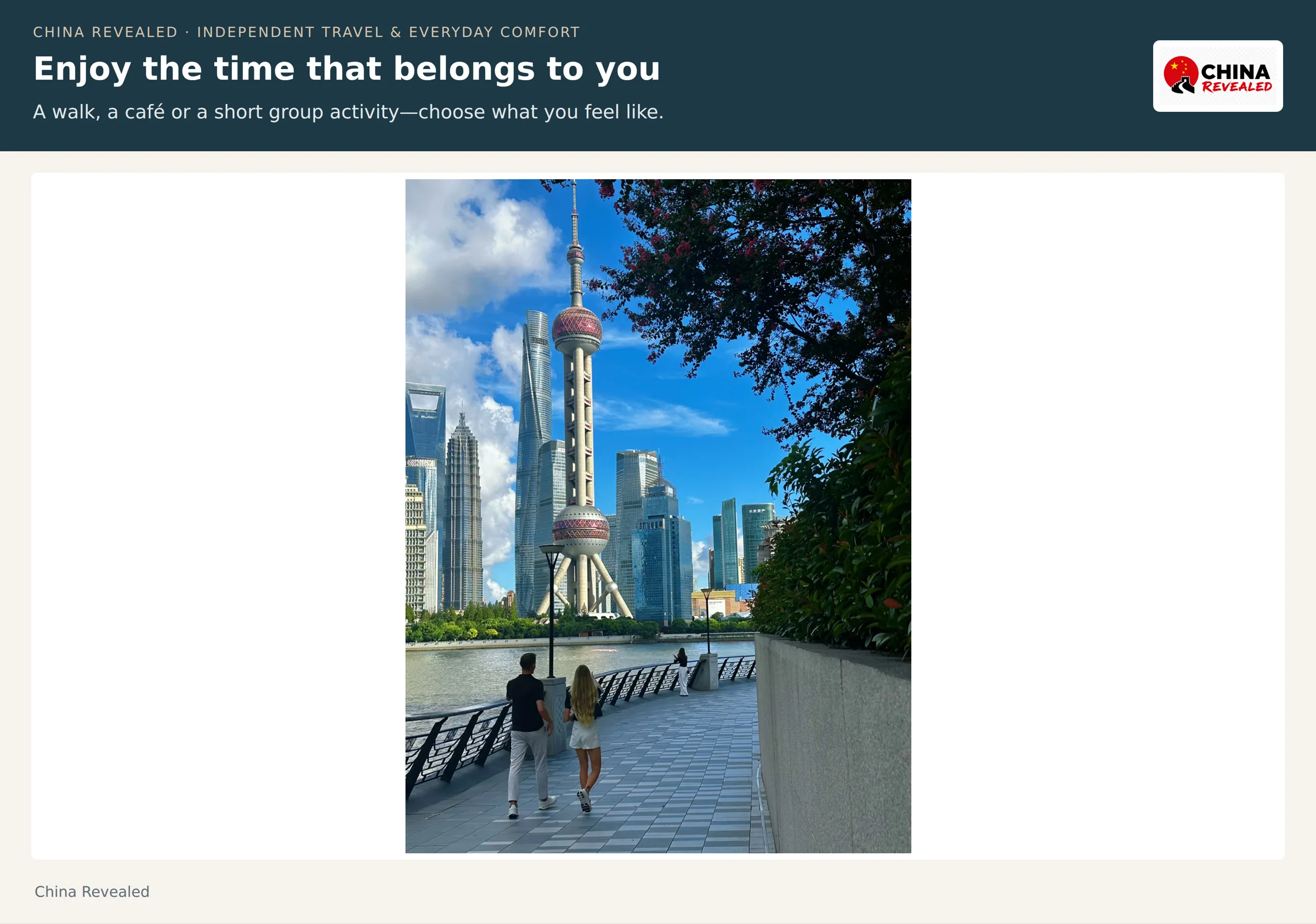
Solo travel gives you choices. You can chat with people in a hostel, join a walk, take a class or spend a whole afternoon alone with a book. None of these is more authentic than the others.
I would choose a structured activity when it improves access or companionship: a food tour, market visit, cooking class, museum walk or day trip with a clear meeting point. Check language, duration, group size, included tickets and the finish location. An “English listing” does not necessarily mean an English-speaking guide is included.
A short activity can be a useful middle ground: independent mornings and evenings, a few hours with other travellers, then back to your own plan. You do not have to buy a two-week tour to have company at one meal.
Questions, photographs and saying no
You may encounter curiosity, particularly away from the most international neighbourhoods. Someone might ask where you are from, whether you are travelling alone, or for a photograph. Experiences differ by place and person; there is no obligation to interpret every request as hostility or to agree to every one.
If you want the photo, say yes. If you do not, 谢谢,不用了。 / Thanks, no is enough. For a clear request not to be photographed, use 请不要拍我。 You do not owe a stranger your relationship status, hotel name, room number or evening plans.
You can answer a personal question lightly and change the subject: “I’m here to see the city.” You can also end the conversation. If someone keeps pushing, repeat the short refusal and move towards staff or a comfortable public place. You do not need a long explanation or a polite debate.
Apply the same courtesy yourself: ask before making a person the main subject of your photograph, especially children, worshippers and staff. Street scenery and a close-up portrait are different requests.
For a drink or a date, choose a public place you selected and keep your own return plan. Keep an eye on your drink. Those are ordinary travel habits, not reasons to skip China’s cafés or nightlife. An invitation that turns into a high-pressure, unfamiliar tea or bar visit is a reason to decline—not a cultural duty.
7. Period supplies: know what is easy to buy
If you use sanitary pads, replenishing them in a Chinese city is generally straightforward. Supermarkets and convenience stores are the first places I would try. Larger stores usually offer more choice than a small station kiosk. Ask staff for 卫生巾 rather than relying on packaging colours.
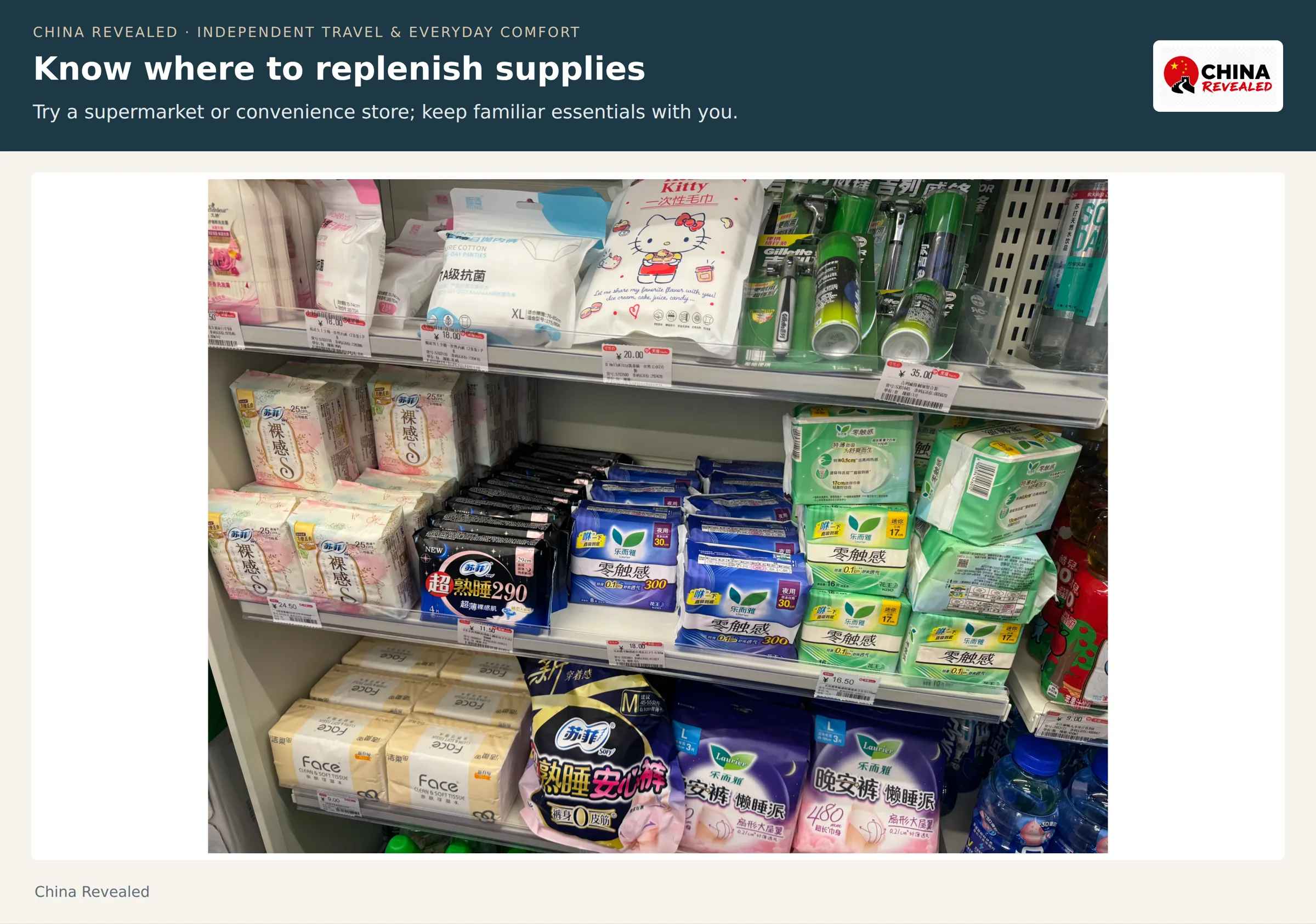
If you use tampons, bring enough of your familiar type to avoid an urgent search. 卫生棉条 are sold in China, including through major online retailers, but your preferred size, applicator or brand may not be on the shelf of the nearest shop. “Available in China” and “available right beside my hotel tonight” are different things.
If you normally use a menstrual cup, bring the cup and cleaning supplies you already know. A holiday is not the ideal time to learn an unfamiliar product simply because you cannot find your usual one.
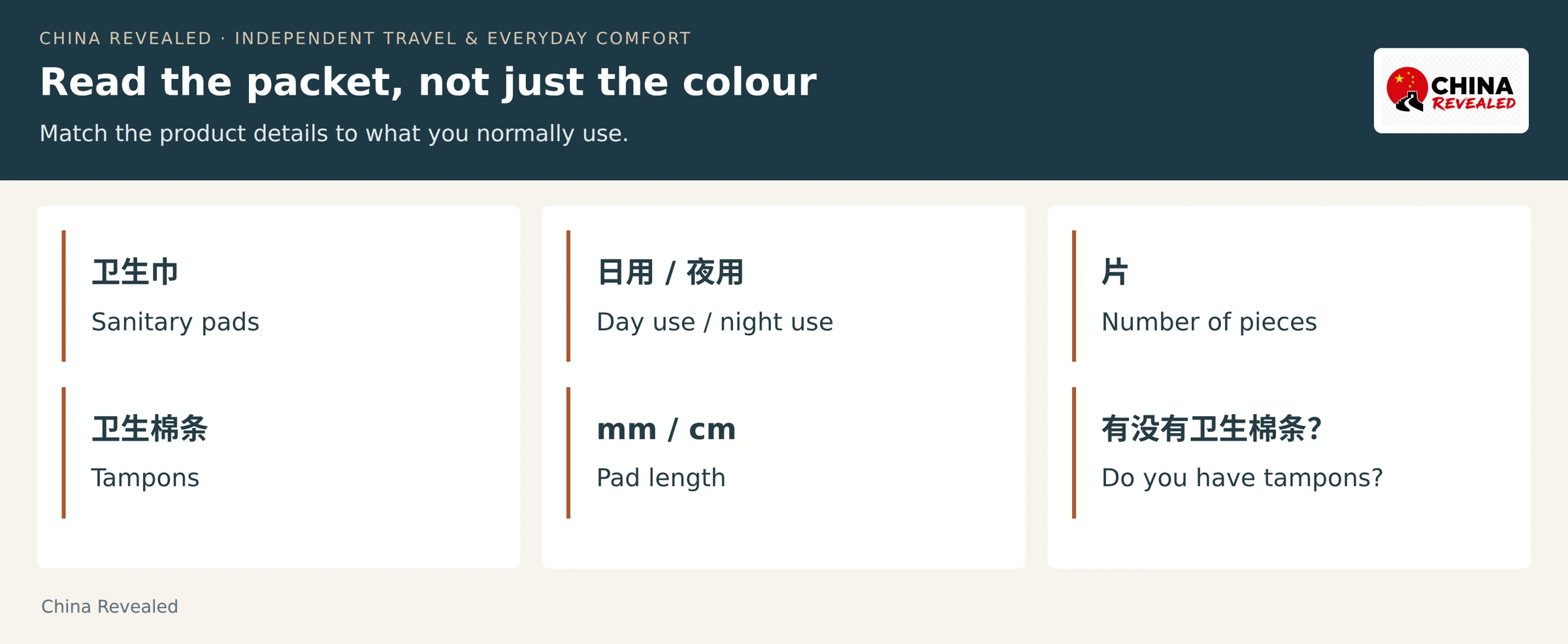
The useful words on a pad packet are:
日用 — day use. 夜用 — night use. 片 — number of pieces. A number followed by mm or cm describes the pad’s length; it is not the packet’s piece count. Check the shape, length and other product details against what you normally prefer. Bright packaging and “ultra thin” wording do not tell you everything.
Keep a few pads or tampons, spare underwear and a small disposal bag in your day bag on a long sightseeing or train day. The rest can stay in your suitcase. Buy replacements before you are down to your last item, and check the shelf price for the actual pack rather than assuming a transport-hub shop will match a supermarket.
For a longer stay, online ordering to your hotel can expand the choice once reception agrees to accept the parcel. For a same-evening need, a walk to a nearby shop is often simpler than setting up an unfamiliar delivery service. Do not leave an important supply depending on a delivery you have not arranged.
8. Toilets, clothes, laundry and other comfort details
Make good toilet stops part of the route
A better shopping mall is often a useful place for a bathroom break, a drink and a rest indoors. Look for the signs and ask which floor; the restroom may be off a corridor near the lifts. Good malls commonly supply toilet paper, but keep a little backup paper for an empty dispenser or a more basic public toilet.

You may find both squat pans and seated toilets. If you need a seat, ask 请问有坐便器吗? Do not climb onto a seated toilet to squat. Put pads and other menstrual products in the provided bin, not in the toilet, and do not flush wet wipes. For ordinary toilet paper, follow the posted instruction and the actual fixture.
For the map search and practical squat-toilet steps, use our toilets in China guide. For a long walk, take a good toilet opportunity before starting rather than making the day revolve around finding one later. Keep tissues, your supplies and hand-cleaning items reachable—not packed at the bottom of the suitcase.
Dress for weather and what you plan to do
For normal city sightseeing, wear the clothes you find comfortable. There is no special “solo foreign woman uniform.” Good walking shoes and a layer for strong air-conditioning are usually more useful than buying a new travel wardrobe.
For temples and religious sites, check the actual visitor rules. Clothing that covers shoulders and reaches around the knees is a low-fuss starting choice; some places have stricter requirements. A light overshirt helps you adapt. Follow photography signs inside halls and do not assume the rules of one temple apply everywhere.
Use laundry to keep your luggage manageable
For a longer trip, I would look for a hotel or hostel laundry option and ask how it works: washing machine, detergent, dryer, opening hours and whether it is self-service or charged by item. A laundry room in the hotel is different from a paid laundry collection service.
Do not plan on everything drying overnight in a humid city. Keep one spare outfit for a train day and allow drying time. With hostel shared bathrooms, a small wash bag and footwear for the bathroom can make the routine easier.
A non-smoking room is worth requesting if smoke bothers you. If the assigned room smells strongly of smoke, ask reception for another room promptly rather than hoping the air-conditioning will fix it. The point of choosing a helpful base is being able to solve this sort of ordinary discomfort.
9. Spend on the things that improve a solo trip
Travelling alone does not make every part of China expensive. A metro trip, train seat or attraction ticket does not need another person to become useful. The costs that change most are rooms, private transfers and services priced for a group.
For a private hotel room, you normally pay the room total yourself instead of splitting it. A taxi or private guide may also cost the same for one guest as for several. A hostel bed, individual train ticket or suitable group activity can reduce those shared-cost disadvantages.
I would prioritise a useful hotel location, a room that lets you sleep and a straightforward late arrival. Save money with ordinary local meals, the metro and fewer hotel changes. Do not spend an hour commuting each way just to claim the cheapest nightly rate.
If you join a multi-day tour, distinguish travelling solo from having your own room. The headline price may assume two people sharing. Ask whether the single supplement covers every night, whether same-gender roommate matching is guaranteed and what you pay if no roommate is found. A day tour without overnight accommodation is a different purchase.
A useful compromise is to organise the main journey yourself and pay for the one excursion you do not want to arrange alone. That might be a countryside day trip, a food walk or a guide for a complex historical site—not a permanent escort.
10. Save a few phrases—and know where help is
Keep these lines as a screenshot. You can be polite and brief without needing a full Chinese conversation.
| Chinese | English meaning |
|---|---|
| 一位。 | One person. |
| 我想要一间安静的无烟房。 | I would like a quiet, non-smoking room. |
| 请问这道菜可以做小份吗? | Can this dish be made in a small portion? |
| 请问卫生巾在哪里? | Where are sanitary pads? |
| 有没有卫生棉条? | Do you have tampons? |
| 请问有坐便器吗? | Is there a seated toilet? |
| 谢谢,不用了。 | Thanks, no. |
| 请不要拍我。 | Please do not photograph me. |
| 请帮我联系前台。 | Please help me contact reception. |

For an ordinary problem, use the person or service connected to it: reception for the room, railway staff for a platform or passenger issue, the order’s support for a ride, and shop staff for a product. If something feels uncomfortable, move to a staffed public place and ask for help rather than staying in an unwanted interaction.
For urgent help, 110 is police; 120 is an ambulance. Give the location first. Show the Chinese address or map pin and ask nearby staff to assist if the conversation is difficult. Serious harassment or an assault is not something you have to dismiss as cultural curiosity.
Most days will be about much nicer decisions: which dish to try, where to stop for coffee, whether to spend another hour in a gallery and whether you feel like company. Leave enough room in the itinerary for those choices.
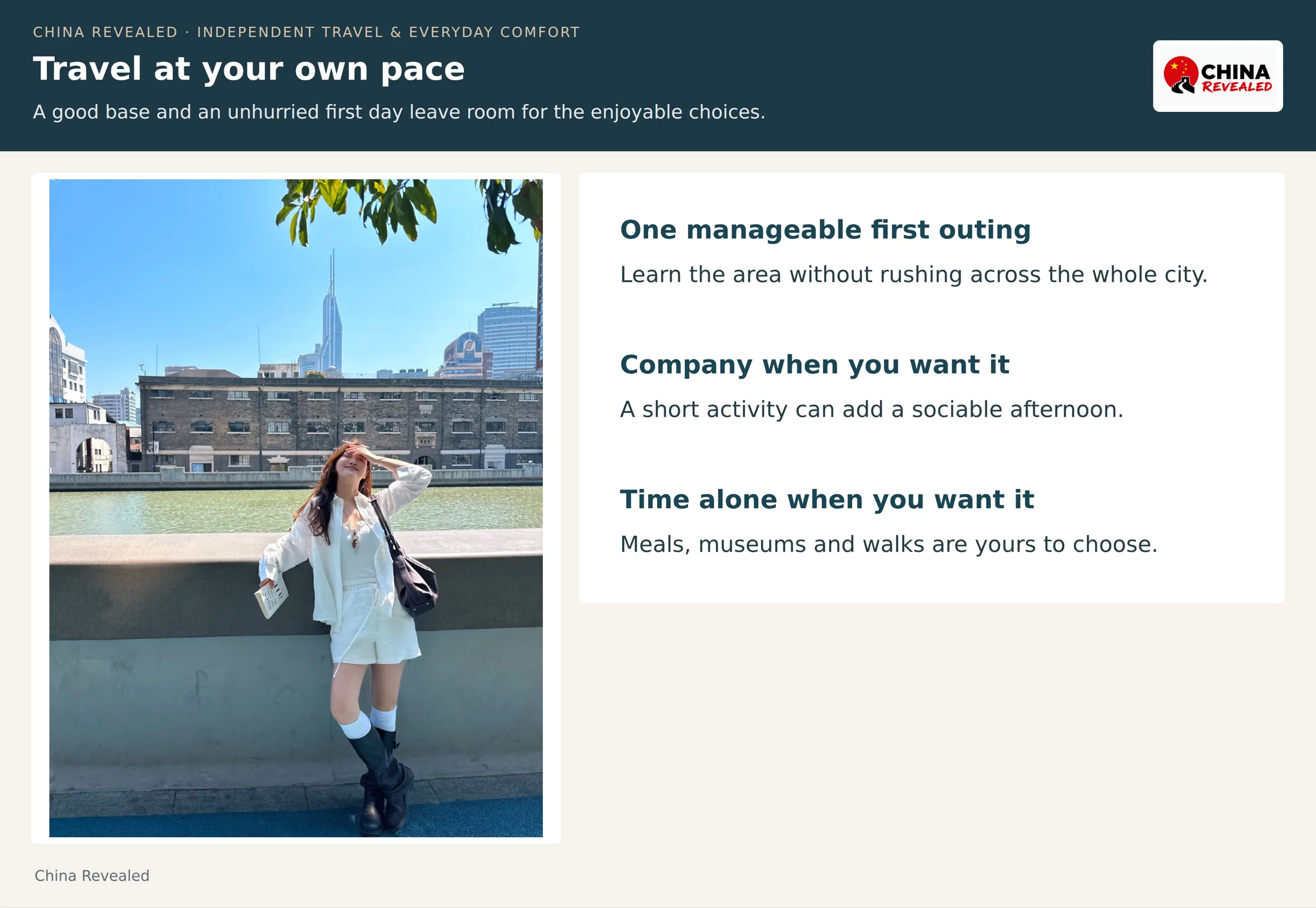
My recommendation: go independently if that is how you like to travel. Start with a convenient, staffed base, a working phone and a first day that is not overloaded. China’s everyday logistics become familiar quickly—and being on your own lets you choose the pace.
About China Revealed
China Revealed is an independent English-language travel guide dedicated to China.
We bring together China travel guides, destination information, local insights and practical travel resources in one place.
Our travel database covers China's provinces, cities, famous attractions, hidden gems, local cuisine, transportation, accommodation, visa requirements, digital payments, mobile connectivity and the other practical details travelers need to explore China.
We focus on depth, careful research and accuracy. Our guides combine official sources, detailed destination data, local knowledge and regularly updated information to give reliable, practical travel advice.
Whether you're visiting China for the first time or exploring beyond the popular destinations, China Revealed is an all-in-one resource for discovering the real China.
China Revealed — Your practical guide to China.
Some links on China Revealed, such as Trip.com booking links, are affiliate links. If you book through them, we may earn a commission at no extra cost to you. This does not change what we recommend.